
Data, Modeling, and Analysis
NLR data, modeling, and analysis researchers examine factors that affect bioprocess technology development and commercialization for chemicals, fertilizers, materials, and fuels.

Bio-based chemicals, fertilizers, materials, and fuels involve complex production pathways. To quantify the materials and energy demands of biomanufacturing processes and technology pathways, NLR researchers focus on techno-economic analysis and process analysis and use the Materials Flow through Industry (MFI) modeling tool. Together, the MFI tool and process modeling examine factors that affect biomanufacturing technology performance and economics.
NLR's biomanufacturing analysis capabilities are supported by next-generation artificial intelligence approaches to accelerate data mining and discovery.
Explore other NLR Energy Systems Analysis research.
Analysis Capabilities
Biomanufacturing project developers consider the permitting process a constraint in commercializing and scaling up new biorefineries and repurposing existing refineries. NLR's criteria air pollutant and regulatory analysis team offers custom analysis for regulators and industries with detailed methodology and data using process models and U.S. Environmental Protection Agency factors. This enables them to quantify potential criteria air pollutants and hazardous air pollutants, which is crucial in obtaining air permits for a new facility/biorefinery as well as modification permits for repurposing existing refineries. NLR also assesses the applicability of air regulations under the U.S. Environmental Protection Agency's New Source Performance Standards and National Emission Standards for Hazardous Air Pollutants to help developers understand air permitting implications. These analyses provide information to speed up the process of obtaining permits and reduce investment risks.
Contact: Arpit Bhatt
NLR bioenergy and bioeconomy air quality research focuses on developing criteria air pollutant quantification methods for permitting and modeling. Researchers conduct novel multiscenario analysis using state-of-the-science chemical transport models and near-source assessments to inform impact quantification of different fuel production pathways. Recent research has focused on artificial intelligence-based surrogate models of complex air quality frameworks for streamlined quantification of the impacts by industry and regulatory agencies.
Contact: Vikram Ravi
NLR's Bioeconomy Optimization Model (BiOpt) is a Python-based network model that integrates rigorous techno-economic analysis with resource assessment data, product market projections, and product cost objectives. The model and connected solver algorithms perform optimizations on the use of alternative energy resources for chemicals, fertilizers, fuels, and heat/power utilization through available conversion pathways.
The concept for BiOpt was developed from refinery linear programming/optimization models for bioeconomy applications. BiOpt has conversion pathways that use biomass, waste, and carbon dioxide resources. The team is developing BiOpt with geographic information system capabilities to enable siting of optimal biorefinery locations.
Contact: Michael Talmadge
NLR offers economy-wide scenario analysis for the adoption of new individual technologies or technology portfolios at industry scale, measuring impacts across economic (e.g., sectoral activity, value added, earnings) and workforce (e.g., total jobs, occupation types, characteristics) metrics. For this, researchers use the Environmentally-extended Multi-regional Projection of Lifecycle and Occupational energY futures (EMPLOY) model. EMPLOY complements pathway-specific analyses using a top-down framework to provide retrospective (2002–2017) and prospective (2020–2050) economy-wide assessments for new or existing technologies with regional-level detail (i.e., state). It can determine trade-offs between adoption strategies for bioeconomy commodities. EMPLOY interfaces with NLR's Bioenergy Scenario Model and Regional Energy Deployment System, allowing researchers to combine chemical, fertilizer, and fuel adoption simulations with different electricity grids and capacity expansion scenarios. It also interfaces with a global supply chain model, EXIOBASE, which allows researchers to analyze net economic effects of reshoring scenarios and highlighting domestic bioproduct supply chains' import dependencies.
Contact: Andre F. T. Avelino
NLR's legacy Feedstock Production Emissions to Air Model is a modular, code-based framework to calculate air pollutant emissions related to the bioenergy supply chain. As a modeling framework, the Feedstock Production Emissions to Air Model integrates agricultural and forestry production, fertilizer application, supply data, and equipment budgets for different activities, with inbuilt methodologies for estimating air pollutant emissions, and can be used as input for air quality models or other reporting purposes.
Contact: Vikram Ravi
This capability combines diverse data—resource availability, infrastructure, demographics, economics, market conditions, and socioeconomic considerations—into integrated analyses that support informed decision-making for biomanufacturing and waste-to-energy and materials projects. These analyses help identify opportunities, assess risks, and inform technology selection, project siting, and regional planning. Decision support tools complement this work by providing interactive, geospatial applications that allow users to visualize, analyze, and download relevant datasets, enabling stakeholders to explore scenarios and make data-driven decisions more efficiently.
Resources
APEX - Alternative Energy at Ports Explorer
Contact: Anelia Milbrandt
NLR uses optimizable refinery models in Aspen Process Industry Modeling System to quantify opportunities for cost reduction and improved performance of bio-based chemical and fuel pathways through integration with existing petroleum refining and distribution infrastructure. These models allow for valorizing bio-based blendstocks and intermediates (such as bio-oils or biocrudes) based on quality metrics, properties, and yields, as may be valued by a refiner through coproduction with petroleum products.
Contact: Michael Talmadge
NLR assesses biomass resources, with a focus on solid and wet organic waste streams, including municipal solid waste, animal manure, wastewater sludge, fats, oils, and greases. These assessments involve quantifying resource availability, characterizing composition and seasonal variability, mapping geographic distribution, and evaluating associated economics. Analyses draw on extensive historic data and employ geospatial, techno-economic, and systems modeling approaches to estimate resource potential, evaluate supply logistics, and account for competing uses of these materials across sectors.
Contact: Anelia Milbrandt
NLR maintains world-class capabilities for techno-economic analysis. When performing analysis across a range of technology readiness levels, different analysis strategies apply. Early-stage techno-economic analysis is used to validate an initial idea, while more rigorous process designs and economic evaluations are performed with high technology readiness level technologies. Rigorous process simulation lies at the core of these models, typically based in Aspen Plus, to capture thermodynamic details for all processing steps integrated into a broader biorefinery configuration. NLR modeling capabilities in this domain include technologies for the production of chemicals, fertilizers, materials, and fuels from lignocellulosic biomass (i.e., oil crops, herbaceous and agricultural residues, forestry residues, select municipal solid waste , fats, oils, and greases), micro- and macro-algae, carbon dioxide and other waste gases, and wet waste feedstocks (e.g., food waste, manure, sludge) as well as analysis for the deconstruction and upcycling of waste plastics.
Contact: Ling Tao
NLR has developed multiple models to explore the supply chain for biomanufacturing, focusing on feedback between systems of systems and how bio-based products could play an increased role in the industrial sector. These include the Bioenergy Scenario Model, Regional BioEconomy Model, Fuels and Industry Integrated Optimization Model, and Waste-to-Energy System Simulation Model. Numerous journal articles, technical reports, book chapters, and presentations have identified potential bottlenecks and leverage points for biomanufacturing expansion. NLR has analyzed extensive feedstock to bioenergy conversion pathways for use in multiple markets, including the aviation, chemicals, fertilizers, on-road, and maritime sectors. This domain knowledge has been used by NLR to explore bioenergy as a fuel for diverse, innovative maritime corridors.
Contact: Emily Newes
NLR's Workforce Impacts and Regional Economic Development Model (WIRED) is a user-friendly tool to assess the local job, workforce, and economic impacts of power generation, infrastructure, and refinery projects in terms of both construction (temporary effects) and operation (long-term effects). The model is the new version of Jobs and Economic Development Impact Models (JEDI), fully coded in Python and based on public datasets.
WIRED allows developers, policymakers, consulting firms and researchers to compare siting options, understand the impact of different suppliers (local versus external vendors), communicate potential economic benefits (jobs, earnings, and economic activity) to local communities, and create engagement with stakeholders (policymakers, community leaders, and residents).
Contact: Andre F. T. Avelino
Featured Projects
Researchers are developing technologies and processes to convert waste carbon dioxide (CO2) from U.S. biorefineries and industrial sites into low-cost e-fuels. NLR collaborates with the U.S. Department of Energy's CO2RUe to perform techno-economic analysis of such technologies. Data from this project have been used to improve costs and efficiencies.
The utilization projects include feasibility studies that support the consortium and other agencies in efforts to produce reliable, abundant energy. Outputs from this project include valorization of CO2 in new technologies and identification of bottlenecks/hot spots of costs in these advancements. The result can increase efficiencies and global competitiveness.
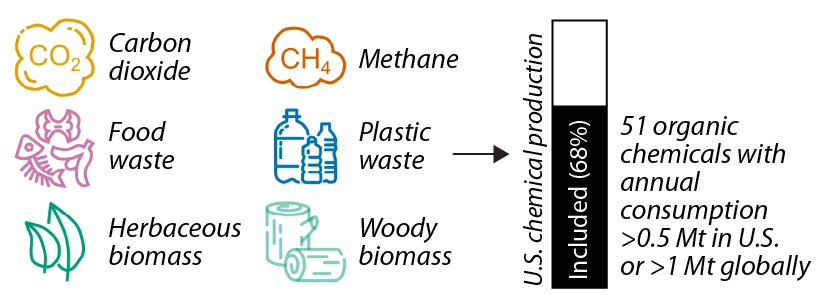
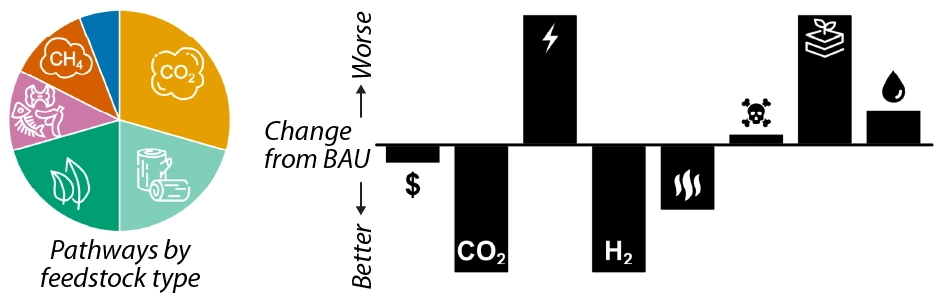
Current research and development lack a quantitative roadmap for prioritizing alternative chemical production. NLR researchers have evaluated the economic and environmental impacts of using domestic biomass and waste to produce 51 high-volume chemicals, aimed at boosting U.S. chemical sector competitiveness. Each of these 51 chemicals are consumed annually in quantities greater than 1 million metric tons (Mt) globally or 0.5 Mt in the United States. More than 200 alternative production pathways were identified, and 88 were analyzed using techno-economic analysis, lifecycle analysis, and multicriteria decision analysis. A linear optimization model further assessed pathway combinations for cost reduction to support biomanufacturing.
Goal:
Identify alternative production pathways for high-impact petrochemicals based on resource use, costs, and environmental impacts.
Outcomes:
Economically feasible alternative pathways using domestic feedstocks exist for 48 of 51 chemicals, half with a high technology readiness level. Possible implementation by 2050:
R&D Opportunities
Significance and Impacts
The outputs from robust techno-economic analysis and lifecycle analysis models may be used to estimate production cost intensities that guide research priorities and optimize economic potential for innovations in industry (including petrochemical and chemical precursors), agriculture (fertilizers and soil amendments), and transportation (biofuels).
Contact
Share

Last Updated Aug. 5, 2026