
The U.S. Department of Energy's (DOE's) Energy Technology Innovation Partnership Project (ETIPP), managed by NLR, continued supporting communities seeking to develop more reliable, affordable, and secure energy systems in coastal, island, and remote areas in Fiscal Year 2025.
Program Highlights
ETIPP saw one of its most expansive years yet in Fiscal Year 2025:
ETIPP selected 38 community projects for Cohort Five support.
The program added two new regional partner organizations.
ETIPP developed 74 tools and resources for communities.
Since the program's launch in Fiscal Year 2020:
ETIPP has supported 95 community
projects.
ETIPP has served communities in 21 states and territories across eight U.S. regions.
Read on to learn more about ETIPP's impacts during Fiscal Year 2025.
Community Impacts
ETIPP expanded its support to more than 80 unique communities after selecting 38 projects for its fifth cohort—the program's largest selection to date. Community-based organizations, local governments, utilities, and other organizations are exploring tailored energy solutions to develop more affordable, reliable energy systems through ETIPP strategic energy planning or deep-dive technical analysis and modeling.
ETIPP also engages communities beyond the scopes of these projects, and its reach extended to thousands of individuals across hundreds of communities in Fiscal Year 2025. Nine regional partner organizations and researchers from ETIPP's four national laboratories facilitated capacity-building, knowledge-sharing, and education for communities before, during, or after pursuing technical assistance.
for advancing energy projects
projects initiated in ETIPP
How ETIPP Supported Local Energy System Improvements in Fiscal Year 2025
Communities seek ETIPP assistance to address multiple intersecting energy challenges, and their projects reflect the multifaceted nature of these issues. In ETIPP's first five cohorts, applicants reported frequent power outages, high energy costs, and aging infrastructure among their top energy challenges.
ETIPP Community Energy Challenges
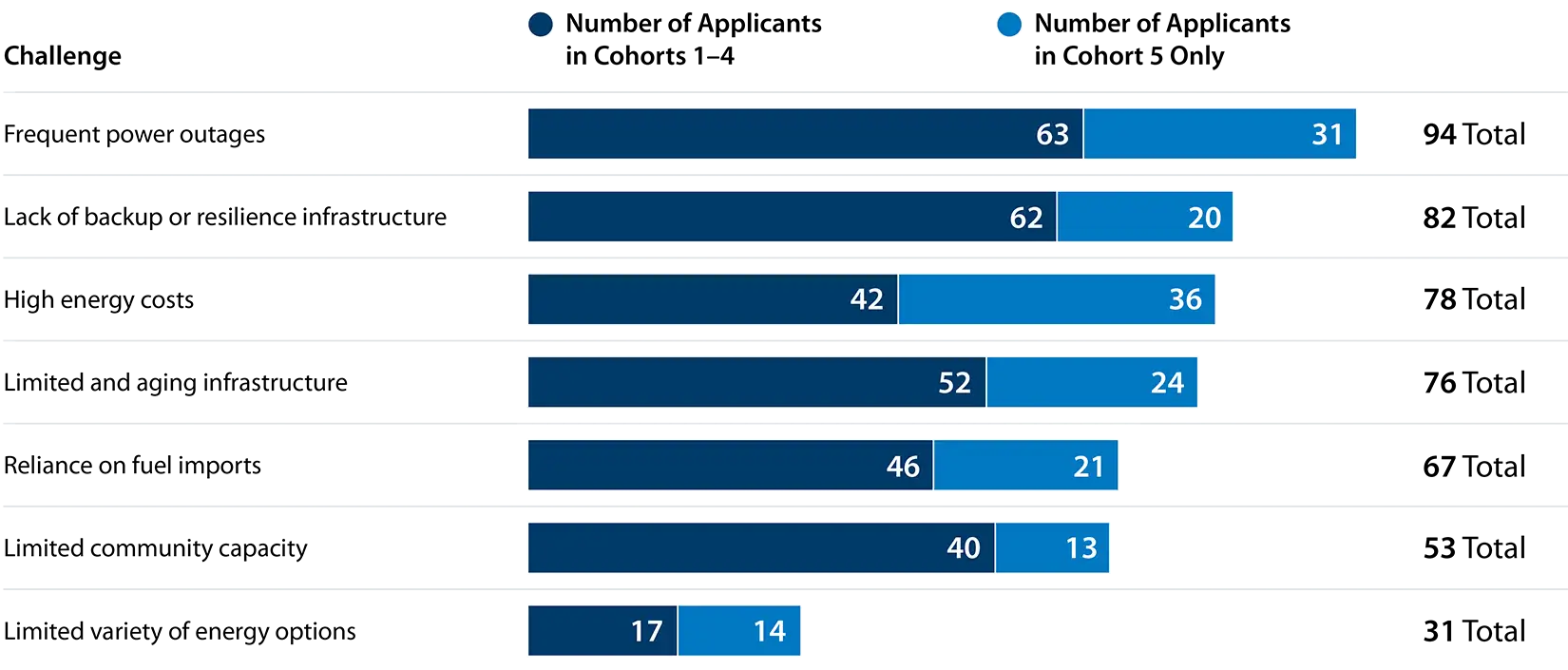
The ETIPP Community Energy Challenges graphic breaks down specific energy challenges and the number of total ETIPP applicants among all cohorts compared with the number of Cohort 5 applicants only. The Frequent Power Outages challenge had 94 total applicants with 31 in Cohort 5; Lack of Backup of Resilience Infrastructure had 82 applicants with 20 in Cohort 5; High Energy Costs had 78 applicants with 36 in Cohort 5; Limited and Aging Infrastructure had 76 applicants with 24 in Cohort 5; Reliance on Fuel Imports had 67 applicants with 21 in Cohort 5; Limited Community Capacity had 53 applicants with 13 in Cohort 5; and Limited Variety of Energy Options had 31 applicants with 14 in Cohort 5.
ETIPP Project Scoping
Local leaders choose the directions that ETIPP projects take. They work with national laboratory researchers and regional partners to identify feasible options for meeting energy goals while accommodating the unique constraints offered by their geographies, available resources, and economic circumstances. Through strategic planning and deep technical analysis, ETIPP projects take a holistic approach to identifying solutions that support the development of reliable, affordable energy systems. Current ETIPP projects include the following focus areas:
ETIPP Project Focus Areas
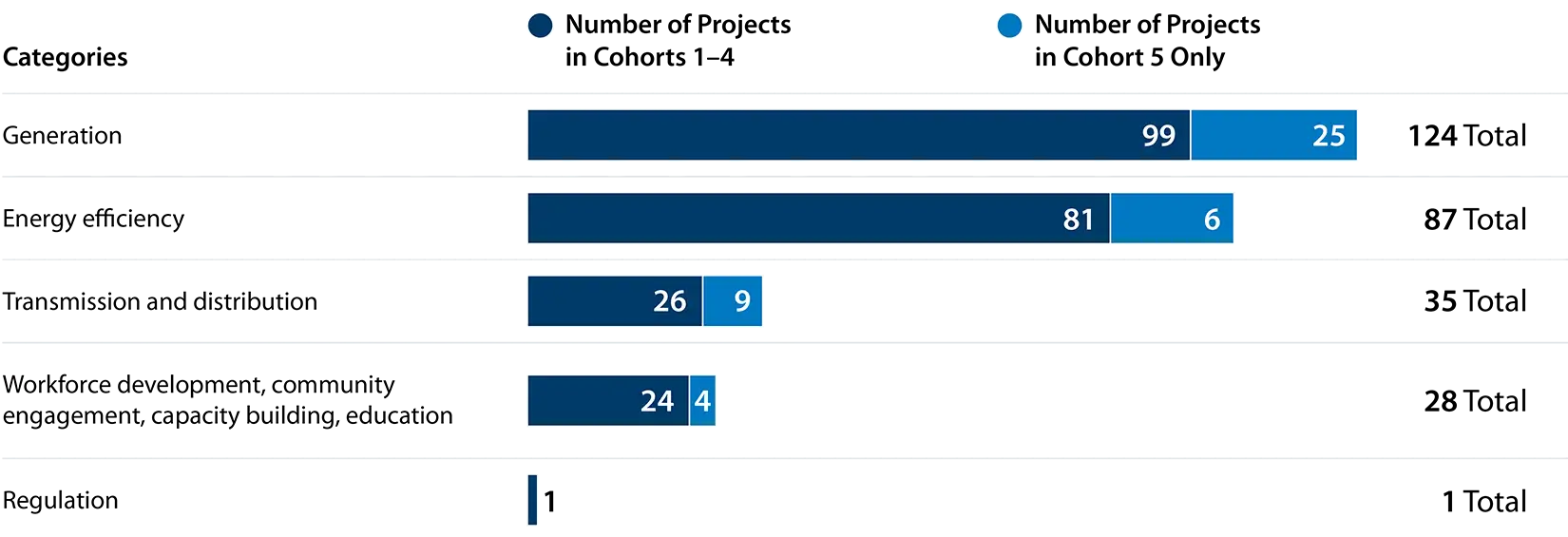
The ETIPP Project Scoping graphic breaks down ETIPP project focus areas categories and the number of projects in cohorts 1–4 compared with the number of Cohort 5 projects only. The Generation project category had 99 projects from cohorts 1–4 and 25 in Cohort 5; Energy efficiency had 81 projects from cohorts 1–4 and 6 in Cohort 5; Transmission and distribution had 26 projects from cohorts 1–4 and 9 in Cohort 5; Workforce development, community, engagement, capacity building, and education had 24 projects from cohorts 1–4 and 4 in Cohort 5; and Regulation had 1 project from cohorts 1–4 and none in Cohort 5.
Insights From Local ETIPP Representatives
Coastal, remote, and island community members from seven locations (Native Village of Saxman, Alaska; Playa de Ponce, Puerto Rico; Gary, Indiana; Key West, Florida; Waianae, Hawaii; Brooklin, Maine; and Tangier Island, Virginia) around the United States and territories responded to the support they received from the ETIPP program. Click or hover over each point to read their responses.
Partner Support
Bolstering Local Energy Security, Reliability, and Affordability
ETIPP's work covers American locales from the tropics to the Arctic Circle. While the program works with communities ranging from islanded small towns to sprawling cities, projects often share common goals, such as reducing energy costs, shoring up critical infrastructure, and building energy systems that can withstand and quickly recover from outages. ETIPP researchers and regional partners help project teams design and map out actionable steps to move them closer to secure and affordable energy systems in ways that make sense in their local contexts.
Below, each ETIPP regional partner organization responded to the prompt:
How did your organization's work with ETIPP advance energy security, affordability, and reliability in your region during Fiscal Year 2025?
"REAP's involvement with ETIPP in 2025 helped rural Alaska communities navigate their energy challenges by facilitating opportunities for community input and turning energy data into actionable, community-driven plans. By offering hands-on learning opportunities in weatherization and energy efficiency, creating spaces for communities to learn from one another at an in-person annual meeting, and identifying funding, programs, and localized support, REAP contributed to existing community efforts to advance short- and long-term impacts."
"This year, our work with ETIPP allowed us to support communities that continue to face the impacts of hurricanes, prolonged outages, and a historically fragile electric system. Together with the communities in Las Margaritas, Toro Negro, and Playa de Ponce, we advanced the conversation around energy reliability, safety, and affordability by analyzing their microgrids, facilitating participatory processes, and gathering essential data to develop strategies grounded in their realities. We have also accompanied communities in developing energy projects that help reduce costs and improve service stability for families living with unreliable energy. Above all, it has been an honor to accompany communities that, despite so many challenges, continue organizing, learning, and leading the way toward a more reliable energy future."
"Our work with ETIPP advanced energy security in the Great Lakes region by supporting Beaver Island's efforts to explore energy generation and funding resources, reducing future reliance on mainland power. In Gary, Indiana, we partnered with local community and city stakeholders to complete a strategic energy planning assessment focused on critical facility resilience and energy generation development potential. We identified opportunities for energy generation installations at key facilities and resilience hubs, modeled cost-optimized systems, and outlined pathways to improve energy affordability and reliability for the community."
"SSDN works with communities across the Gulf Coast of the United States to address the challenges associated with hurricanes, flooding, high temperatures, and other weather hazards that tend to affect the region. Through ETIPP, and in partnership with NLR and the Lawrence Berkeley National Laboratory, SSDN has been able to help the city of Key West, Florida, put together a community-specific plan to reduce energy costs and improve energy reliability. Additionally, SSDN supported a record number of Gulf Coast communities to apply for ETIPP Cohort Five, showing that the program is filling a critical need by helping communities advance energy security, affordability, and reliability."
"STEM NOLA coordinated with six communities to apply for ETIPP technical assistance in the Gulf Coast region in 2025, including those in the immediate New Orleans area in Louisiana, as well as communities in the states of Mississippi and Texas. Through community outreach, we raised awareness among these communities about ETIPP initiatives for technical support and guided them through the ETIPP program application. Of the communities that applied, St. Vincent's House in Galveston, Texas, was selected and is committed to moving forward in the ETIPP process, creating a more secure, affordable, and reliable energy plan for their community in this region."
*STEM NOLA served as an ETIPP regional partner through April 2026.
"HSEO's work with ETIPP as regional partner, which began in April 2025, strengthened energy reliability planning in the off-grid community of Kahikinui, Maui, through analysis of power options for a resilience hub. In Waianae, Oahu, ETIPP strategic energy planning helped identify priorities that can strengthen energy security, affordability, and reliability."
"By supporting island and coastal communities in the Northeast, Island Institute has been able to support ETIPP communities in engaging with the complex challenges associated with living on the fringes of the grid. Island Institute often serves as a bridge between communities and utilities, supporting the development and growth of relationships that amplify community energy needs and build opportunity for energy projects to come to fruition. Through this bridging work, as well as energy education, supporting technical analyses and the development of strategic energy plans by national lab scientists, and building local capacity, Island Institute has supported end-of-the-line communities in advancing energy security, affordability, and reliability."
"Through our work within the ETIPP program, we have supported communities in hiring dedicated energy staff and training existing personnel to turn long-term visions into actionable projects that reduce energy use, strengthen local energy systems, and support greater energy independence. By hosting multiple hands-on educational workshops across the region, we have built local capacity, empowering communities to make their own informed decisions. The program has also enabled our communities to build strong partnerships with local utilities, balancing authorities, and funding organizations."
"Our work with ETIPP advanced energy resilience in two key communities. On Tangier Island, Virginia, we facilitated the development of the community's first strategic energy plan, which led to local utility-driven energy savings programs, improving affordability and reducing energy consumption and energy peaks. And in Brunswick, Georgia, we delivered an Energy 101 training in the fall of 2024 that empowered residents with knowledge and resources. This engagement positioned Brunswick to apply for technical assistance through ETIPP's Deep Dive track with a goal of strengthening long-term energy reliability."
Putting Energy Research Into Practice
By conducting techno-economic analyses, modeling energy technology integration, and outlining the feasibility and tradeoffs of different energy strategies, ETIPP's four national laboratories each provide unique capabilities that can provide the data communities need to inform nuanced decisions about local energy systems. National laboratory experts offer innovative and technology-agnostic solutions, produce replicable and scalable results, and apply institutional knowledge amassed through years of experience. They also build capacity beyond the DOE national laboratory complex by training external organizations to use lab-developed, publicly accessible tools.
In Fiscal Year 2025, ETIPP research teams developed 74 new tools and resources in direct response to project needs. Some highlights of their work are below.
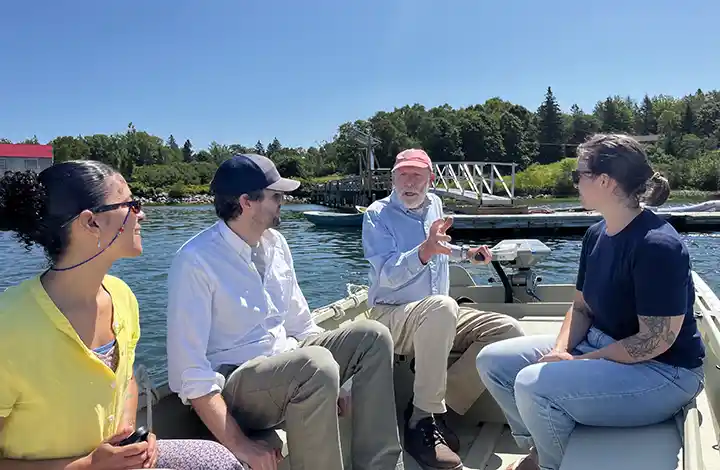
Lawrence Berkeley National Laboratory
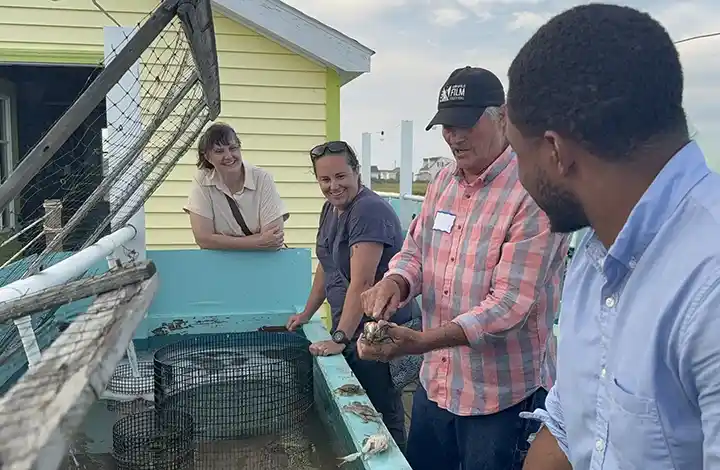
National Laboratory of the Rockies
Pacific Northwest National Laboratory

Sandia National Laboratories
A Message From Leadership
ETIPP continued to build capacity at the federal, regional, and local level to support island and remote communities in their journeys toward more reliable, affordable energy systems during Fiscal Year 2025. The program built on its two established tracks for technical assistance, refining the structure of its support for communities pursuing both strategic energy planning and technical deep-dive projects. ETIPP saw its most robust application cycle to date and welcomed 38 community projects into its fifth cohort—its largest cohort yet.
To provide ongoing support for island and remote communities across the United States and its territories, ETIPP added Hawaii State Energy Office and Hispanic Federation to its regional partner network, bringing its full bench to nine organizations with deep local knowledge of the energy landscapes in their areas. These organizations, alongside ETIPP's four national laboratories, are essential players in the technical assistance ETIPP offers as they bridge the gap between federal and local stakeholders, support workforce development, and provide connections to additional funding opportunities and programs.
Looking ahead, the ETIPP partnership network will compile and share regional learnings and trends from its years of work in the energy assistance space across eight regions. ETIPP's partnership network will continue to build on the foundation of these lessons to respond to communities' unique needs, ensure access to innovative solutions, and shore up island and remote energy systems for the future.
Download Fiscal Year 2025 ETIPP Metrics Definitions and Methodology
Share

Last Updated June 24, 2026