
Perovskite Patent Portfolio
NLR's perovskite patent portfolio focuses on nine technology areas that are critical to the development of a commercial perovskite solar cell device.
Whether taken individually or collectively, these patents capitalize on NLR's foundational research in perovskite device development and application.
Technology Areas
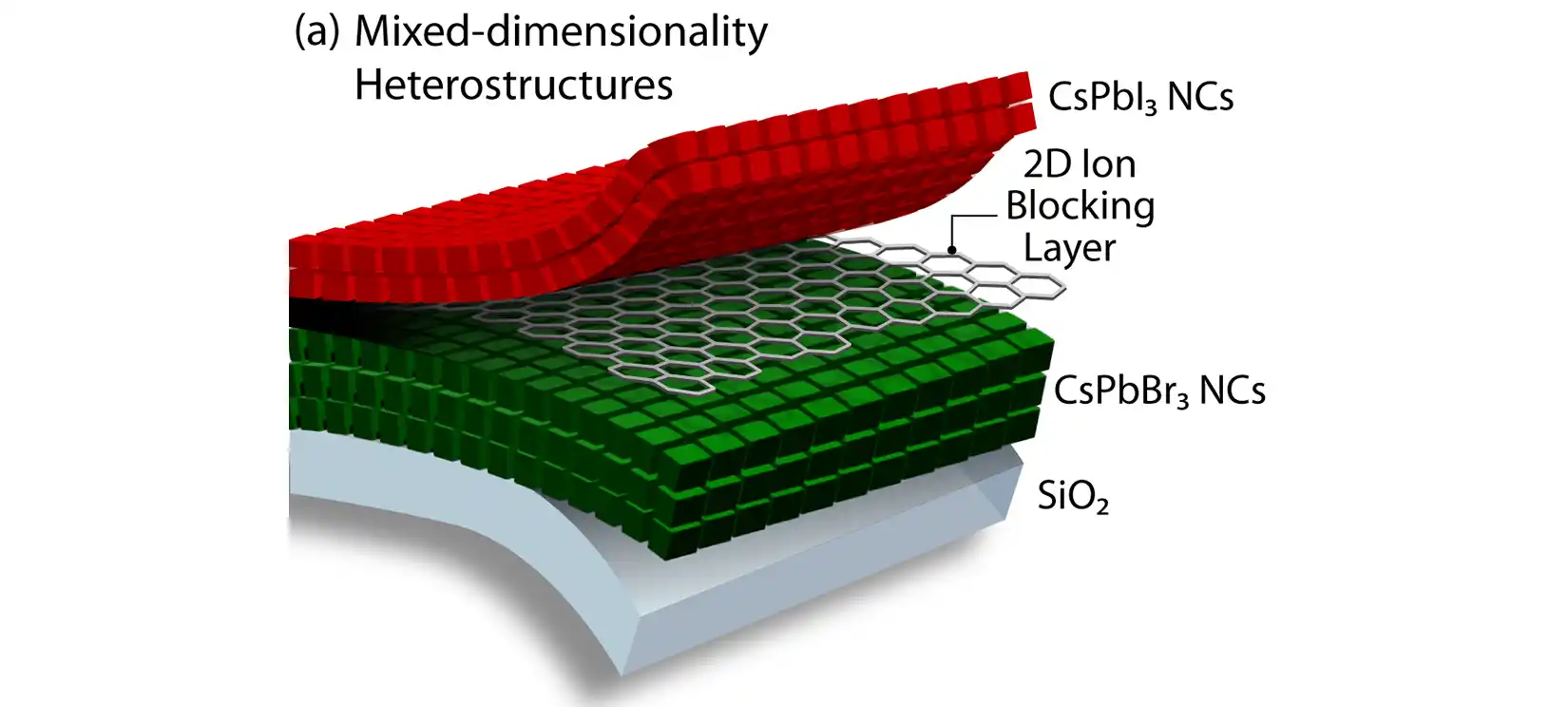
A thin blocking layer stabilizes perovskite solar cells against halide migration. Illustration by Alfred Hicks, National Laboratory of the Rockies
These patents comprise technologies that improve perovskite devices' resistance to performance degradation over time. These technologies include methods of depositing perovskite films, encapsulant coatings, contact layer compositions, and novel film chemistries.
These patents consist of novel methods for growth and deposition of high-quality perovskite films. These techniques have been published in multiple peer-reviewed journals and could be scaled to commercial levels.
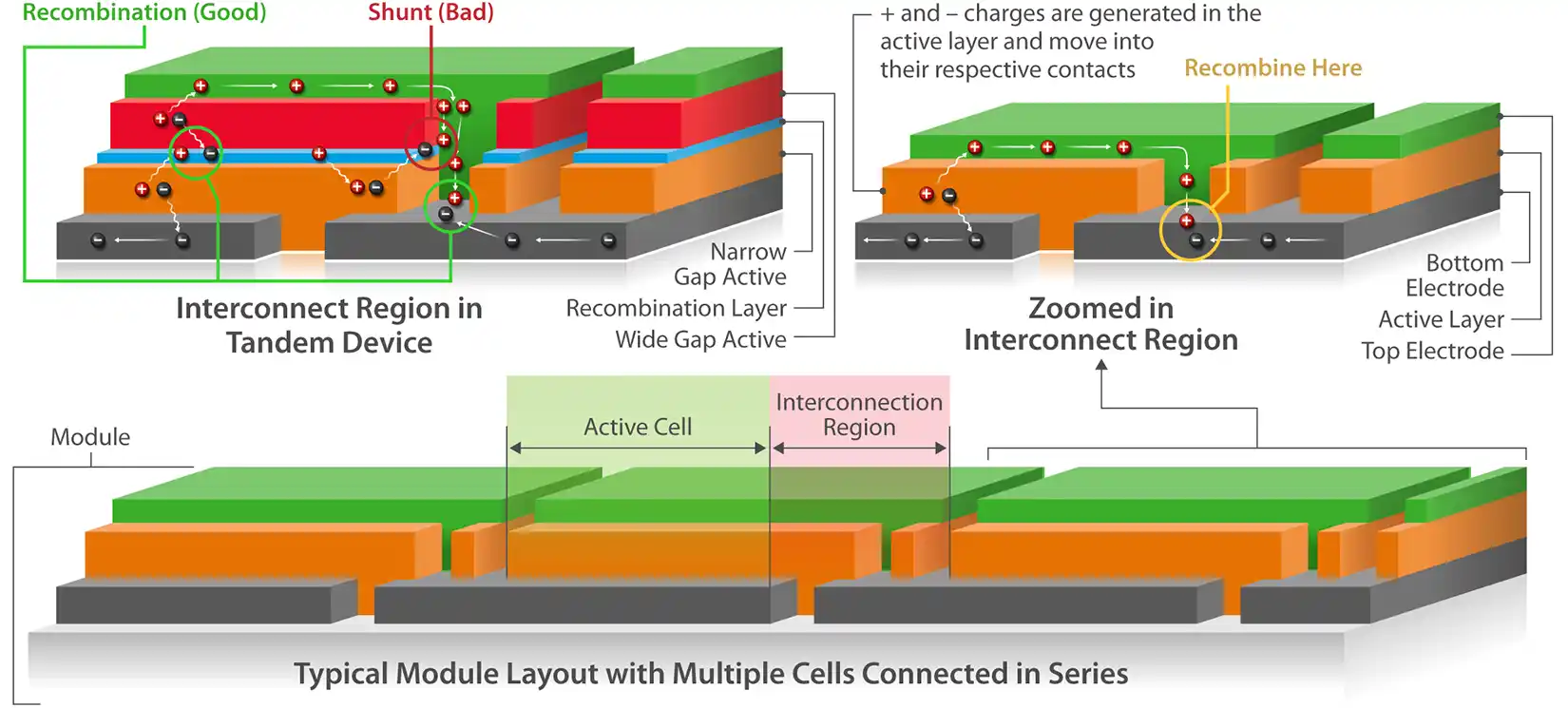
Market-ready perovskite solar panels contain multiple cells connected in series, as shown in this illustration. The deposition, scribing, and interconnection of the cells have major impacts on overall efficiency. Illustration by Alfred Hicks, National Laboratory of the Rockies
These patents consist of techniques and processes that enable rapid, inexpensive deposition of high-quality perovskite films. These inventions allow perovskite photovoltaics to be manufactured consistently and cost-effectively in an industrial environment.
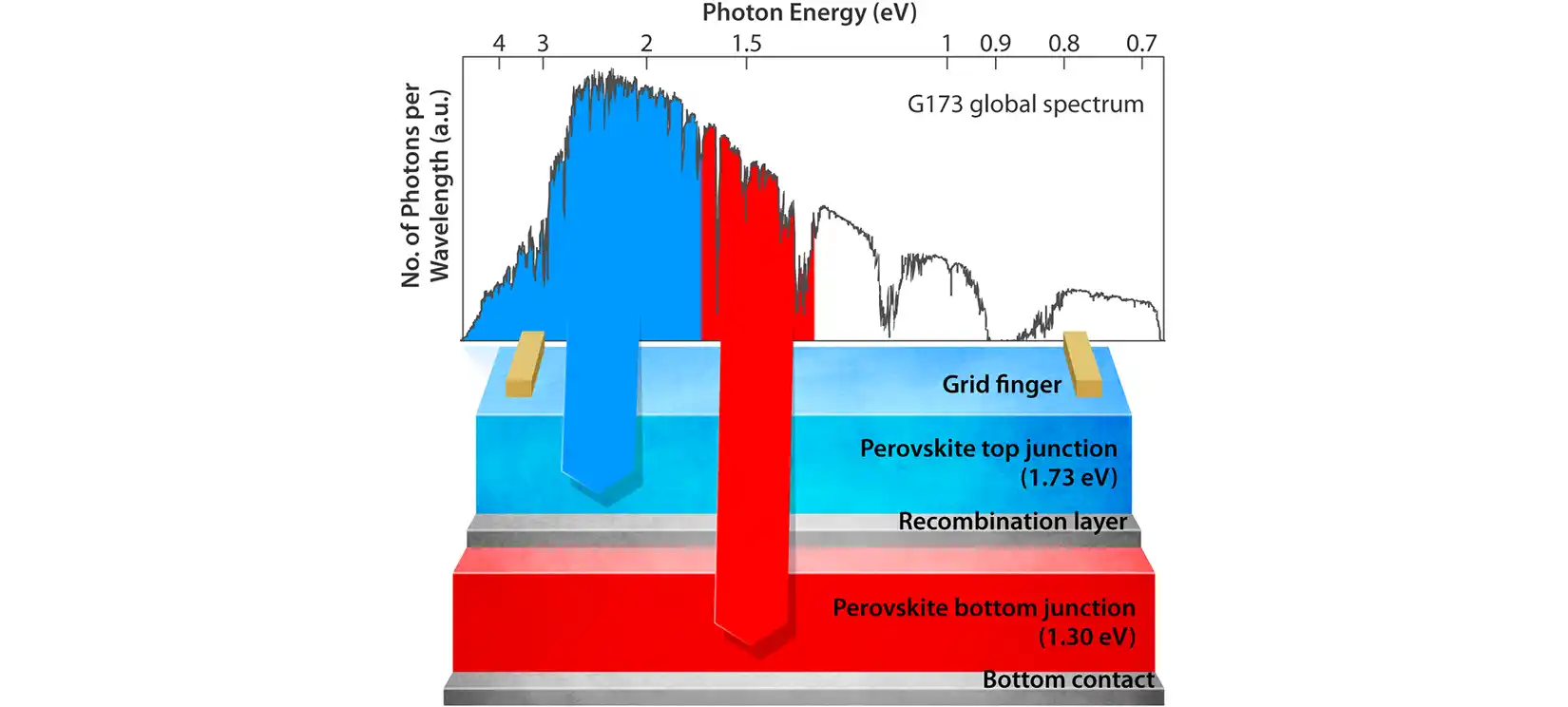
Tailoring perovskite chemistry enables materials with narrower or wider bandgaps, ideal for high-efficiency perovskite-perovskite or perovskite-silicon tandem solar cells. Illustration by Alfred Hicks, National Laboratory of the Rockies
These patents consist of thin-film and quantum dot alternatives to the common methylammonium lead halide (MAPbI3) perovskite chemistry. These alternative compositions include novel organic, inorganic, and hybrid compositions for cations in the ABX3 perovskite crystalline structure and have been shown to improve the performance of perovskite films by demonstrating both increased stability and efficiency.
These patents consist of film deposition methods, chemistry improvements, and engineering of the perovskite active layer and device architecture to push commercial perovskite device efficiencies to 20% and beyond.

A researcher holds a dimethylammonium-containing wide-bandgap perovskite that enables high efficiency tandem solar cells. NLR researchers use nucleation surfaces during deposition of tandem cells to ensure all layers are in good contact with one another. Photo by Dennis Schroeder, National Laboratory of the Rockies
These patents comprise improvements to hole-selective, electron-selective, or other material layers that are found in perovskite-based optoelectronic devices.
These patents comprise new perovskite solar cell device designs, such as interdigitated back-contact perovskite solar cell devices, that capitalize on the unique properties of the perovskite layer to create low-cost devices with improved efficiency and reliability.
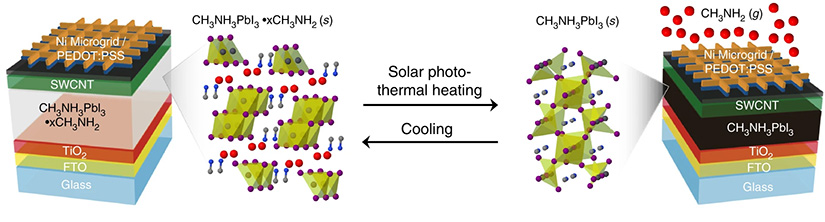
This perovskite film reversibly switches between a transparent state and an opaque, electricity-generating state under sunlight, forming a thermochromic window. Illustration by Lance Wheeler, National Laboratory of the Rockies
These patents comprise inventions enabling perovskite devices that reversibly switch between a transparent state and a tinted state. These patent applications enable semitransparent, photovoltaically active windows that modulate building thermal load while simultaneously converting solar radiation to power.
Also, see NLR's portfolio of chromic technologies for photovoltaic applications on the Lab Partnering Service website.
These patents contain technologies that demonstrate successful long-lasting sequestration of lead within perovskite solar cells, helping address the concerns of lead leakage in perovskite applications.
Technologies Available for Licensing
Search and browse perovskite technologies by keywords and technology areas. Access more information about the technologies on the U.S. Department of Energy's Lab Partnering Service website.
Loading data...
| Technology (Lab Partnering Service) |
|---|
No technologies match your search.
Contact
Share

Last Updated March 27, 2026