
Systems Performance Laboratory
The Energy Systems Integration Facility's Systems Performance Laboratory is a one-of-a-kind testing space that connects appliances, a home, and even a community in an end-to-end energy ecosystem.
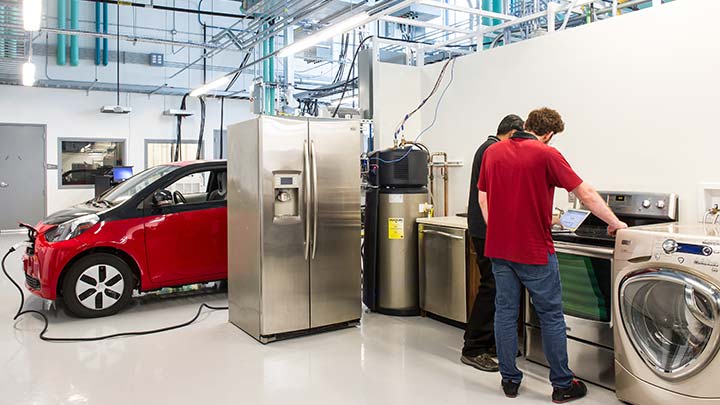
Key Infrastructure and Services
- 5,300-ft2 working space
- Three residential mock homes, equipped with major appliances and other typical loads
- Connections in each home for 120/240 volts of electric service, water, and natural gas
- Residential advanced metering infrastructure and breaker panels with circuit-level power meters for each test home
- Data acquisition and control systems to collect sensor data related to each appliance and to manage controls for simulated occupancy
- Environmental chambers that can impose location-specific heating, ventilation, and air-conditioning loads through application of hardware-in-the-loop techniques
- Distribution transformers, which allow mock homes to be connected and evaluated as a mini-neighborhood
- Mock homes that incorporate distributed energy resources, including solar panels, electric vehicles, stationary batteries, and natural gas generators
- Cyber-Physical Systems Security and Resilience Testbed
- Connection to other ESIF resources via ESIF's Research Electrical Distribution Bus and supervisory control and data acquisition system
Types of Research
- Evaluation of connected appliances, advanced sensors and controls, and home energy management systems in collaboration with industry, academia, and other research stakeholders
- Validation of the features, effectiveness, and energy savings of home energy management systems, nonintrusive load-monitoring systems, advanced sensors, and smart appliances
- Exploration of different communication protocols, functionality, interoperability, and cybersecurity questions related to Internet of Things technologies prior to deployment
- Optimization of controls for backup power and energy storage solutions, including batteries, generators, and fuel cells, to improve a home's resiliency
- Evaluation of advanced algorithms for energy savings and new techniques for fault detection and diagnostics for buildings and systems
- Hardware-in-the-loop evaluation capability, allowing researchers to implement hardware controls on residential loads in the lab and simulate impact on the distributed generation with NLR's high-performance computing capabilities
- Innovation in advanced metering, residential batteries, and home energy management systems
Recent Projects
Validating Whisker Labs peel-and-stick submetering technology
Analyzing residential energy storage and sizing with Bosch and Bonneville Power Administration
Addressing the challenges of high-penetration PV on the grid with SolarCity and HECO
Evaluating cybersecurity for distributed energy resource technologies
Coordinating ARPA-E projects in electronics bay
Check out the Smart Homes and Buildings Research YouTube video for more details.
Share

Last Updated April 20, 2026