
Marine Energy Microgrid and Power Electronics Webinar Series
The Marine Energy Microgrid and Power Electronics Webinar Series provides an introduction to NLR's water power facilities and capabilities.
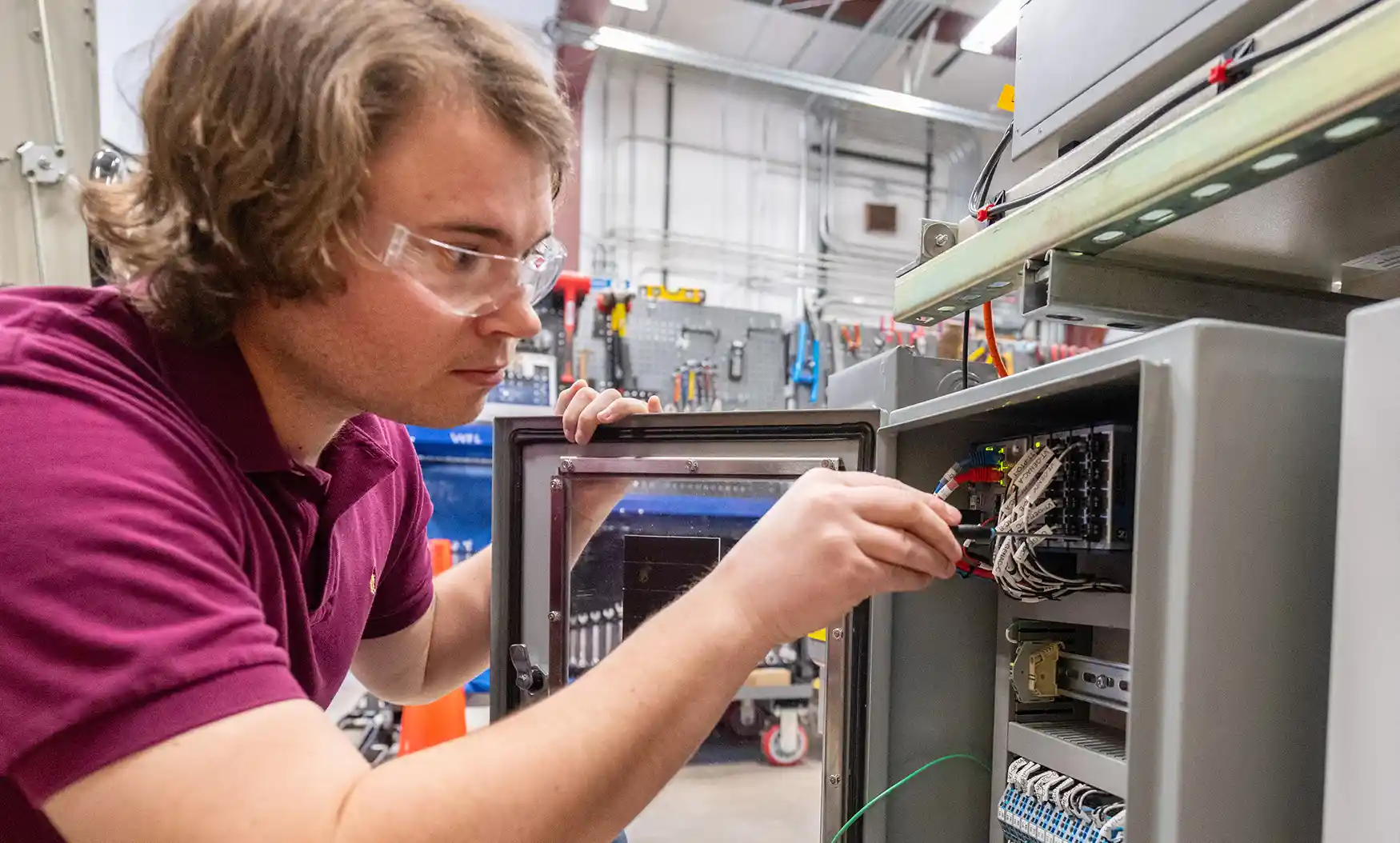
The series features marine energy technologies such as modeling tools and hardware-in-the-loop capabilities. These tools offer a safer, faster, lower-cost, and lower-risk way to validate new grid systems and energy technologies before they're deployed.
Most energy resources vary over the course of days, hours, or minutes, but wave energy fluctuates on the scale of seconds. This leads to power generation with significant peak-to-average ratios and frequent periods of zero output. These unique characteristics pose challenges for wave energy converter (WEC) power electronics that remain largely underexplored in both industry and academia. Over the past 2 years, NLR researchers have investigated a variety of power electronic topologies inspired by other energy sources. Rigorous full-WEC simulations have identified promising topologies with the potential to outperform traditional power takeoff systems in deployed WECs. Using power-hardware-in-the-loop testing and physical prototypes, NLR researchers provide valuable insights into the strengths and limitations of different energy conversion approaches applied to wave energy. Participants gained a deeper understanding of advanced power electronic solutions to unique challenges in wave energy that improve the efficiency and performance of wave energy converters.
The Hydraulic and Electric Reverse Osmosis Wave Energy Converter (HERO WEC) is a 6-ft wave energy device that turns seawater into drinking water. It is designed for rapid deployment in disaster response scenarios where fresh water is limited. Featuring both hydraulic and electric power takeoff systems, HERO WEC has undergone two ocean deployments at Jennette's Pier on the Outer Banks of North Carolina in addition to extensive in-lab testing. The research provides practical insights into the real-world challenges of wave energy conversion beyond modeling and dry-lab environments. Webinar participants developed an understanding of the practical considerations for deploying wave energy devices and the lessons learned from real-world HERO WEC deployments.
Watch the HERO WEC Journey webinar recap on YouTube.
Stakeholders and industry partners in the marine energy sector are developing tidal and wave energy technologies for deployment in remote areas, often integrating the technologies with existing microgrids. The complexity of these systems, combined with their connection to unique distributed microgrids, introduces significant risks during design and installation. At NLR, researchers are developing generic, open-source microgrid models and libraries—paired with hardware-in-the-loop software—that can be easily customized to match the specifications of real-world microgrids. This approach allows researchers to test and de-risk marine energy generation systems prior to deployment while also providing partners with insights to improve reliability and reduce costs in the design of their technologies. Webinar participants gained practical strategies for modeling and testing microgrid-integrated marine energy systems to enhance reliability and reduce project risk.
Watch the Introduction to Microgrid Research webinar recap on YouTube.
This webinar, demonstrated our power hardware-in-the-loop (HIL) microgrid model for marine energy integration with microgrid testing. This demonstration featured a repurposed tidal energy generator mounted on NLR’s 20-kW test bench connected to a bidirectional grid emulator and an HIL device. The HIL model is configured to represent the microgrid in Igiugig, Alaska. We ran a series of different microgrid load and fault scenarios to show the measured energy generation from the marine energy device as well as power quality and grid stability.
Watch the Microgrid Power Hardware-in-the-Loop Modeling webinar recap on YouTube.
Contact
For questions about the webinar series, contact Rebecca Fao.
Share

Last Updated Sept. 18, 2026