
EVI-EnSitePy: Electric Vehicle Infrastructure – Energy Estimation and Site Optimization Python Tool
NLR's Electric Vehicle Infrastructure – Energy Estimation and Site Optimization Python tool (EVI-EnSitePy) is a charging station site design, modeling, and analysis tool.
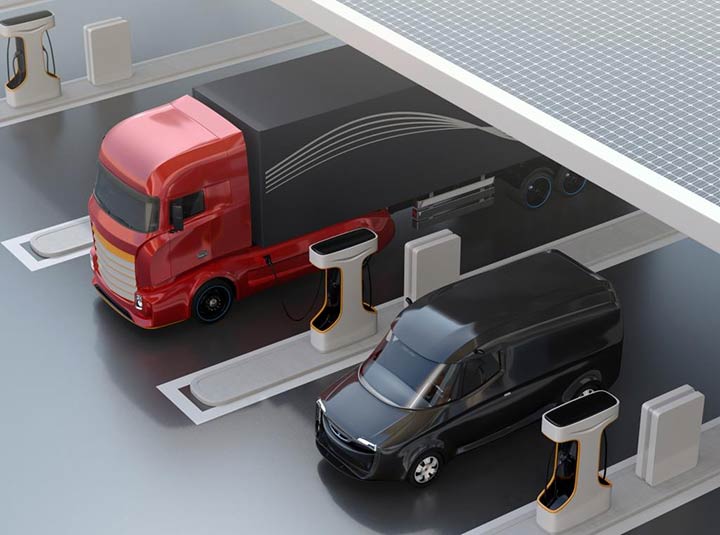
EVI-EnSitePy is a Python package that replaces its predecessor, EVI-EnSite.
Today, the vehicle charging and energy industries face the challenge of designing and sizing high-power electric vehicle (EV) charging sites while balancing implementation costs and customer satisfaction and convenience. To respond to this challenge, EVI-EnSitePy offers solutions for:
- The planning and development of EV charging station site infrastructure
- The evaluation of operational performance and quality of service, such as power demand profiles, customer experience (e.g., queue lengths and wait times), and site management impacts.
EVI-EnSitePy can simulate light-, medium-, and heavy-duty EV charging under different charging station configurations—including power rating, port count, charger efficiency, power modules, and connector type—covering scenarios from low-power charging (Level 1 and Level 2) to high-power, direct current fast charging (DCFC). EVI-EnSitePy also supports integration of distributed energy resource (DER) assets (e.g., photovoltaic and energy storage systems) and custom load consumption nodes that can coexist within a charging site. In addition, it provides modules for charging control, energy management, trip and route planning, multi-site simulation, and site optimization to support design, analysis, and operational studies.
Developed as a Python package, the EVI-EnSitePy interface is designed to be familiar to researchers and data scientists alike and can be incorporated into existing Python analysis workflows.
EVI-EnSitePy can simulate multiple large sites (e.g., with more than 100 charging ports) and can significantly reduce site planning time and cost while providing operational visibility with high-fidelity grid-to-charging-port system simulation.
Key Capabilities
EVI-EnSitePy is a modular and flexible site simulation framework designed to help researchers and industry members quickly construct and analyze a variety of EV charging infrastructure and control scenarios. The primary capabilities of EVI-EnSitePy are to simulate the arrival and charging of EVs at a hub/charging site and to perform analysis on system properties and behaviors.
Power Flow Simulation and Energy Management
- Investigating novel energy management systems and power allocation procedures
- Simulating steady-state DC microgrid power flow with resistive losses
- Generating individual equipment load profiles using stochastic or deterministic vehicle schedules
- Generating realistic temperature-dependent EV battery charge acceptance profiles to understand impacts of weather conditions on charging operation
Site Architecture Design
- Designing and optimizing site-level power architecture and equipment selection with respect to objectives such as quality of service, peak power, and energy storage requirements
- Analyzing charging station operation with ports with different power capacities
Performance and Evaluation
- Modeling vehicle queuing depending on the availability of compatible charging port(s)
- Estimating station performance and quality-of-service metrics
How It Works
EVI-EnSitePy
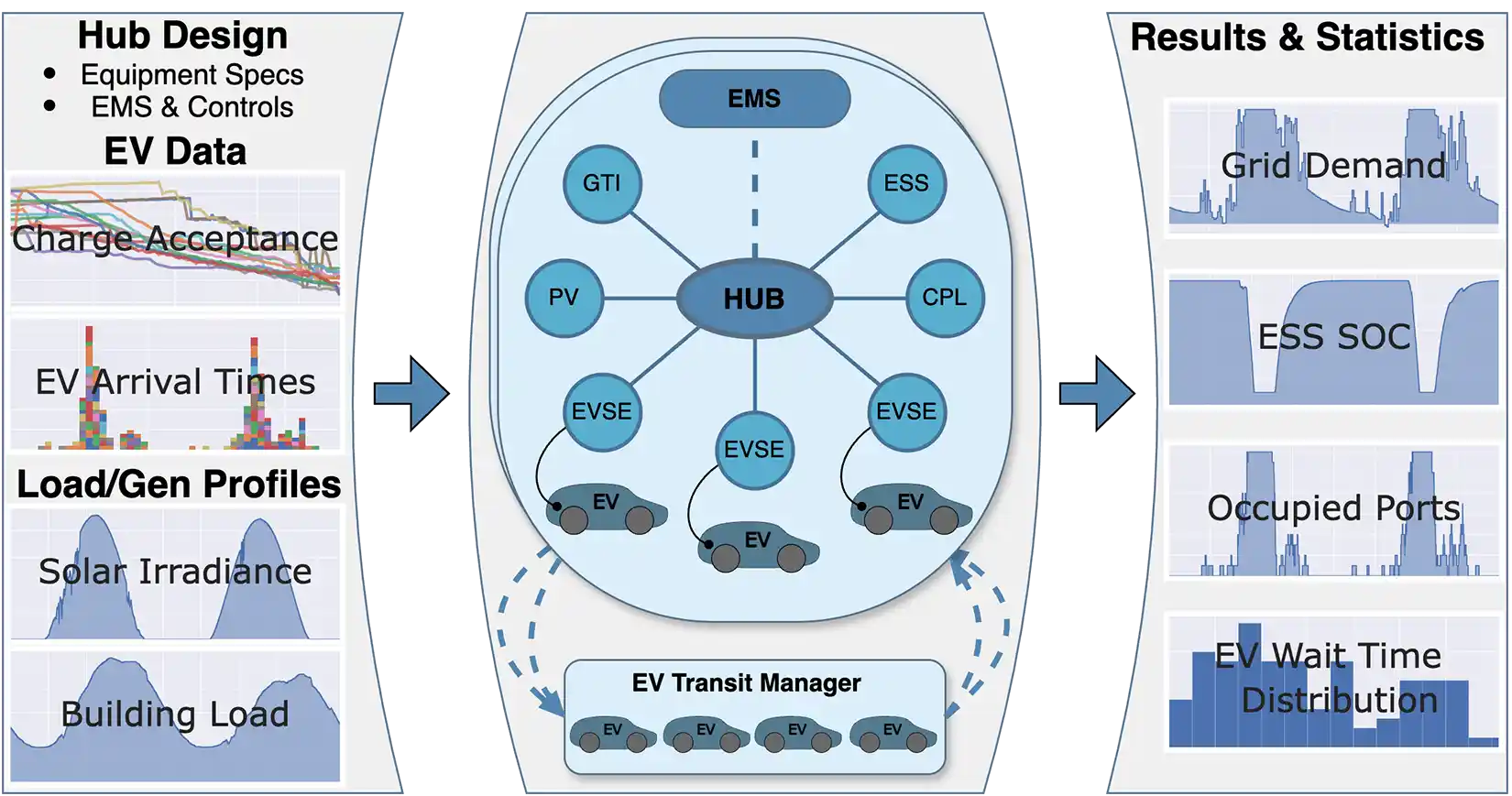
This image illustrates the types of input data EVI-EnSitePy uses for simulation, the general simulation model structure, and the type of results and analysis that it can provide. Graphic by Derek Jackson, National Laboratory of the Rockies
The core simulation platform computes the discrete time steady-state power flow and change of state variables (e.g., state of charge, or SOC) within a user-defined hub system. The hub system structure is highly customizable to represent various site architectures with customizable assets, such as one structure shown below. EVI-EnSitePy has a library of hub assets, including grid-tie inverter (GTI), battery energy storage system (BESS), electric vehicle supply equipment (EVSE) consisting of multiple EV charging ports, solar photovoltaic (PV) system , power converter, and constant power load (CPL) such as a building's heating and lighting load.
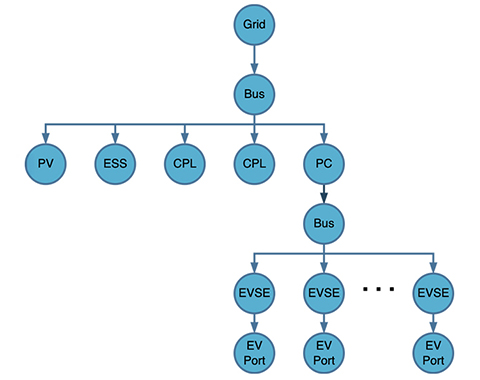
An example node tree diagram of a charging hub's power system architecture that can be constructed for EVI-EnSitePy simulations. The node "PC" represents a power converter. Graphic by Derek Jackson, National Laboratory of the Rockies
The EVI-EnSitePy detailed charging station simulations output time-series data pertaining to hub assets, along with vehicle-side data like charging power and SOC profiles. It calculates station metrics such as the distributions and statistics for average charging or waiting time and charging equipment utilization rates.
EVI-EnSitePy can analyze a specific station using deterministic vehicle arrival schedules or run a sweep of operation scenarios using stochastic vehicle arrival data and Monte Carlo simulation technique.
An optimization workflow developed around the simulation framework enables users to quickly construct their own charging station design studies by defining their parameters, objectives, and constraints in an intuitive format.
An agent-based tool, EVI-EnSitePy has two primary agent categories—vehicle agents and charging station agents.
Vehicle Agents
A vehicle agent is defined by arrival time, initial SOC, battery capacity, port connector type, and a charge-acceptance curve. The vehicle's charge-acceptance curve—which maps the battery pack's SOC and maximum charging power—acts as a proxy to emulate complex battery management system (BMS) control algorithms. By using this curve, EVI-EnSitePy ensures that battery charging power is limited by either the port power capacity or the BMS control action.
Station Agents
The station agents represent the various hub assets associated with charging operations and other colocated power loads or generation. Equipment power losses are captured using a constant efficiency or efficiency lookup table. Distribution power losses can be modeled as a resistive network.
Power system equipment such as GTI, BESS, power converter, and the distribution bus are defined by parameters including their power ratings, efficiency, discrete power stages, energy capacity, and SOC. Load and generation equipment such as PV and CPL are defined using user-provided time series of solar irradiance or load power profiles.
EVSE are defined by the number of charging ports, total and individual port capacity, power modules, and their efficiency. When a vehicle arrives at the station, following an underlying arrival schedule, it is either plugged into a charging port, if available, or queued if all the ports are occupied. During charging, the vehicle agent estimates the SOC and relays it to the station controller. Charging is completed when the battery pack reaches a given SOC target or a designated stop time.
Default Site-Level Control
The default site-level control incorporates a decentralized charging approach, where vehicles are charged with the maximum available power, subject to the vehicle agent and EVSE limits. EVI-EnSitePy can also integrate centralized controllers for optimizing EV charging loads, stationary energy storage, and on-site energy generation.
EVI-EnLitePy
The Lite version of the EVI-EnSitePy, called EVI-EnLitePy, is freely available to use under NLR's REopt® web tool. EVI-EnLitePy delivers a lightweight, user-friendly platform for rapid site operation analysis and early feasibility studies.
NLR's REopt web tool allows users to evaluate the economic viability of DERs for a building, campus, or microgrid. REopt has integrated EVI-EnLitePy to incorporate customizable EV charging loads into their DER assessment workflow.
EVI-EnLitePy uses a server-based API to execute high-level charging simulations, allowing a user to select the mix of vehicle types, their arrival rates, and charging demand that best matches their expected on-site EV charging needs. This aggregated charging load from the EVI-EnLitePy simulation is added to the other 1-hour time resolution building, campus, or microgrid site loads calculated using REopt.
Publications
The EVI-EnSitePy tool was previously known as EVI-EnSite and the DCFC Station Simulation Model in some publications.
A Comparison of AC and DC Distribution Architectures for Electric Vehicle High Power Charging Facilities, IEEE Energy Conversion Congress and Exposition (2024)
Hybrid Energy Management with Real-Time Control of a High-Power EV Charging Site, IEEE Energy Conversion Congress and Exposition (2024)
Grid Voltage Control Analysis for Heavy-Duty Electric Vehicle Charging Stations, IEEE Power and Energy Society Innovative Smart Grid Technologies Conference (2021)
Grid Impact Analysis of Heavy-Duty EV Charging Stations, IEEE Power and Energy Society Innovative Smart Grid Technologies Conference (2020)
Modeling and Analysis of a Fast-Charging Station and Evaluation of Service Quality for EVs, IEEE Transactions on Transportation Electrification (2019)
Development of a DC Fast-Charging Station Model for Use with EV Infrastructure Projection Tool, IEEE Transportation Electrification Conference (2018)
Contact
For licensing and purchasing or any other questions, contact us at evi-ensite@nlr.gov.
Share

Last Updated Jan. 28, 2026