
Explore our collection of new stories for this topic.
Search or filter for a specific story using the options below.
April 2017
Co-Optima Highlights Primary Causes of Misfueling and Mitigation Strategies
A newly released report developed under the NREL-led Co-Optimization of Fuels & Engines (Co-Optima) initiative spotlights the primary causes of vehicle misfueling, resulting issues, and potential strategies for mitigation. Researchers want to avert any risk of drivers filling up with the wrong fuel when new Co-Optima high-performance formulas hit the market. The study drives home the need for more effective misfueling mitigation strategies to ensure the successful commercial rollout of any new fuels.
Connecting Electric Vehicles to the Grid for Greater Infrastructure Resilience
NREL has managed a variety of studies and partnerships under the Integrated Network Testbed for Energy Grid Research and Technology Experimentation (INTEGRATE) project, which aims to enable the nation's electric grid to handle increasing amounts of renewable energy. As part of this broad-reaching initiative, NREL's transportation team played a leadership role in INTEGRATE's transportation-related efforts, collaborating with industry partners and other national labs across the country.
NREL-Led Effort Results in Groundbreaking New ASTM High-Octane Fuel Standard
The release in March of a new ASTM International high-octane fuel standard with guidance from NREL’s research engineer Robert McCormick is expected to impact the development of gasoline products compatible with vehicles that feature high-performance fuel-efficient engines.
March 2017
Computer-Aided Design Speeds Development of Safe, Affordable, and Efficient Batteries
Cutting-edge battery simulation tools developed by NREL and its partners in the Computer-Aided Engineering for Electric Drive Vehicle Batteries (CAEBAT) project are improving battery safety and performance, while driving down cost and development time.

February 2017
NREL Engineer Robert McCormick Named SAE Fellow
Robert L. McCormick, an engineer at the U.S. Department of Energy's National Renewable Energy Laboratory (NREL), has been named a fellow of SAE International, an association for engineers and other technical experts in automotive, commercial-vehicle, and aerospace industries.
Co-Optima Targets Maximum Transportation Sector Efficiency, Energy Independence and Industry Growth
The National Renewable Energy Laboratory (NREL) released a new report that spotlights key accomplishments the first year of the U.S. Department of Energy Co-Optimization of Fuels & Engines (Co-Optima) initiative.
January 2017
Race for a Better Fuel Begins with NREL Researchers
Catalyst converts sustainable carbon sources into fuel for high-performance engines.
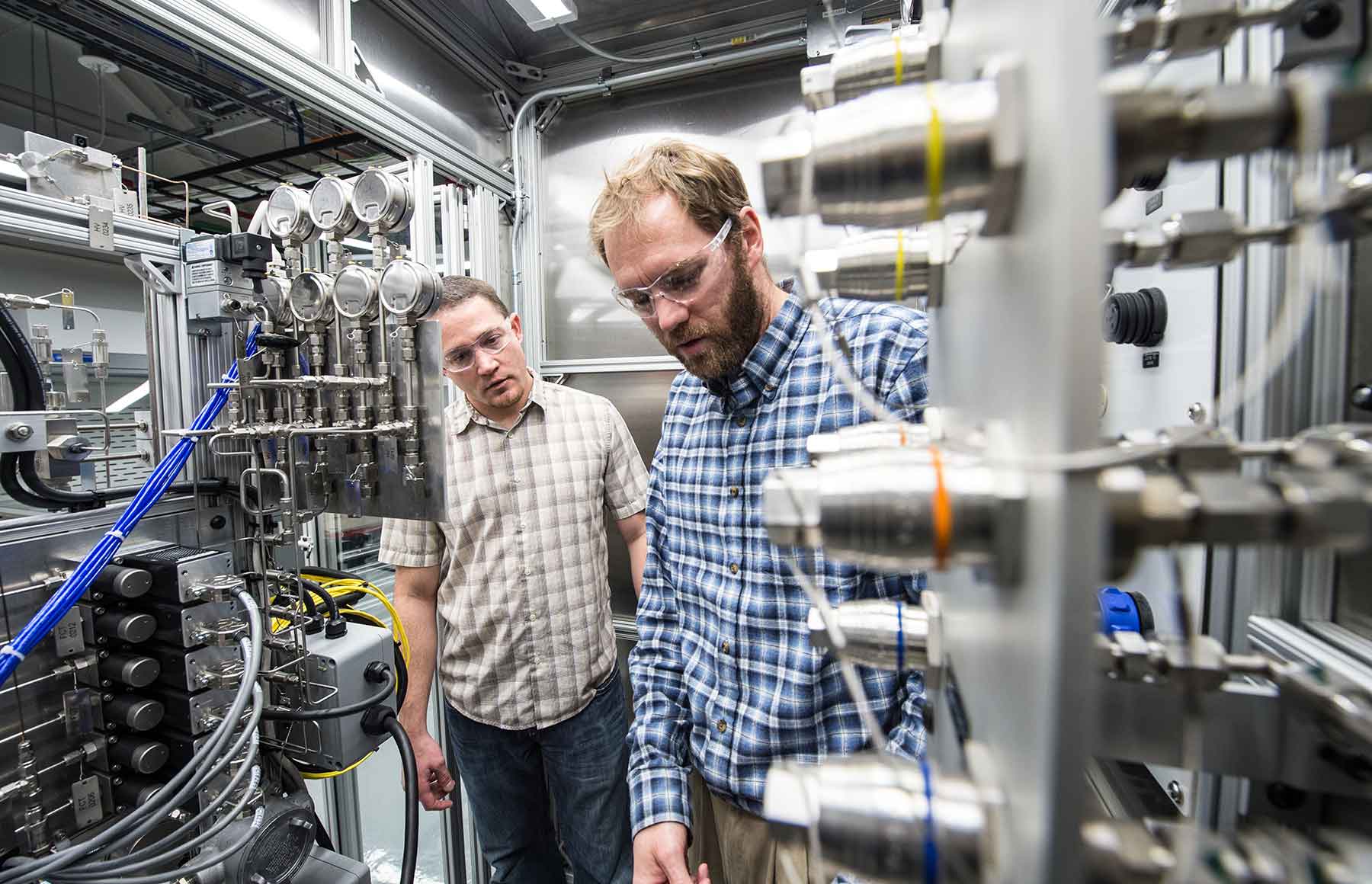
NREL Awarded $1.6 Million to Accelerate Development of Plug-In Electric and Propane Medium- and Heavy-Duty Vehicles
The Energy Department (DOE) recently announced the award of funding to accelerate the development and deployment of alternative vehicle and fuel technologies, including $1.6 million for the National Renewable Energy Laboratory (NREL) to support three projects led by industry partners Blossman Services, Blue Bird Body Company, and Odyne Systems, LLC. NREL will support these partners in advancing electric-drive and propane fuel technologies for medium- and heavy-duty vehicles.
December 2016
Study Examines Lithium-ion Battery Electrodes through Advanced Microstructure Simulation
Researchers at the National Renewable Energy Laboratory (NREL) and Texas A&M University have developed advanced computational models to enhance scientific understanding of a battery electrode’s material recipe and how it controls battery performance.
News Release: Analysis of Connected and Automated Vehicle Technologies Highlights Uncertainty in Potential Effects on Fuel Use, Miles Traveled
A joint study from the U.S. Department of Energy's National Renewable Energy Laboratory (NREL), Argonne National Laboratory, and Oak Ridge National Laboratory revealed the potential effects of connected and automated vehicle (CAV) technologies on fuel use and efficiency, vehicle miles traveled, and consumer costs.
Share

Last Updated May 5, 2025