
Unified Theory of Excitons Reveals New Control Methods in Semiconductors
Team Led by National Laboratory of the Rockies Researchers Publishes Complete Picture of Excitons in Magnetic van der Waals Materials

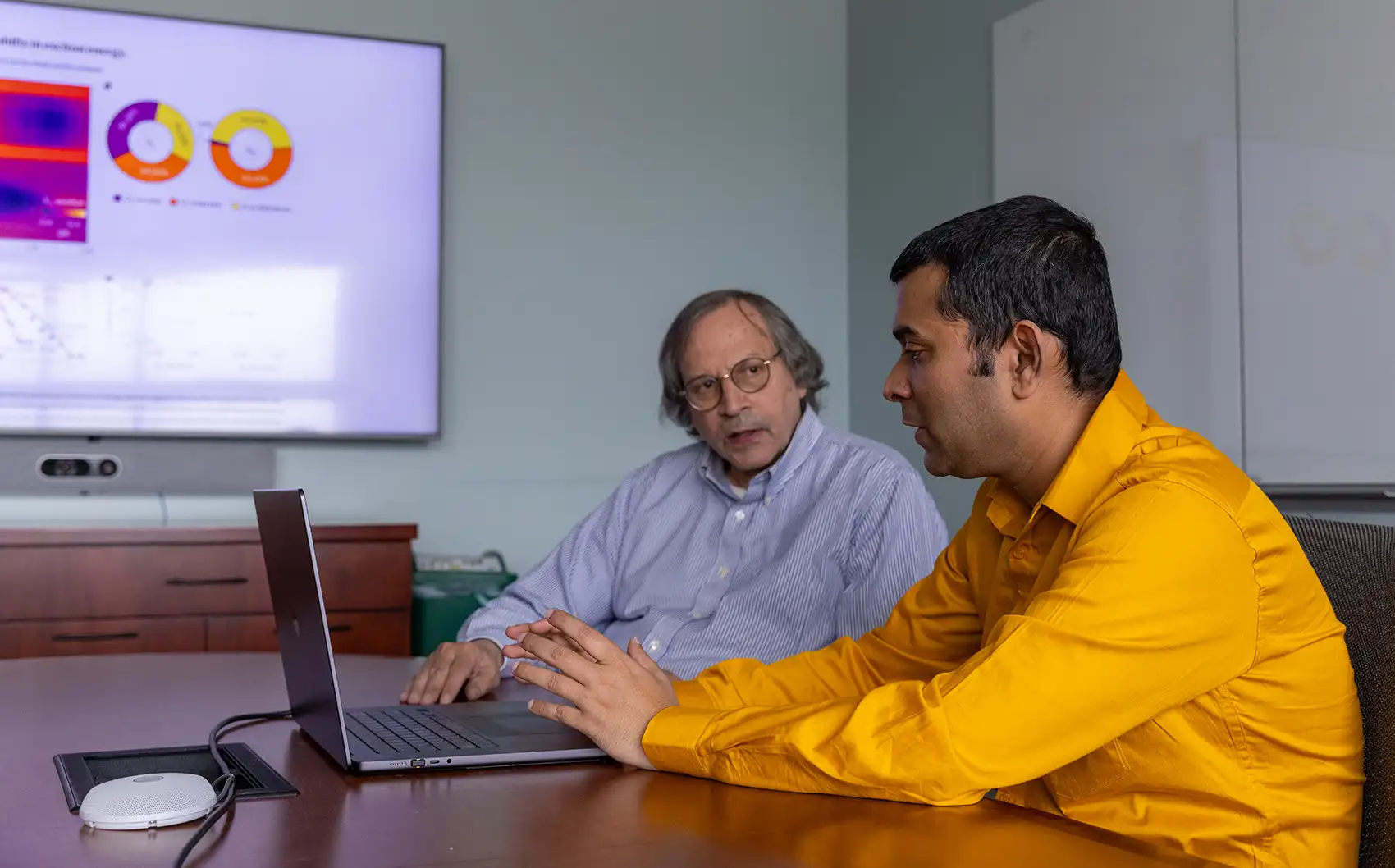
In the saga of semiconductor discoveries, we have entered the era of two-dimensional (2D) magnets. Researchers are exhilarated by these materials’ ability to process information on stackable, atomically thin sheets. But a fundamental mechanism related to the materials’ optical response has gone unexplained for years, hampering innovation.
A global team led by researchers at the National Laboratory of the Rockies (NLR) has contributed a unifying view to the field of 2D magnetic semiconductors in two papers: (1) a synthesis of the achievements to date, titled “Excitons in van der Waals Magnetic Materials,” published in Nature Materials, and (2) an application of the authors’ holistic interpretation to a representative semiconductor, “Distinct Magneto-Optical Response of Frenkel and Wannier Excitons in CrSBr,” published in Nature Communications.
Signals From Spin and Light
The basic ideas of electronics are familiar to most: There are positive and negative charges, they attract and repel each other, and so on. But have you heard about excitonics? Surely less familiar, this emerging domain is based on electrically neutral energy carriers called excitons that can also support signal processing and computation, possibly in ways that electronics cannot.
“Excitons are a different beast,” said Swagata Acharya, an author of the recent Nature Materials and Nature Communications articles describing excitons in magnetic semiconductors. This work is funded by the U.S. Department of Energy (DOE) Office of Science Basic Energy Sciences program. “With excitons, we are controlling electrons and holes together, not separately, as in electronics. That makes all the difference,” Acharya explained. “An electron has a charge, whereas the electron-and-hole is neutral. You don’t use voltage to control them, you use light.”
Excitons are quasiparticles that interact with light, but they also interact with the magnetic spin of materials. This light-spin convertibility is useful for signal processing, but its subtle and unusual nature in 2D magnetic semiconductors has confounded researchers, until now.
Theoretical Clarity for a High-Interest Quasiparticle
In “Excitons in van der Waals Magnetic Materials,” the authors unify concurrent ideas to reveal a consistent explanation of excitons in 2D magnets.
“Scientists have always thought about having one kind of exciton or the other,” said Mark van Schilfgaarde, a leading contributor in the field of quasiparticles and a research advisor at NLR.
Commonly, two exciton types exist—a localized type (Frenkel), in which the coupled positive and negative charges are within a few atoms of each other, and a dispersed type (Wannier-Mott), in which the charges are spread up to hundreds of atoms away.
Within 2D magnets, the distinction between exciton types is not clear cut. The excitons are not strictly localized or dispersed. As a result, theories about exciton nature have also been dispersed.
“When both exciton types are present, they respond differently to probes,” van Schilfgaarde explained. “Experiment gives a result, but scientists don’t know what it means. They have no way of knowing that one exciton is in this limit and the other is not.”
The researchers cataloged exciton-magnetic interactions in such materials, including a review of their experimental signatures and theoretical explanations. In doing so, they affirmed excitons in 2D magnets exist as both Frenkel and Wannier-Mott types, and sometimes on a spectrum between the two. This finding explains some of the remarkable properties of upcoming materials, such as chromium sulphur bromide (CrSBr).
Theory in Practice: Hybrid Exciton Analysis of Chromium Sulphur Bromide
For scientists, the 2D semiconducting magnet CrSBr has the makings of a wonder material. It is stable, it couples strongly to light and magnetism, and, like other van der Waal materials, it can be stacked in modular sheets.
In their paper titled “Distinct Magneto-Optical Response of Frenkel and Wannier Excitons in CrSBr,” the researchers explain exciton behavior in CrSBr, whose exciton energies were known to show a dual nature in a way that was not addressed satisfactorily by theory.

Using many-body perturbation theory leveraging an open-source, in-house Questaal software and validating their results by scanning a CrSBr sample with optical spectroscopy inside a magnet, the team resolved some unknowns about hybrid exciton states and developed an explanatory theory of excitons in 2D magnets.
“This is a proper theory that doesn’t use any free parameters, and it can explain all the results and properties,” Acharya said.
For example, their approach explains an enigmatic 100-millielectron-volt energy shift in one of the excitons, which had been imprecisely predicted by the traditional theories that describe excitons at their limits.
The achievements documented in both articles are largely the result of a collaboration of 20-plus participating research organizations. Van Schilfgaarde and Acharya both have deep experience in quasiparticles and have worked closely together on exciton behavior. Their relationships with collaborators around the world enhanced their efforts to develop the explanatory theory of excitons in 2D magnets.
Exciton research is a global priority because of the many possible applications, such as sensing, data processing, computing, quantum communications, and those yet to be discovered. NLR’s contribution is a theory that affirms the experimental properties of excitons and makes new predictions not readily accessible to experiment, such as the spatial structure of an exciton. This new insight into the microscopic understanding of excitonic processes is vital to the deployment of excitons in technological applications.
Learn more about basic energy sciences at NLR. Read “Excitons in van der Waals Magnetic Materials” in Nature Materials and “Distinct Magneto-Optical Response of Frenkel and Wannier Excitons in CrSBr” in Nature Communications.
Last Updated April 28, 2026