
Scientists Shine Light on Materials That Remember
Optoelectronic Synapse Shows Exceptional Photoresponse for Neuromorphic Vision

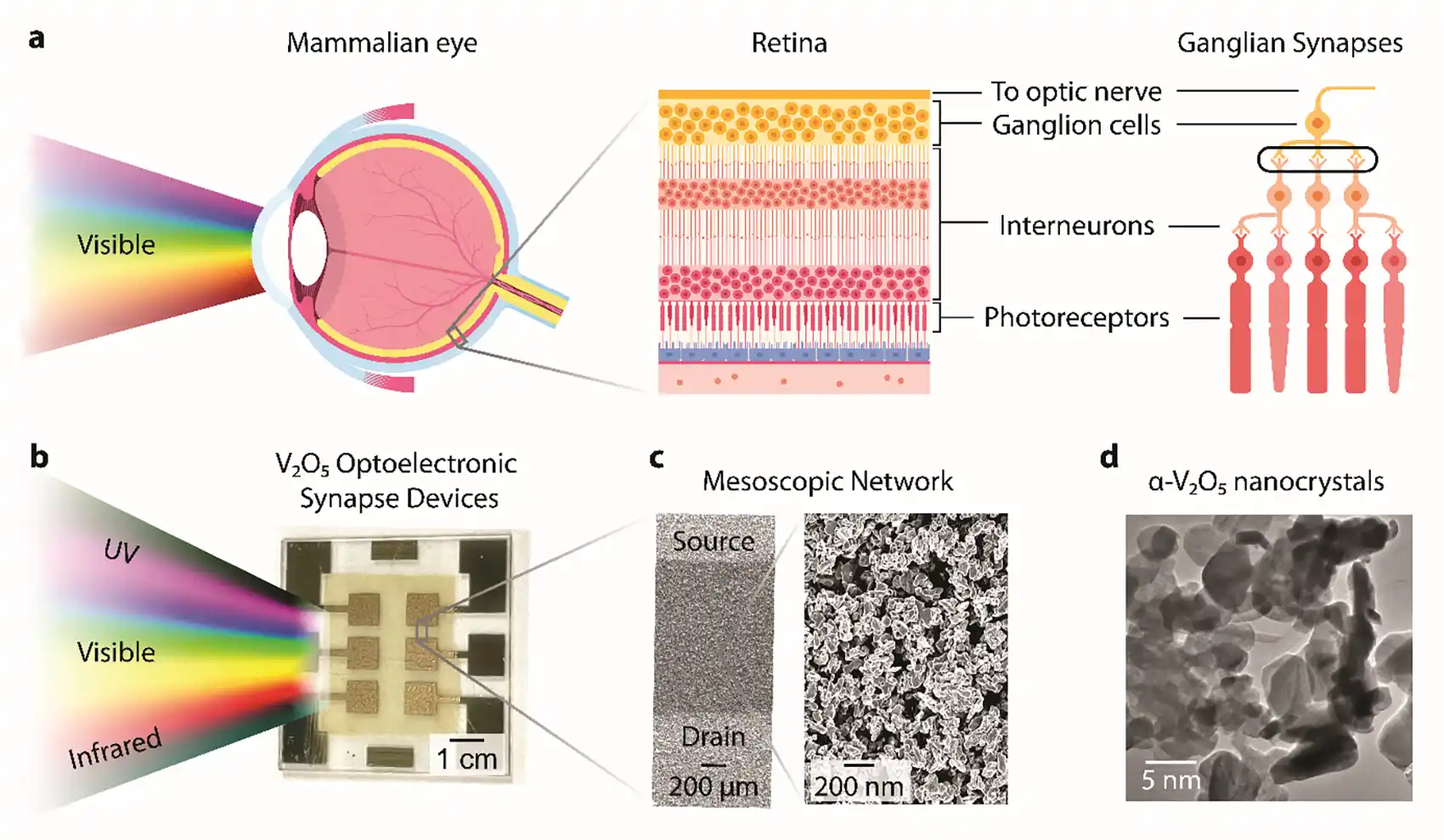
Like so much else in nature, the human visual system has both a complex structure and functional efficiency that is difficult for scientists to replicate. The system is both a sensor and a processor, with the eyes and the brain working together to resolve images with less energy use than anything people have invented.
But a technology called optoelectronic synapses can reproduce at least some of the phenomena that make human vision so successful, and a team of researchers at the National Laboratory of the Rockies (NLR) has discovered why certain materials perform so well at artificial vision and memory.
In their article “Interlayer Exciton Polarons in Mesoscopic V2O5 for Broadband Optoelectronic Synapses” published in Advanced Functional Materials, the NLR-led research team discovered the source of persistent photoconductivity—a mechanism that mirrors some of the functionality of biological synapses in the eye—for a particular vanadium-oxide material.
This work was part of the U.S. Department of Energy’s Reconfigurable Electronic Materials Inspired by Nonlinear Neuron Dynamics (reMIND) Energy Frontier Research Center, funded by the Office of Science Basic Energy Sciences program, and was coauthored with researchers from Lawrence Berkeley National Laboratory, Texas A&M University, and Istituto di Struttura della Materia-CNR.
“This work builds on years of past research in optoelectronics, but it also presents a fundamental discovery of how certain atomic vacancies give rise to longer photoresponse times, which is a key to eye-like vision and applications like multispectral imaging, sensing, and communications,” said Lance Wheeler, NLR scientist and contributing author.
From Crystal to Synapse
For decades, scientists have known of persistent photoconductivity in certain oxide crystals, which have especially long-lasting conduction after exposure to light. The exact cause of these phenomena has been debated among specialists but was presumed to result from missing oxygen atoms.
In this work, the scientists elucidated the exact role of oxygen vacancies by modeling, fabricating, and testing optoelectronic synapse devices based on α-phase vanadium pentoxide (V2O5).
About reMIND
The reMIND Energy Frontier Research Center is a multidisciplinary team led by Texas A&M Engineering Experiment Station with participants National Laboratory of the Rockies, Sandia National Laboratories, and Lawrence Berkeley National Laboratory. ReMIND's mission is to establish the foundational scientific knowledge required to build computing architectures that function like the human brain, revolutionizing computing and artificial intelligence through massive increases in energy efficiency and speed.
They found oxygen vacancies within the V2O5 crystals trapped charges created from incoming light, forming a so-called “polaron,” which endows the crystal with a sort of memory. As long as the charge persists, the crystal keeps a record of the light, which can then be read out with electrodes. During fabrication of the crystals, researchers can modulate characteristics of this optical memory to adjust sensitivity and photoresponse time.
When the team pulsed the material with a variety of light wavelengths, they observed persistence for more than 25 minutes. This longer decay time is functionally similar to a neural synapse. In the brain, this charge persistence leads to long-term potentiation and plasticity—the keys to memory.
Applications in Optoelectronics
This study opens the door to fabricating a new generation of materials with tunable memory and machine vision. Because of the way such crystals emulate synapses, they offer a simplified circuitry that reduces both energy consumption and signal interference.
They also do things our eyes cannot, like see infrared light.
With their sensitivity to a wide spectrum of light—and their ability to be affixed to flexible glass—crystals such as V2O5 could be the base for applications in neuromorphic vision, such as robotics, edge electronics, distributed sensing, bioengineering, and more.
“An important outcome of the study was identifying the role of polarons for achieving tunable persistent photoconductivity in this class of oxide materials,” said Jeffrey Blackburn, NLR research fellow and contributing author.
“This insight—when coupled with areas like low-cost polycrystalline materials, scalable device fabrication methods, broadband sensitivity, and flexible substrates—opens possibilities to exploiting similar mechanisms across a broad array of materials and optically driven neuromorphic device architectures.”
Learn more about basic energy sciences at NLR and about the U.S. Department of Energy's Office of Science Basic Energy Sciences program. Read “Interlayer Exciton Polarons in Mesoscopic V2O5 for Broadband Optoelectronic Synapses” in Advanced Functional Materials.
Last Updated April 28, 2026