
Researchers Use Light To Tune Electronic Properties in Ultrathin Materials
Spatially Precise Dedoping Technique for 2D Semiconductors Could Advance Their Use in Next-Generation Microelectronics and Optoelectronic Devices

One of the ways that researchers increase the performance of microelectronics and optoelectronics used in many everyday devices is by fine-tuning the materials' electronic properties.
Electronic doping of semiconductors—the ability to tune their electron density and conductivity—is a fundamental process that enables the incorporation of semiconductors into small, fast, and energy-efficient electronic devices. But atomically thin (two-dimensional [2D]) semiconductors present a distinct challenge for researchers trying to tune them with both high spatial resolution and long-term stability, which are necessary for many applications.
Although efforts to tune charge conductivity in 2D semiconductors, such as transition metal dichalcogenides (TMDCs), have been demonstrated, they fall short for practical implementation at commercial scale. But that may be changing.
Ten National Laboratory of the Rockies (NLR) researchers—alongside researchers from the University of Colorado Boulder, University of Virginia, and Oak Ridge National Laboratory—fabricated a scalable method to reliably electronically dedope (remove electrons from) monolayer, wafer-scale molybdenum disulfide (MoS2, a TMDC) with long-lasting stability. The method could open a door to commercial applications for 2D materials in multilogic devices, inverters, and optoelectronic devices.
The researchers detailed their findings in a paper, “Spatially Precise Light-Activated Dedoping in Wafer-Scale MoS2 Films,” published in Advanced Materials. Funding for this work was provided by the U.S. Department of Energy’s Office of Basic Energy Sciences, with additional, individual support from the Office of Workforce Development for Teachers and Scientists, the Graduate Assistance in Areas of National Need fellowship in quantum engineering, and the Virginia Space Grant Consortium program.
“Much research has gone into developing 2D materials for electronic applications,” said Jao van de Lagemaat, NLR’s Chemistry and Nanoscience Center director, “but we focused on tuning the doping of these materials and mapping patterns in the doping, almost like printing a structure with light, which is essential if you want to integrate these materials in real devices.”
Tuning Up the Bandgap: Dedoping Correlates to Photoluminescence in MoS2
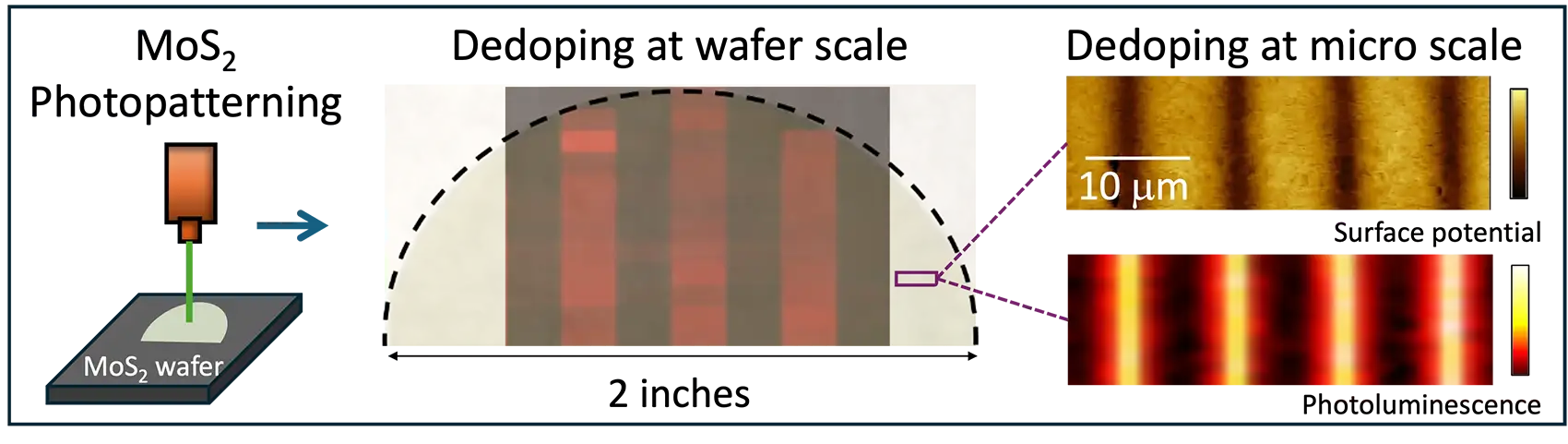
Under ambient conditions, the photoluminescence (PL) intensified dramatically for MoS2 films upon illumination with visible laser light. That surprised the research team, said NLR’s Jeffrey Blackburn, a chemist and nanoscience researcher, but it provided the impetus to use light to tune electron concentration in monolayer MoS2.
PL tells researchers about the purity, quality, and electron concentration of 2D semiconductors, and illuminated MoS2 showed enhanced PL. Further, two other spectroscopic features sensitive to carrier concentration—which is connected to electron doping, or the introduction of impurities in a semiconductor—shifted, providing evidence consistent with dedoping in the illuminated MoS2. In this case, “dedoping” means that excess electrons present in MoS2 were removed by the illumination, leading to enhanced PL.
Kelvin probe force microscopy confirmed the correlation between dedoping and PL, where illuminated areas of MoS2 showed an increase in PL and decreased surface potential. This surface potential directly relates to an increase in the work function, a movement of the Fermi level away from the conduction band and toward the valence band that supports the dedoping mechanism.
“We can tune thin-layer semiconductor films like 2D MoS2 to change their optoelectronic properties in a stable way,” said NLR’s Elisa Miller, Photochemical and Chemical Processes Group manager. “The more we can fine-tune doping levels, the more we can selectively enhance semiconductor capabilities.”
Level Up: Dedoping Stability and Scalability Is Important for Devices
A doped 2D semiconductor must be scalable for cost-effective deployment. The researchers demonstrated scalability by patterning across a large-area wafer, while also showing high fidelity in the types of patterns that could be created. These strategies enabled the fabrication of variable patterns of doped and tunably dedoped regions, necessary for small-scale devices.
For a doped semiconductor to be useful for device integration and performance under ambient conditions, it must also be stable, and comparisons of freshly photopatterned samples after seven days showed little change in local doping densities. This indicates the stability of the researchers’ procedure under ambient conditions. Seven-day-old samples withstood temperature and vacuum stress tests, too, further evidence of their resilience.
“The stability and scalability are promising for the use of this method to improve devices,” Miller said. “And we think it’s possible to mirror this method with other TMDCs where similar photoluminescence enhancement has been seen.”
With a reliable, scalable, and stable dedoping method in hand, this team hopes to promote 2D materials from laboratory hopeful to serious commercial contender.
Learn more about basic energy sciences at NLR and about the U.S. Department of Energy's Office of Science Basic Energy Sciences program. Read “Spatially Precise Light-Activated Dedoping in Wafer-Scale MoS2 Films” in Advanced Materials.
Last Updated April 28, 2026