
Peer-Learning Cohorts Welcome 27 Participants To Share Lessons on Utility Grid Planning, Data Centers
Energy to Communities (E2C) Launches Two Six-Month Peer-Learning Cohorts: One on Leveraging Data for Modern Utility Grid Planning and Another About Navigating Local Data Center Development

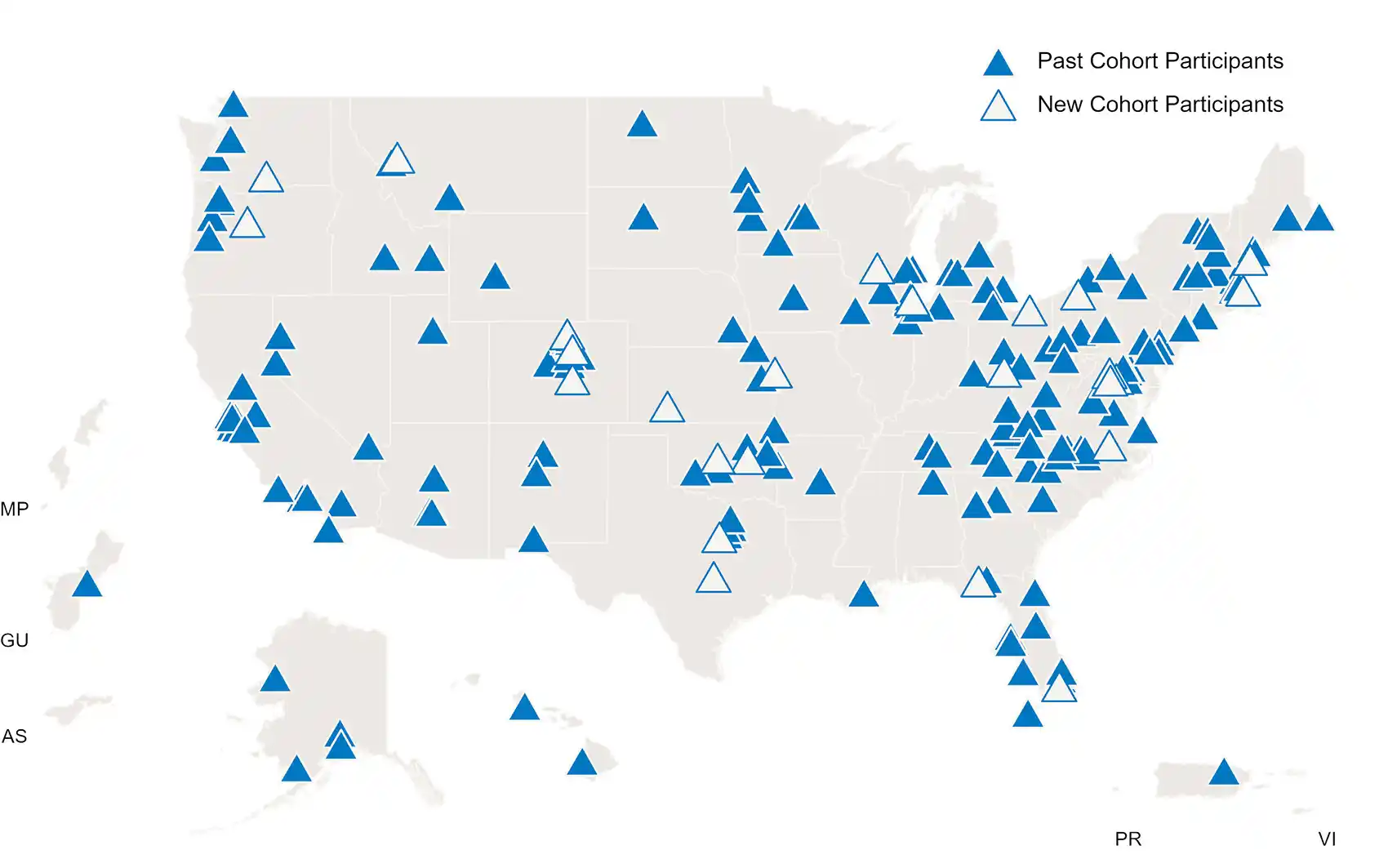
The National Laboratory of the Rockies (NLR) is pleased to announce that 27 local participants across the United States were recently selected for two new Energy to Communities (E2C) peer-learning cohorts, managed by NLR on behalf of the U.S. Department of Energy (DOE).
E2C peer-learning cohorts launched two separate engagements in July. The first, “Leveraging Data for Modern Utility Grid Planning,” is a series designed for public utility grid planners and data managers to learn about data sources, storage, and management best practices. The second engagement, “Navigating Local Data Center Development,” supports local governments, Tribal organizations, and planning commissions to better understand data center characteristics, risks, benefits, and trade-offs that may affect their communities.
Once a month from July through December 2026, participants will meet to explore best practices, strategies, and tools to advance participant energy goals related to their cohort’s topic.
“E2C peer-learning cohorts empower local communities by sharing knowledge and tools and creating dedicated spaces to answer questions about topics that directly support the latest U.S. energy needs,” said Jenny Sumner, NLR’s E2C program lead. “With the addition of these two, E2C will have hosted more than 20 total cohorts. We’re excited to keep providing the tools, expertise, and collaborative experiences participants need to bolster their local energy systems.”
The new participants join a group of about 300 local leaders from nearly 280 communities that have participated in E2C’s peer-learning cohorts to access educational resources, review case studies, learn about analysis and modeling tools, apply templates to streamline their work, undergo trainings, and participate in facilitated collaboration on common energy topics.
Navigating Local Data Center Development
Communities are facing complex decisions as data center development accelerates. These centers can affect energy costs, economic growth, resource adequacy, and land and water use.
After learning from expert insights, peer exchange, and case studies, participants in the Navigating Local Data Center Development cohort will leave the experience better equipped to understand and communicate data center characteristics and trade-offs, identify potential project impacts, and plan strategies to mitigate risks and capture benefits that advance local goals.
Six workshops will provide opportunities for participants to explore the technical characteristics of data center infrastructure and the development phases and timelines of data center development, understand the potential impacts of proposed data centers in their regions, and assess trade-offs of different strategies for navigating data center development based on local goals. Before leaving the cohort, participants will select strategies that best fit their organizations’ goals and needs related to data centers and practice communicating those next steps with cohort peers.
“I am excited to work with these communities representing every corner of our country as they wrestle with understanding and evaluating both the potential challenges and potential opportunities data center development could bring to their communities,” said NLR’s Jonathan Morgenstein, who will serve as a subject matter expert for the data center cohort. “I’m hoping they can walk away better equipped and more confident to work with others in their communities to make informed, quality decisions for the best interests of their hometowns.”
The participants in this new cohort include representatives from local governments, Tribes, and planning and economic development organizations.
Participants in the Navigating Local Data Center Development cohort:
- Adams County, Colorado
- Capital Area Regional Planning Commission, Dane County, Wisconsin
- City of Chicago, Illinois
- City of Kansas City, Missouri
- Colorado River Indian Tribes
- Fairfax County, Virginia
- Ford County, Kansas
- Johnson County, Texas
- Loudon County, Virginia
- Miami-Dade County, Florida
- Missoula County, Montana
- Muscogee (Creek) Nation
- Prince William County, Virginia
- Village of Waverly, Ohio
- Warm Springs Economic Development Corp.
Leveraging Data for Modern Utility Grid Planning
As understanding energy demand becomes more complex, strong data practices can help utilities plan for a variety of energy needs and scenarios with more reliability and flexibility. The cohort on Leveraging Data for Modern Utility Grid Planning supports utility grid planners and data managers in understanding essential data sources, data storage and management best practices, and the standards and open-source tools that enable systemwide data integration.
In the Leveraging Data for Modern Utility Grid Planning cohort, participants will learn which data categories, types, and sources are needed throughout different phases of grid planning and where to find that data; identify opportunities for improving data management and utilization with new data practices, software, or tools and understand common barriers to their implementation; explore opportunities to leverage AI for data quality, formatting, and processing; and discuss the external factors that impact their data use and management, such as regulatory requirements and cybersecurity. After participating in this workshop series, cohort participants will come away with strategies and next steps to help them implement their proposed data improvements within their organization.
“Folks from utilities are coming from different parts of the nation to explore how they can improve the stewardship and use of the data they use to plan their systems, and I’m looking forward to spending the next six months with them,” said NLR researcher Vincent Westfallen, the subject matter expert supporting the grid planning cohort. “As we consider best practices in these areas and learn from practitioners within and outside of the cohort, I expect that everyone will come away with useful tips and ideas for how they can improve their data management techniques to streamline and more accurately make informed planning decisions.”
The participants in this new cohort include local utility representatives engaged in grid planning.
Participants in the Leveraging Data for Modern Utility Grid Planning cohort:
- City of Georgetown, Texas – Electric Utility
- City of Fort Collins, Colorado
- City of Tallahassee Electric and Gas Utility
- Cleveland Public Power
- Colorado Springs Utilities
- Edmond Electric
- Hingham Municipal Lighting Plant
- Jamestown Board of Public Utilities
- Kennebunk Light and Power District
- Town of Enfield Electric Utility
- United Power
- Yakama Power.
About E2C
Peer-learning cohorts are one of three technical assistance offerings from the E2C program, ranging from short-term technical assistance to address near-term energy challenges to multiyear in-depth technical partnerships that support communities in developing abundant, reliable, affordable, and secure energy systems.
To learn more about E2C’s recent accomplishments, visit the program’s 2025 Annual Highlights report.
E2C is funded by DOE’s Office of Energy Efficiency and Renewable Energy and managed by NLR with support from Argonne National Laboratory, Lawrence Berkeley National Laboratory, Oak Ridge National Laboratory, and Pacific Northwest National Laboratory.
Last Updated April 28, 2026