
Office of Science Awards Lukas Dahlin Early Career Research Honor
Funding Enables Dahlin To Expand Genome Recoding Research for Emerging Biotechnologies

The U.S. Department of Energy’s Office of Science (SC) has selected bioenergy and bioeconomy researcher Lukas Dahlin from the National Laboratory of the Rockies (NLR) to receive a funding boost through its Early Career Research program. SC’s Biological and Environmental Research (BER) program will fund $2.75 million to support Dahlin’s genome recoding research over a five-year period.

Dahlin becomes only the seventh researcher from NLR to be recognized with this honor during the 15-year history of the early-career program, which is limited to scientists within 10 years of having earned their doctoral degree.
A molecular biologist, Dahlin has worked at NLR since November 2014, initially conducting research at the laboratory as a doctoral student under Matthew Posewitz at the Colorado School of Mines on a joint project led by Michael Guarnieri of NLR. Dahlin received his Ph.D. in applied chemistry in 2019 from Mines and joined NLR as an employee in January 2020 as a postdoctoral researcher.
“These awards are extremely competitive, with only a few percent of proposals being accepted for funding, so it’s truly humbling and an honor to be selected,” Dahlin said. “They can jump-start your career and open doors that enable researchers to pursue bold ideas and do incredibly novel science.”
Dahlin’s research focuses on genome recoding, which is a synthetic biology technique that leverages redundancy in the genetic code to free up genetic signals. Through recoding, scientists have expanded biological functions by enhancing virus resistance, enabling biocontainment, and establishing the ability to produce proteins with non-standard amino acids. With new to nature abilities, these novel proteins can enable more efficient biomanufacturing approaches and expand on the suite of products made biologically. This can be leveraged for domestic production of critical minerals, chemicals, polymers, fertilizers, and more, ultimately reducing costs to consumers. Additionally, genome recoding may provide fundamental insights into the evolution of the genetic code, for example helping scientists understand why the genetic code is redundant.
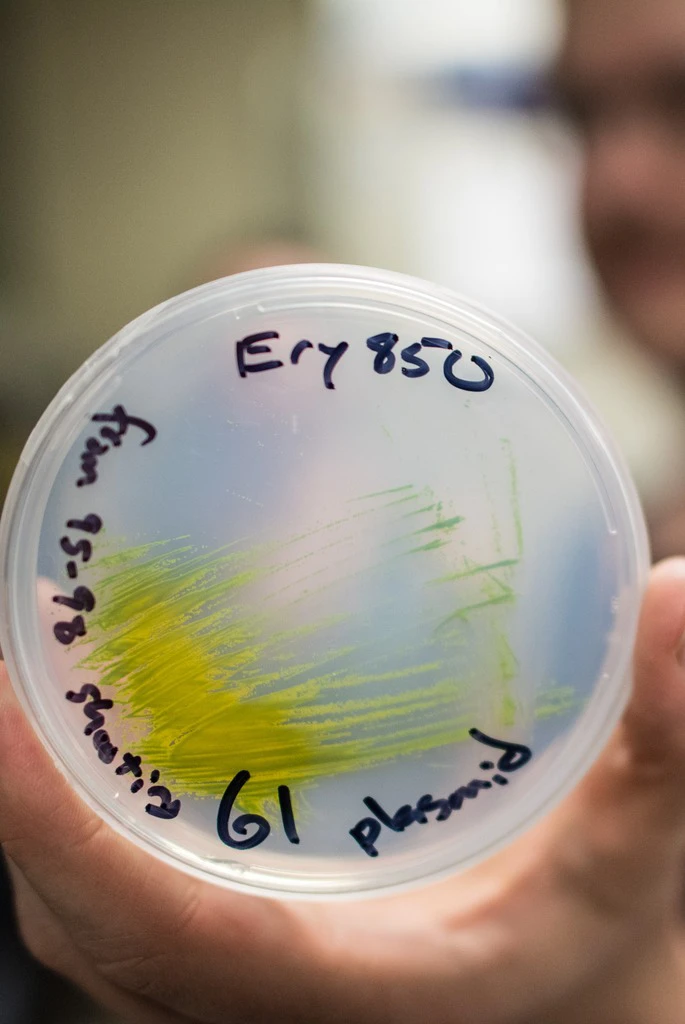
With this new funding support, Dahlin is turning his attention to adapting genome recoding technology to the chloroplast genome. Chloroplasts are organelles that allow plants and algae to convert light into chemical energy and biomass.
Dahlin said the technology to date has largely been applied to a few species of bacteria that are considered relatively easy to genetically modify. His work involves the microalga Picochlorum renovo, a fast-growing species that has a chloroplast genome about 50 times smaller than that of a bacterial genome.
The research will help address key knowledge gaps and expand genome recoding technology to a eukaryotic organism for the first time. Further, the project has the potential to enable the use of genomic recoding technology in bioenergy crops, with the possibility to overcome previously insurmountable hurdles that limit crop productivity.
Until now Dahlin’s genome recoding work has been funded through the Laboratory Directed Research and Development program, an internal NLR mechanism that promotes innovations in science and technology, and via collaborative activities with NLR’s BER-funded Secure Biosystems Design Science Focus Area. The funds that come with the Office of Science recognition will enable Dahlin to dive deeper into his work.
The Early Career Research program is highly competitive. Only six other scientists from NLR have been selected previously: Julie Bessac, Davinia Salvachúa Rodriguez, Cara Lubner, Andriy Zakutayev, Kirstin Alberi, and Adele Tamboli.
Discover other NLR bioenergy and bioeconomy research, including more research on the science of biological energy conversion.
Last Updated April 28, 2026