
NLR-Led Center Could Spur Industrial Adoption of New Membrane Technologies
3 National Laboratories Are Merging Expertise To Create Single Pathway To Help Industry Partners Translate New Membrane Technologies From Lab to Market Adoption To Help Improve Energy Affordability and Reduce Costs Across Range of Industrial Processes
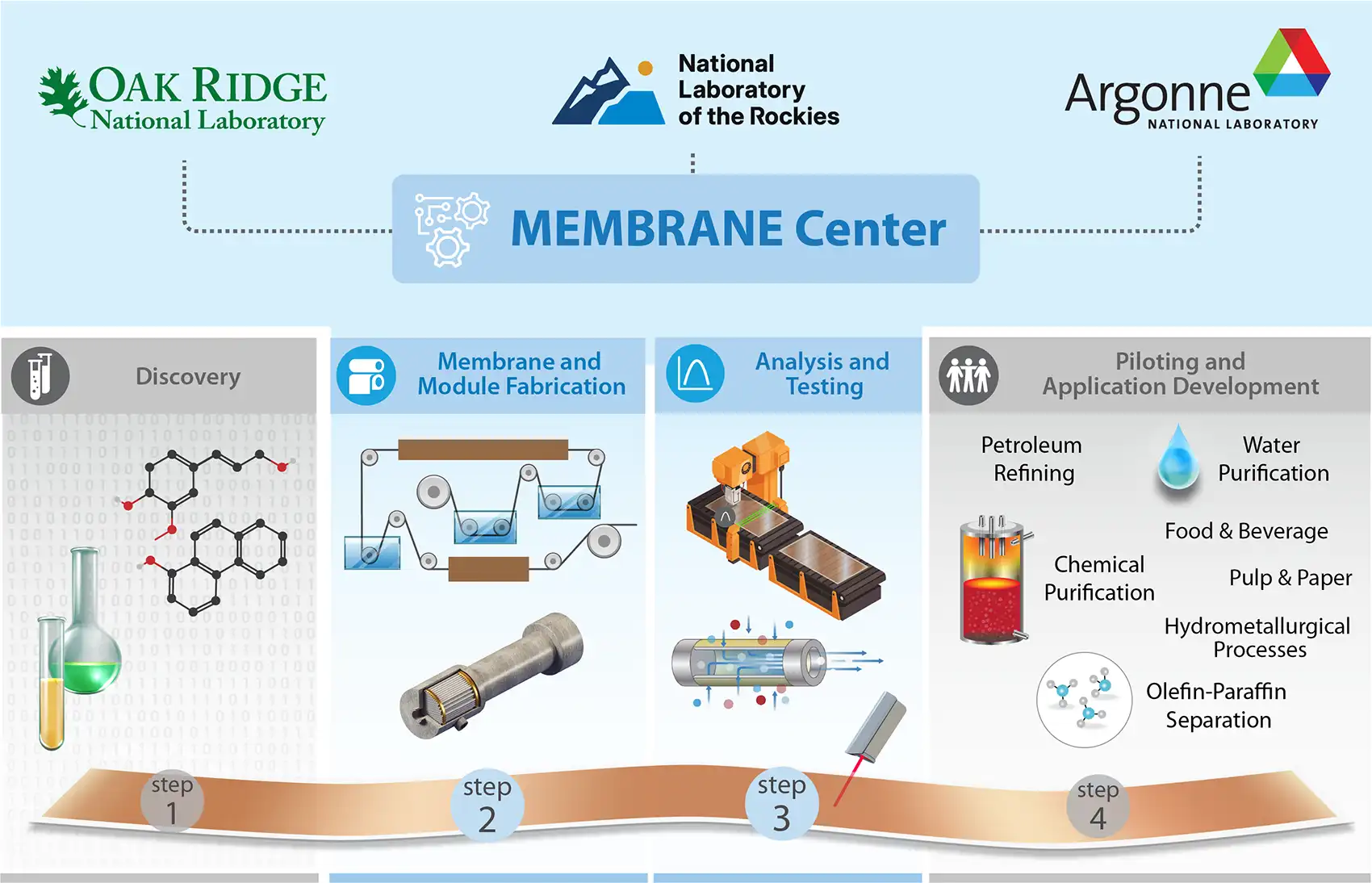
The National Laboratory of the Rockies (NLR), in collaboration with Argonne National Laboratory and Oak Ridge National Laboratory, is leading the creation of a national, user-focused membrane center to help national laboratories, industry, and academia develop and pilot new membrane technologies that can help U.S. industries improve energy affordability, reduce their water consumption, and strengthen their competitiveness.
A $12 million award by the U.S. Department of Energy Industrial Technologies Office will establish Membrane Engineering for Manufacturing, Benchmarking, Research, Analysis, and Next-Gen Evaluation (MEMBRANE) as a national membrane center, which will enhance the existing capabilities at the three national laboratories. The center will translate discoveries from lab-scale breakthroughs to real-world industry deployment, supporting membrane development, device prototyping, and device testing in application-relevant conditions.
The center will rely on input from and close collaboration with industry partners to ensure its work is addressing key industry needs.
New Membranes Technologies Can Advance Industrial Separation Processes but Need To Overcome ‘Valley of Death’
Membranes are thin layers of selective, semipermeable materials that allow separation of certain molecules from others. They are a promising technology for reducing energy costs and are widely used for liquid separation, gas separation, and electrochemical processes, including common applications such as water purification, resource recovery from wastewater, and recovery, separation, and purification of hydrocarbons and critical minerals.
Academic, national laboratory, and industrial researchers have been working to develop new membrane technologies, but often the results fall into the so-called “valley of death,” wherein an idea fails to find the funding necessary to reach industrial scale and relevance.
To address this challenge, researchers from the MEMBRANE center will establish the United States’ first membrane market development facility, comprising industrial-scale membrane flat sheet and fiber manufacturing pilot lines, membrane module fabrication infrastructure, and test beds that replicate industrial conditions. The center will also convene stakeholders to identify key barriers and collaborate with industrial and academic partners to address those barriers, helping reduce the energy costs and water demand of U.S. industries.
“Membranes can enable new industrial processes and potentially lower costs for many existing processes, but it’s proven really difficult to get new membrane materials from lab scale to industrial scale,” said Matt Ringer, laboratory program manager at NLR. “This center brings together a huge set of existing capabilities across three national labs to bridge that gap and attempt to scale-up new solutions that could make American industry more cost competitive.”
The MEMBRANE center is part of $155 million the U.S. Department of Energy is investing in national laboratories to build infrastructure and capabilities to enable faster adoption of technologies that improve the efficiency and competitiveness of American industry.
Collaborating To Bridge the Valley
Industry and academic partners will help inform how the center’s capabilities can best be developed to support future membrane research. The following organizations provided letters of support for the proposal that led to the creation of the MEMBRANE center:
- ADM
- Cirba Solutions
- EnergyX
- Entegris Inc.
- ExxonMobil
- Flexcon
- Fortescue
- Generon· Georgia Institute of Technology
- Membrane Technology and Research Inc.
- New Era Converting Machinery
- Osmoses Inc.
- SABIC
- Schlumberger Inc.
- UL Solutions
- University of California Los Angeles
- University of Colorado Boulder
- University of Connecticut
- University of Pennsylvania
- University of Texas Austin
- University of Virginia
- West Virginia University
- Xylem
- ZwitterCo.
The center will be open to partnership with a range of entities, including small to medium enterprises, innovators, and end users.
Organizations interested in partnering with the MEMBRANE center or in providing input on how the center could engage with users should contact membranes@nlr.gov.
Last Updated April 28, 2026