
NLR Expands Computational Capability for Large-Scale Decision Optimization Under Uncertainty
Demonstration Strengthens Laboratory’s Ability To Support Decision-Making Across Complex Energy Systems

Imagine the price of fuel for your vehicle varies depending on the location, the day, and even the time when you buy it. You might want to find the optimal place and date to fuel your car, but you cannot commit to a plan in advance, and you do not want to run out of fuel to get there.
What if stochastic optimization—a mathematical framework for making such decisions in the face of uncertainty—could decide for you, significantly lower your cost, and hedge against running out of fuel? Stochastic optimization allows here-and-now decisions to be made while considering their implications across a set of possible future scenarios the decision maker might be forced to contend with.
Researchers at the National Laboratory of the Rockies (NLR) have already successfully shown the power of stochastic optimization models across a range of domains, including power grid infrastructure planning, power generation operations and scheduling, and airport infrastructure planning.
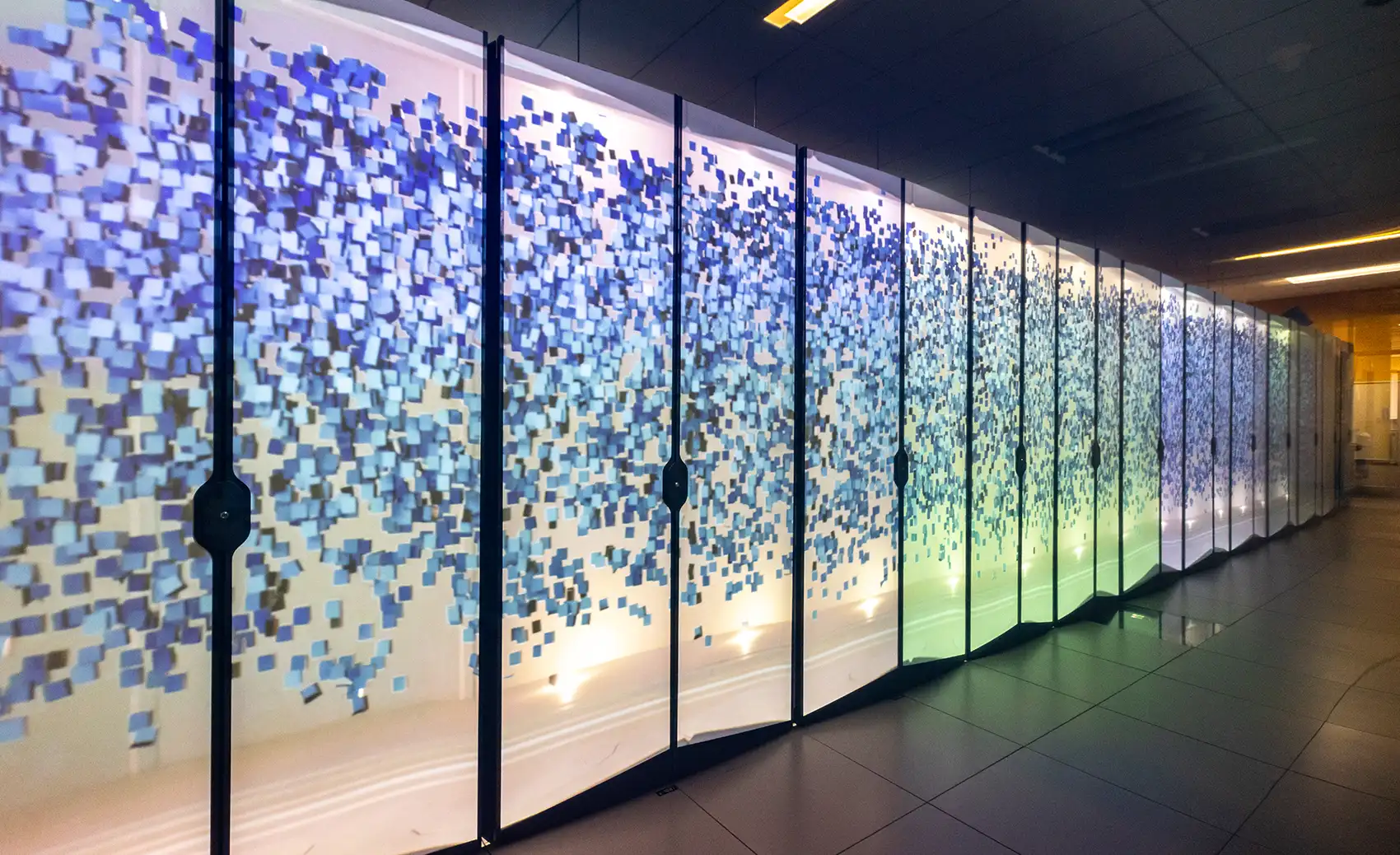
A recent demonstration using NLR’s Kestrel supercomputer and the FICO Xpress Solver tool has shown that a class of planning models—built using stochastic optimization—can now be executed at a faster pace and on larger problems than previously possible at the laboratory.
"This recent demonstration now shows we can run optimization models at much larger scales, considering more uncertainty utilizing stochastic optimization," said NLR researcher Devon Sigler. "If researchers have a problem that requires a here-and-now decision that someone has to live with while the future unfolds, we have this capability to help them."
NLR researchers are using stochastic optimization to find solutions that work well in multiple possible scenarios in large-scale, highly complex, interconnected energy systems across the United States.
"This expanded capability enables NLR researchers to evaluate system designs, operational strategies, and scenarios with greater rigor and integrity through advanced computation," said Wesley Jones, NLR’s principal scientist for advanced computing solutions.
Planning for Many Possible Futures at Once
Stochastic optimization analyzes how a decision today might play out (or emerge) over multiple possible futures. Energy planners and decision makers may find that an ideal present-day decision is one that offers potential positive outcomes across multiple possible futures.
Sigler and NLR researcher Ben Knueven applied stochastic optimization to a test case: a unit commitment problem for a power grid. It is the job of deciding which power generators to turn on or off each day and for how long. This can be difficult because generators tend to have operational constraints, such as how long they need to stay on once turned on and how long they need to rest (hours or days) before they can be restarted.
So, grid operators must decide on tomorrow’s generator schedule ahead of time, and that schedule needs to work well across many different possible versions of tomorrow. For example, a schedule that works if there is a power outage, or demand at 5 p.m. is above average, or a generator goes offline, among other possibilities.
This type of stochastic-generation-scheduling capability is relevant for energy stakeholders who are grappling with growing power demands and trying to anticipate future infrastructure needs.
Many of the problems addressed at NLR are formulated as multistage, multiscenario optimization models that represent uncertainty across time and thousands of possible futures. These models can involve hundreds of millions of decision variables and require optimization solvers that can leverage specialized mathematical structures to be solved efficiently.
For the generator-optimization problem, Knueven and Sigler needed to know: If this version of tomorrow happens, what would the best generator schedule be? That is where the FICO Xpress Solver—a mathematical optimization calculator—comes into play. Actually, thousands of Xpress Solvers (one solver for each scenario) run simultaneously on the Kestrel supercomputer. Knueven and collaborators at Lawrence Livermore National Laboratory and the University of California, Davis, developed software that coordinates the work of all solvers and combines their output into a single optimized decision.
Custom-Built Software Enables Solver Coordination
Previously, when NLR researchers tried to launch hundreds or thousands of solvers at the same time, many would fail to complete their assignment due to technical issues (FICO Xpress is just one type of available solver).
To address this issue, Sigler, Knueven, and application researchers in Jones’ group worked with high-performance-computing administrators to resolve the bottleneck.
Now NLR can reliably run 4,000 solvers at once. This is like having 4,000 math experts each solving their own version of the problem side by side at the same moment.
"We can now run thousands of FICO Xpress Solver licenses simultaneously on Kestrel without errors," Knueven said, "and the software we created can coordinate other solvers as well."
Stochastic optimization can be applied to help solve U.S. Department of Energy mission problems and other real-world challenges involving uncertainty. Learn how you can tap into NLR’s applied mathematics capabilities.
Last Updated April 28, 2026