
New Framework Finds Unexpected Order Inside Amorphous Materials

Scientific discovery often begins with identifying patterns to help navigate an otherwise complicated world.
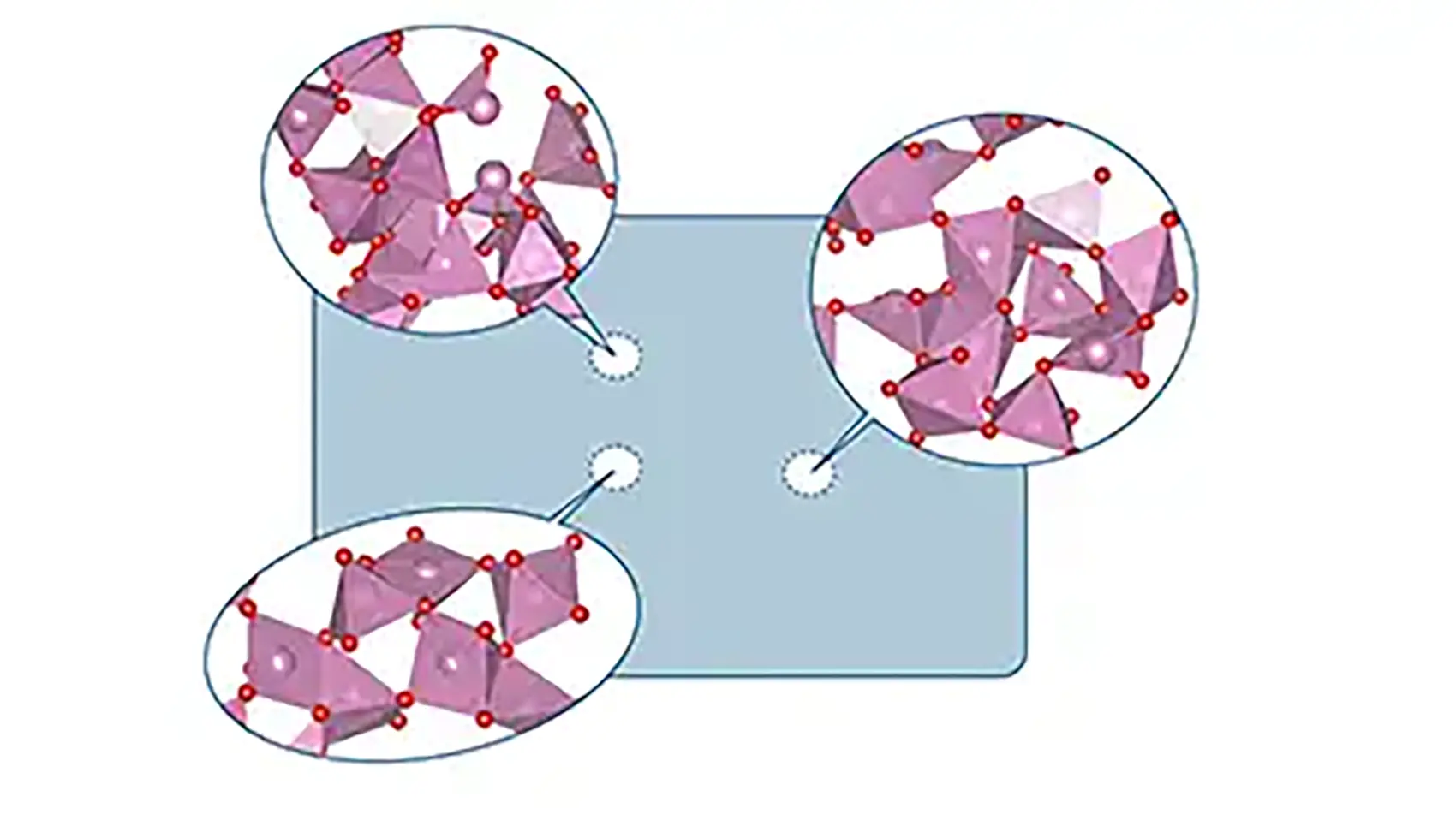
For decades, physicists have relied on the precise, repeating atomic structures within crystals to map how electrons move and to calculate their quantum energy states. However, amorphous materials—characterized by their disorderly atomic structure—have remained largely uncharted territory.
Recent research has identified a new approach.
Researchers at Colorado School of Mines teamed with the National Laboratory of the Rockies (NLR) to develop a computational framework that makes it possible to predict electronic properties in amorphous materials, while revealing surprising similarities between crystalline structures and amorphous solids. The study, published in Nature Physics, could transform how scientists design the next generation of electronic materials.
Understanding Structure Without Symmetry
The predictable patterns of crystal structures simplify understanding of how electrons move through a material and reveal how a material will respond to external forces. Periodicity enables physicists to map discrete quantum energy levels into a continuous spectrum, which makes it possible to explain and engineer quantum behaviors such as electrical conductivity, transparency, light absorption, heat transport, and magnetism.
However, many of the materials critical to modern electronics—such as the indium oxide film used to coat smartphone screens or computer displays—are not crystalline but amorphous. Although physicists know some amorphous materials conduct electricity, they did not have the tools to explain why, relying instead on trial and error to improve material performance.
This work gives scientists a new computational framework to explore a class of materials that has long been difficult to describe—a major bottleneck to technological advancement.
Charting a New Course for Amorphous Materials
The central challenge for NLR researchers was finding a way to mathematically represent electronic states in a material with no repeating structure. The team decided to model an amorphous system as a composite of local environments, carefully averaged according to the statistical likelihood of each environment appearing in nature.
“Think of it like a pinball machine,” said NLR’s Mark van Schilfgaarde, chief theorist on the project. “At any given moment, the pinball is in a specific spot on the playfield, which we represent as a unique composite of small crystalline structures. Not all positions are equally likely—as gravity pulls it downhill, the ball loses energy, but occasionally flippers bounce the ball up the field where it has higher energy. Similarly, as an atom migrates within a material, it tends toward configurations that require less energy, but occasionally it is kicked to higher energy by thermal fluctuations.”
Whereas previous models relied on simplified descriptions of disorder, the new approach uses more representative structures, reducing the number of assumptions while remaining computationally feasible. To model electron behavior within this composite framework, the team applied an advanced quantum-mechanical technique, quasiparticle self-consistent GW theory, to account for the complex interactions between electrons.
To test the method, the researchers turned to the same transparent film found on household electronic screens around the world: amorphous indium oxide. They successfully constructed an approximation of the band structure and accurately reproduced the material’s electrical conductivity. The results were striking: The approximation closely resembled the band structure of the crystalline version of the same material.
Understanding Materials Science Implications
The result is a replicable computational method that can be applied to materials beyond indium oxide. This method offers scientists a common language to describe and predict the electrical characteristics of other amorphous solids, such as metallic and silica-based glasses, amorphous silicon, and conductive polymers.
Instead of testing countless material modifications and seeing what works, scientists can begin predicting how changes to a material will affect its properties. For researchers who have long navigated without a map, this framework offers a guide for where to go next.
NLR’s portion of the work was funded by the U.S. Department of Energy’s Office of Science Basic Energy Sciences program. This study was coauthored with researchers from Colorado School of Mines (funded by the U.S. National Science Foundation’s Division of Materials Research–Condensed Matter and Materials Theory program), King’s College London, University of Colorado Boulder, and Florida State University.
Learn more about basic energy sciences at NLR. Read “Effective Bands and Band-Like Electron Transport in Amorphous Solids” in Nature Physics.
Last Updated April 28, 2026