
New Advanced Air Mobility Framework Helps Industry Prepare for Future of Flight
Airports, Governments, Communities, and Aviation Sector Can Chart Their Readiness for Next-Generation Air Mobility


Advanced air mobility (AAM) is rapidly moving from concept to reality. Flying taxis are no longer a figment of “Jetsons”-style science fiction—they are preparing to cross American skies, joined by planes that can take off and land on rooftops, uncrewed aerial cargo haulers, and emergency aircraft that could one day bring life-saving medical support to hard-to-reach areas.
As new aircraft advance through testing and certification, pilot projects expand, and communities across the country begin to consider how these technologies may fit into the future of transportation, one practical question is emerging: What does it actually mean to be ready for advanced air mobility?
For airports, governments, utilities, infrastructure owners, and industry, readiness extends well beyond the aircraft themselves. Infrastructure, energy, operations, investment, and long-term planning will ultimately determine how—and where—advanced air mobility can be successfully deployed.
To help answer those questions, researchers at the National Laboratory of the Rockies (NLR) leaned on expertise in AAM modeling, vertiport designs, and more to develop a first-of-its-kind capability maturity framework.
In a new report, Preparing for Advanced Air Mobility, the laboratory introduced this new assessment framework to help aviation stakeholders evaluate readiness and identify priorities for future planning, investment, and deployment.
The framework can help airports, cities, utilities, and aviation agencies understand their AAM readiness and the steps they can take to prepare today’s infrastructure, energy systems, and operations for advanced aircraft.
“When a technology is sitting at the intersection of research and deployment, you need a bridge to cross from one side to the next,” said Wesley Maurer, NLR’s chief transportation strategist and author of the framework. “A capability maturity framework is that bridge. It’s a structured way to assess readiness and then to decide what levers an organization needs to pull to become more ready.”
Understanding Readiness
While aircraft technologies continue to advance, successful deployment depends on far more than the aircraft themselves. Organizations must also consider infrastructure, energy availability, operations, policy, investment, and stakeholder coordination as part of an integrated transportation system.
But advanced aircraft require more than just concrete pads and clear skies to operate. As the United States Department of Transportation and Federal Aviation Administration clear pilot AAM demonstrations for takeoff, organizations are beginning to ask similar questions about infrastructure, energy systems, operations, investment priorities, and long-term planning. NLR's framework provides a structured way to organize these questions into a common language for assessing readiness and identifying priorities.
The matrix allows organizations to chart their readiness in seven domains—ranging from infrastructure preparedness to cybersecurity protocols—on a scale from 1 to 5. A score of 1 means the organization is learning about and exploring that domain.
Rather than serving simply as a scorecard, the framework is intended to help organizations understand where capabilities are developing, where gaps remain, and where future investments may have the greatest impact.
“The framework is intended to provide a common language for discussing readiness,” Maurer said. “By understanding where capabilities are strong, where gaps exist, and which priorities matter most, stakeholders can make more informed decisions about how to prepare for advanced air mobility.”
Turning Readiness Into Action
Each airport, city, utility, and aviation agency considering AAM readiness is likely beginning from a different place. Some may already have supportive planning processes but require additional infrastructure analysis. Others may have strong technical capabilities but need to better understand future energy demand or operational considerations.
“The goal isn't for every organization to follow the same path,“ Maurer said. “It's to understand where they are today, identify what matters most for their unique circumstances, and make informed decisions about where to invest and how to move forward.“
Maurer noted that AAM is a flagship research area for the laboratory, and subject matter experts are queued up and ready to offer customized assistance in a variety of areas.
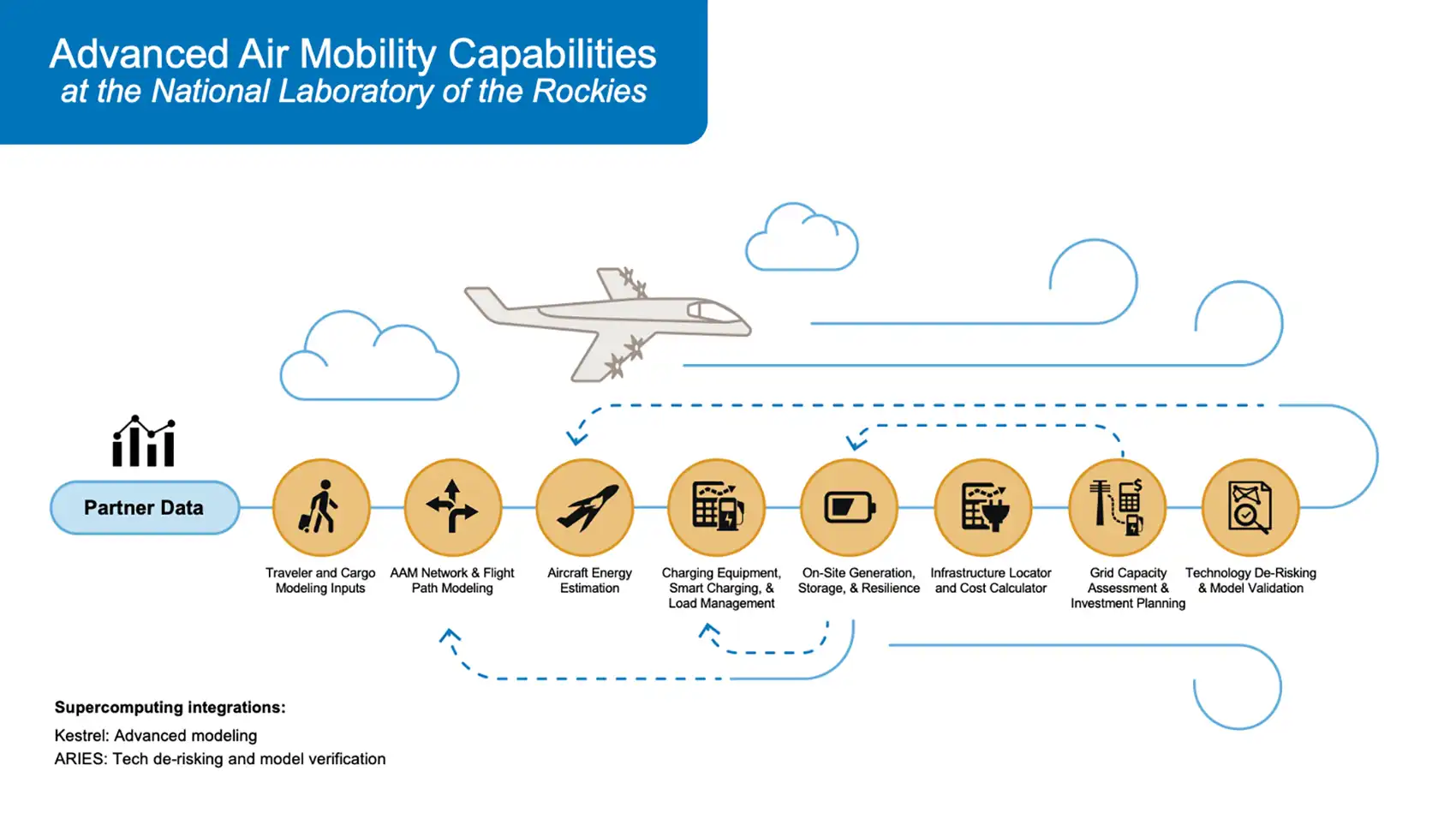
Particular areas of expertise at NLR include:
- Infrastructure and network planning
- Energy storage and grid integration
- Charging and power management
- Load modeling, digital twins, and optimization
- Aviation fuels and energy carriers, including hydrogen
- High-performance aircraft components and vertiport designs
- Safety and cybersecurity.
Organizations interested in applying the framework can engage NLR through technical discussions, readiness assessments, and collaborative planning efforts tailored to their unique goals and challenges, Maurer said. Scoping calls, technical presentations, and readiness assessments are all possibilities, in addition to NLR’s more traditional partnership pathways.
“AAM is a flagship research area for NLR, and we have subject matter experts queued up to offer customized assistance.“
“Advanced air mobility brings together transportation, energy, infrastructure, and operations in new ways,” said Brett Oakleaf, NLR’s strategic partnership manager for the aviation sector. “That’s where NLR comes in—bringing together expertise across those disciplines to help stakeholders prepare for deployment.”
For questions about the Advanced Air Mobility Readiness Framework, contact Wesley Maurer, and to discuss aviation-related partnerships, contact Brett Oakleaf.
Explore NLR’s cross-cutting work on aviation energy futures online. Find information about related NLR transportation and mobility research and sign up for NLR’s transportation and mobility research newsletter to stay current on the latest news.
Last Updated April 28, 2026