
Modeling Tool Can Help Developers Recycle Waste Heat
Updates to Building Energy Modeling Tool Enable City Planners To Evaluate Energy Distribution To Save Time and Money

Have you ever found yourself standing next to a running air conditioner condenser outside, felt it expelling unpleasantly hot air (and noise) on a summer day, and thought: Wow, that’s a lot of heat?
That might not be your first thought, but it is for those working on capturing waste heat to use as energy, like Nicholas Long, a senior researcher and group manager at the National Laboratory of the Rockies (NLR).
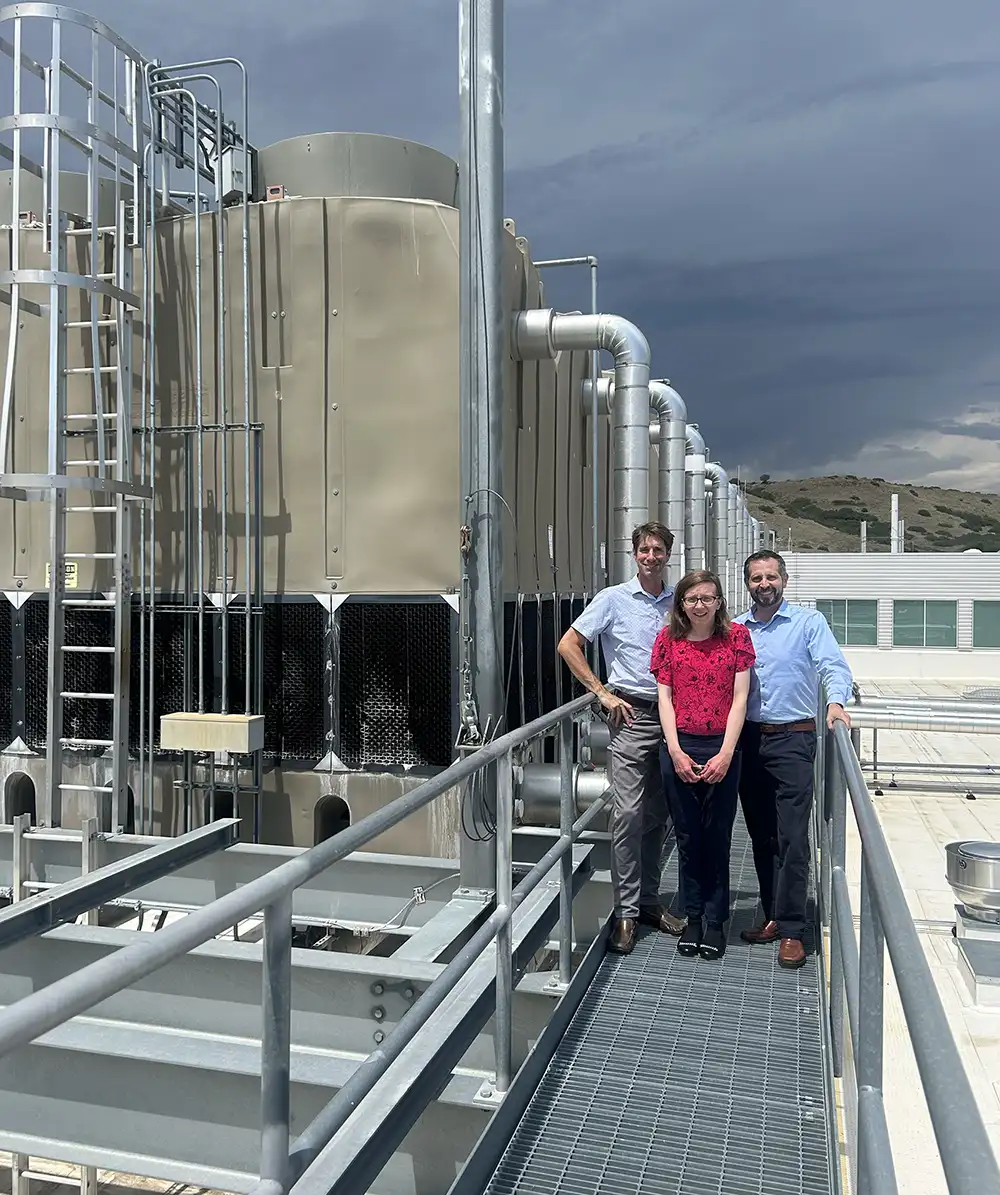
“Any time you drive down the road and you see a bunch of cooling towers pushing water vapor into the air, that’s a bunch of heat that’s just being rejected to the environment and could be reused,” he said.
But heat produced by machinery and industrial processes that might otherwise be lost as waste has actually been harnessed for hundreds of years. That heat can be distributed through a district energy system (DES), an interconnected network of insulated pipes that provides hot water, space heating, and/or chilled water to buildings within a district. DESes can include college campuses, hospitals, airports, cities, and businesses, all linked together to share energy.
“With DES, we can grab that energy,” Long said about the cooling tower vapor, “and use it to heat another building that needs it within the system.”
Using waste heat to manage building heating loads can save building owners up to $50 billion annually, according to the California Energy Commission. However, developers can be hesitant to invest in DES without transparent and robust analyses readily available.
That is where URBANopt™ comes in.
Developed by NLR researchers, including Long, in collaboration with Lawrence Berkeley National Laboratory (Berkeley Lab), industry, and university partners, URBANopt is an advanced analytics platform that integrates the U.S. Department of Energy's (DOE’s) open-source building energy modeling ecosystem, including OpenStudio® and EnergyPlus™, as well as the Modelica Buildings Library. With those data and models at its core, URBANopt allows users to simulate energy systems across buildings, focusing on one geographically cohesive area, such as a city block or district.
Funded by multiple projects from DOE’s Industrial Technologies Office (ITO), Office of Geothermal, and Building Technologies Office, NLR researchers and partners from Berkeley Lab, industry, and academia have incorporated DES workflows into URBANopt to make DES analysis more approachable. This could better enable district and city planners to evaluate developing new systems and expanding existing ones.
The ITO-funded URBANopt project specifically developed new URBANopt capabilities focused on waste heat reuse in DES. These additions allow researchers and practitioners to optimize the distribution of captured waste heat from various sources to reliably and cost-effectively meet energy demand.
Virtual Modeling for Real-World Savings
Compared to building-by-building approaches, district- and neighborhood-scale projects offer unique opportunities for city planners to save energy and costs, but they require extensive planning due to the complexity of systems that size.
“Our goal was to create high-resolution models in URBANopt that de-risk the real-world implementation of DES for the mechanical, electrical, and plumbing firms that actually develop and build these systems,” said Long, who led the ITO-funded URBANopt project.
URBANopt’s DES workflow includes a tool called the GeoJSON to Modelica Translator that enables the model to easily swap building loads, district systems, and network topologies, allowing users to quickly explore multiple configurations and scenarios.
That means project planners can identify opportunities and pathways for district-scale projects, such as integrating new building technologies, reducing utility bills for businesses and families, and updating aging infrastructure. This platform even estimates hourly heating and cooling loads, informing planners where overlapping loads could be redistributed among neighboring buildings.
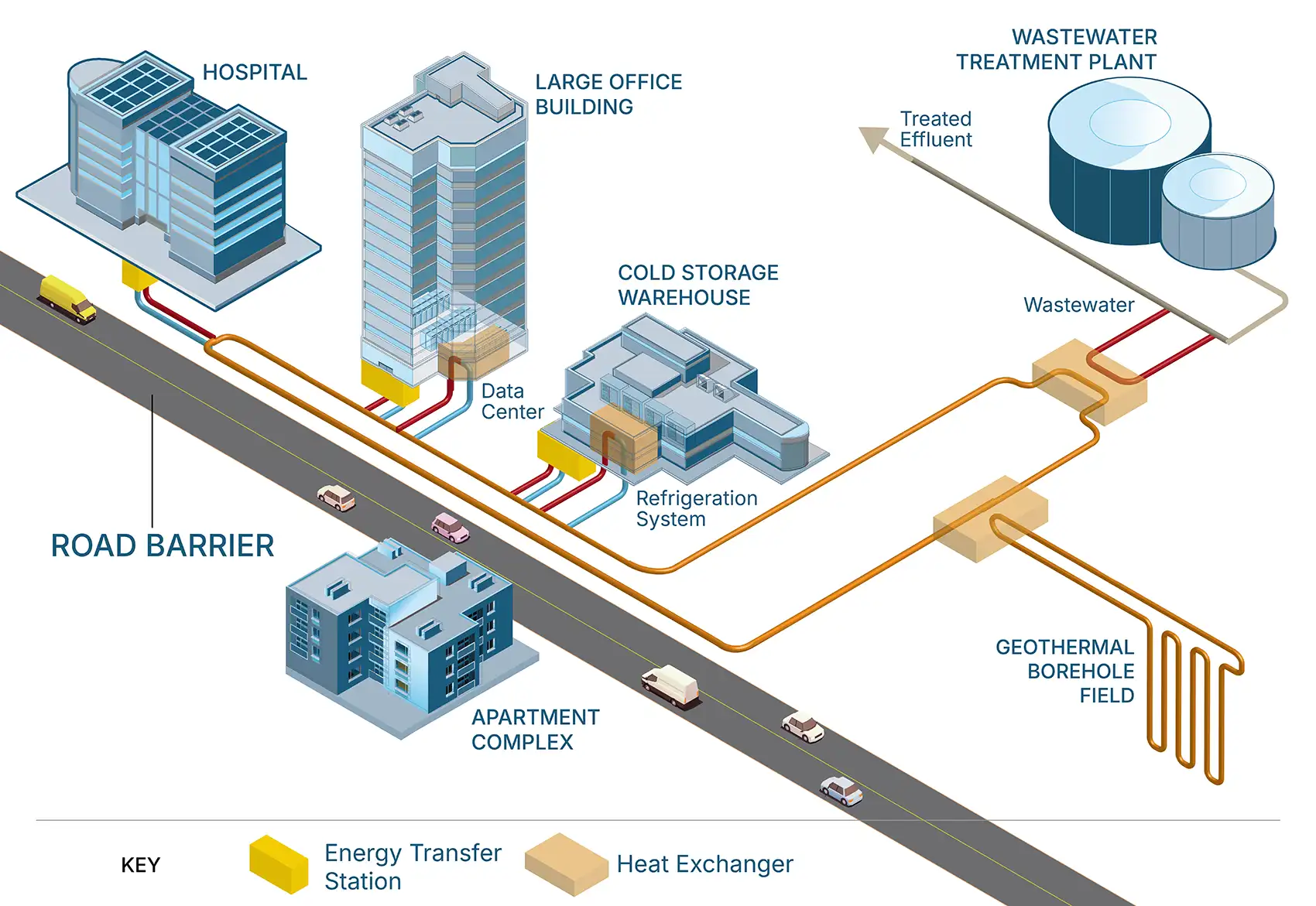
Communities have already used URBANopt’s DES to explore affordable system improvements. As part of another DOE-funded project, NLR researchers used URBANopt to develop a district energy model for Carbondale, Colorado, that allowed city planners to identify the appropriate size of the ground heat exchanger they wanted to install. Thanks to this detailed analysis, they learned that a hybrid integrated system would decrease the number of required boreholes, reducing the timeline and costs for developers while still providing the expected level of building comfort.
Decoding the Potential of District Energy Systems
Since the DOE-funded URBANopt DES efforts started in 2019, the team has completed 10 major releases of the URBANopt software development kit that companies can use to integrate URBANopt capabilities into other tools. This enables cross-sector energy master planning, allowing developers to add workflows like DES to their software. The addition of such workflows, in turn, allows developers to evaluate heating and cooling DES technologies in conjunction with buildings, potential local energy generation and storage systems, and the electric distribution grid.
The URBANopt team published their software advances in journal articles, conference papers, presentations, and software documentation to help build on the body of knowledge. In addition to providing resources for developers, published documentation helps support a domestic workforce that can run the models and help implement DES on a wider scale. In fact, some of the team who worked on URBANopt’s DES workflow as graduate students are now implementing it in their professional careers.
For instance, Jing Wang worked on URBANopt DES while obtaining her doctoral degree from the University of Colorado Boulder. Immediately after graduate school, she joined NLR as a research engineer and worked on several district-scale energy projects, including an Office of Geothermal-funded project in Carbondale, Colorado. Now a transient thermal simulation technologist at Jacobs Engineering Group, Wang plans to continue applying URBANopt DES for designing borefields, district heat pumps, and central piping systems.
“This tool is unique because it enables end-to-end design, modeling, and the dynamic simulation of district energy systems, especially those with geothermal resources,” Wang said. “Few tools can do that at the current stage.”
Through URBANopt’s analyses, district energy planners can see how to use DES to reduce demand on the grid and lower operational costs—before they start expensive and time-consuming development projects. With that kind of information, planners could pass savings on to building owners, customers of businesses in the system, and residents across the country.
To help support the use of URBANopt and ensure its benefits to planners and developers, NLR researchers will continue to improve the models and city-specific analyses, disseminate results to the DES community, and educate a budding workforce to model how to keep all that perfectly good energy from going to waste.
Learn more about NLR’s URBANopt tool and its capabilities.
Last Updated April 28, 2026