
From Willy Wonka to Cookie Monster: Meet 3 (of 7) West Gate Fellows and Their Technologies
Fellows Aim To Fix Plastics Recycling, Make It Safer and Cheaper To Produce Chlorine (and Energy), and Extract Critical Minerals from Mining Waste—With Some Help From NLR Experts

This article is part two of a two-part series featuring the laboratory’s seven newest West Gate fellows. Part two profiles three startup founders; read part one to meet four more.
What keeps a startup founder up at night? What is the story behind a company’s name (like “Rhea’s Factory,” “Rushnu,” or “Stalagmite”)? And why does one founder resonate with a Wallace and Gromit scene involving a villainous penguin and robotic trousers?
Here, three of the seven latest fellows to join the National Laboratory of the Rockies’ (NLR’s) West Gate program answer all those questions—and more. All seven have built technologies that could turn problems, like mining waste, into opportunities, like a boost in U.S. critical minerals supplies. And, through the West Gate program—one of four nodes in the U.S. Department of Energy Office of Technology Commercialization’s Lab-Embedded Entrepreneurship Program (LEEP)—they are working to test, refine, and ready their inventions for the real world.
The 2026 West Gate cohort will spend two years at NLR where they gain access to the laboratory’s expertise, facilities, and commercialization resources. Below, three of the four fellow share more about their technologies and how NLR’s experts and facilities could help them make the leap from promising prototype to commercial success.
Rhea’s Factory Morphs Hard-To-Recycle Plastics Into Virgin Materials (With No Added Costs)

West Gate Fellow: Arzu Sandikci, CEO and Co-Founder
What’s the story behind your company name?
“More than a story, it is the name of a Greek goddess,” Sandikci said. Rhea symbolizes rejuvenation, regeneration, and rebirth. Rhea’s Factory regenerates the Earth’s resources to bring them back into people’s everyday lives.
What problem are you trying to solve?
Today’s plastic recycling can only break down plastics that are not too tough, too contaminated with food waste, or too varied. Mechanical recycling also creates weaker materials each time. And chemical recycling requires significant energy and harsh conditions. In short, “today’s plastic recycling is fundamentally broken,” Sandikci said. She wants to fix it.
“The secret is in biology,” Sandikci said. Biological recycling relies on enzymes: teeny cellular chemists that make all life, including human life, possible. Although researchers have explored engineering enzymes to break down plastics, Rhea’s Factory is using machine learning to quickly explore new potential enzyme designs and find the best biological recyclers. Their goal is to return plastics to their original molecular building blocks—no matter their type or level of contamination—so they can be built into new, just-as-tough products again and again without high energy, temperatures, or even costs.
“Our technology can do recycling at cost parity with manufacturing virgin plastics,” Sandikci said. That means it would cost the same to convert old materials as it would be to dig up new ones.
Sandikci and her Rhea’s Factory colleagues, who include experts at NLR, have already found and engineered their first plastic-purifying enzyme. Now, they are building their first demonstration facility alongside a traditional recycling plant to put their enzyme to work on the plant’s rejects as well as other messy plastics waste. In an ideal world, Sandikci said, “our technology turns landfills back into original raw materials all the time.”
“This is how life can exist,” Sandikci said. “And that is what I’ve worked for throughout my career.”
What keeps you up at night?
Scale.
“It’s a first-of-a-kind technology,” Sandikci said. “Everything works, but we need to show it works at a scale that is commercially relevant.”
That is what she hopes to do during her two-year fellowship at NLR—while continuing to improve the technology. “We don’t want to stay at cost parity,” she said. Their goal is to make their process cheap enough that landfills cease to exist. And every material can find a new life.
If your technology were a fictional character, who or what would it be?
Cookie Monster, a friendly eater.
Rushnu Makes Chemicals and Energy On-Site at Wastewater, Steel, and Other Industrial Plants

West Gate Fellow: Roxanna Delima, CEO
What’s the story behind your company name?
“Rushnu” means harmony without sacrifice. The company hopes their harmonious chemical manufacturing improves human safety and reduces waste without sacrificing profits.
What problem are you trying to solve?
In 2005, a train transporting chlorine crashed in South Carolina, sending a chemical plume high into the air. “Chlorine is like mustard gas,” Delima said. The resulting disaster was expected to cost about $30 million. About 250 people underwent treatment for exposure to the toxic gas. Nine people died.
The United States cannot stop making chlorine. Industries need the chemical to treat our drinking water and make PVC pipes, refrigerants, pharmaceuticals, and more.
But, with Rushnu, Delima plans to make chlorine while also helping to prevent chemical disasters, reduce waste, and cut costs for industrial facilities, too. The company’s technology can turn a plant’s waste—the heat and gases they already produce every day—into energy and chemicals, like natural gas, chlorine and bleach, right on site.
“We can actually be more profitable than the current method for making chlorine,” Delima said. Their process uses a purified stream of natural gas from waste gas to generate energy, “meaning we effectively have free energy,” she added. And because the company can set up a modular chemical production shop at almost any industrial plant—and sell extra product to local businesses—they do not need to transport dangerous chlorine across state lines.
“You don’t have that risk anymore,” Delima said.
Already, Delima and the Rushnu team have partnered with a wastewater treatment facility in California to launch an 80-ton-per-year commercial demonstration project on their campus. But the company hopes to expand beyond wastewater and bleach to serve larger industrial plants that produce steel and also turn their chlorine into other products, like hydrochloric acid (used in mining) and PVC (used in building construction and beyond).
That is where NLR comes in.
“What West Gate will help us do is prove our technology for these different markets,” Delima said. “We can work at wastewater treatment facilities to start and show 1,000 tons per year at commercial scale.”
But, for the company to build chemical plants that are say, 50,000 tons per year, they need to expand into steel, mining, and PVC industries.
“If we can do that,” Delima said, “it would make domestic chemical production safer and cheaper. That’s a huge win.”
What keeps you up at night?
The Rushnu team is building a new, unconventional option for the chemical industry, which tends to prefer established, traditional processes.
“We are attempting to show that waste can produce profit, which not many have done before,” Delima said. “If we succeed, we will have created a new framework for large industries to adopt.”
If your technology were a fictional character, who or what would it be?
Willy Wonka. “We turn raw ingredients into valuable products that resemble a golden ticket for the chemical industry,” Delima said.
Stalagmite Transforms Mine Wastewater Into Valuable Critical Minerals
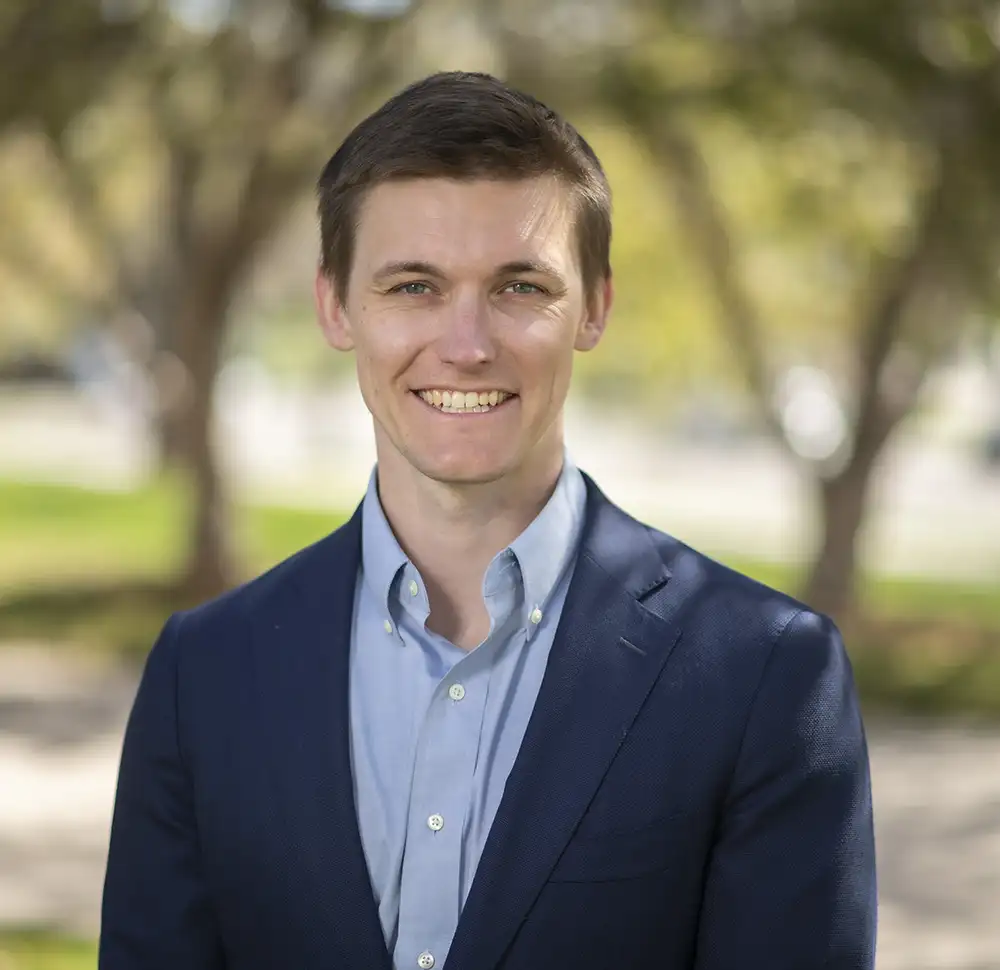
West Gate Fellow: Ryan Herz-Thyhsen, Director of Science and Engineering
What’s the story behind your company name?
The company is called Stalagmite, and its tagline is “From the ground up!” When water drips down onto a cave floor, minerals from that water are deposited and, over time, grow into a spire-like deposit called a stalagmite. Stalagmites “push up from the ground with all their MIGHT,” according to the National Park Service. Stalagmite, the startup, extracts critical minerals from water but at an industrial scale.
What problem are you trying to solve?
More than an eighth of the U.S. economy depends on critical minerals. And yet, more than 80% of the country’s critical minerals come from foreign sources, in part because the United States simply does not produce enough of what it consumes.
But Herz-Thyhsen and his startup, Stalagmite, are trying to change that. They built a new way to collect and separate hard-to-find critical minerals, like cobalt, manganese, nickel, and copper—and they do not need to do any digging either.
“There are many different industries with streams of wastewater containing critical minerals,” Herz-Thyhsen said. That wastewater is usually just discarded as waste. Industries, like mining, coal, and oil and gas, could extract those minerals, but traditionally it has been too expensive to do so.
Until now.
“Our fundamental approach is we’re going to save the industry money with our water treatment technology and also extract the critical minerals at the same time,” Herz-Thyhsen said.
The Stalagmite team is starting by treating polluted mine waters, often acid rock drainage, which mining companies have to treat anyway. Today’s mining wastewater treatment process is expensive and creates sludge that companies must also dispose of. But Stalagmite’s process reduces the amount of chemicals needed and volume of sludge created—all while recovering critical minerals.
Herz-Thyhsen said “NLR is the ideal national lab” to help the startup bridge the gap between recovering critical minerals from wastewater and refining them into a supply-chain-ready product. NLR experts will also help the company test prototypes and chart out the U.S. regulatory and supply chain landscapes.
In 10 years, Herz-Thyhsen said he’d like to see Stalagmite scale critical mineral extraction to all kinds of industrial wastewater.
“It’s definitely a major challenge,” he said, “but the partnerships we’re developing with regulators, industrial partners, and NLR are the exact ones we need.”
What keeps you up at night?
“We’re a startup, so depending on the week, there’s always a different challenge keeping me up at night,” Herz-Thyhsen said. But as with any early startup, picking which challenges to prioritize and when to prioritize is the key to success. “Being part of West Gate helps keep us pointed in the right direction.”
If your technology were a fictional character, who or what would it be?
Herz-Thyhsen said working at Stalagmite has been a bit like a scene from the 1993 Wallace and Gromit film, “The Wrong Trousers.” In the film, Wallace and Gromit are pursuing a penguin on a model train when the track runs out and Gromit races to lay down spare track so the train does not derail. At Stalagmite, Gus Marquez (Herz-Thyhsen's co-founder), is racing to construct the commercial and customer track “as fast as he can,” Herz-Thyhsen said, while he pushes toward their technical goals in the lab.
Learn more about the latest West Gate fellows in the first article in this series. Discover how the program has helped startup founders grow their businesses, launch new technologies, and turn entrepreneurial energy into real power for industry, communities, and more.
Last Updated April 28, 2026