
From Life Events to Travel Trends, DEMOS Tool Brings Demographic Realism to Transportation Modeling
New Tool From National Laboratory of the Rockies Draws on Long-Term Demographic Data To Simulate Population Evolution Over Time

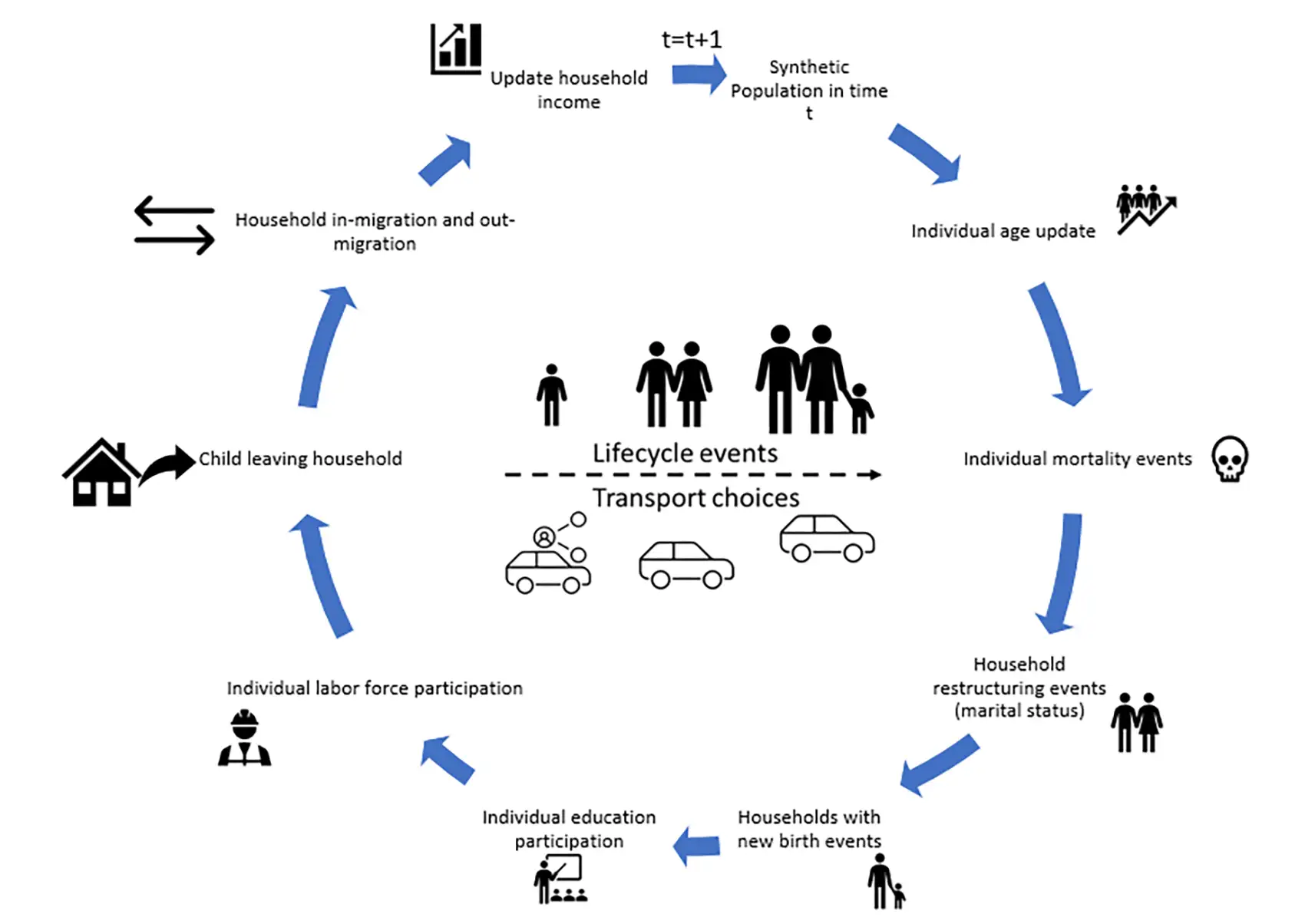
Many personal transportation-related decisions—such as vehicle purchases—are influenced by life events, like the birth of a child or a change in employment. Modeling tools that reflect how life trajectories evolve over time enable researchers and planners to more effectively assess how people might adopt new transportation technologies.
To address this need, researchers at the National Laboratory of the Rockies (NLR) developed DEMOS, a demographic microsimulator that fills a critical gap in transportation modeling by accounting for major life transitions that shape population dynamics and mobility patterns.
By generating realistic and dynamic demographic inputs, DEMOS enhances a broad spectrum of transportation modeling applications such as vehicle transaction modeling, travel demand analysis, infrastructure investment assessment, system operations optimization, mobility behavior analysis, and the assessment of emerging transportation technologies.
Leveraging data from the Panel Survey of Income Dynamics, one of the world’s longest-running longitudinal household studies, DEMOS simulates a wide range of life events at both the individual and household level, including marriage, divorce, childbirth, migration, educational attainment, employment status, and mortality.
“Longitudinal studies track the same households and their members over an extended period, collecting data at multiple points to observe changes in household characteristics, behaviors, and circumstances,” said Bingrong Sun, an NLR senior researcher and the lead developer of DEMOS. “By capturing these transitions, DEMOS enables transportation modeling to more accurately represent how people’s lives evolve—a key factor influencing travel choices across different life stages.”
The development and application of DEMOS are detailed in an article, “Demographic Microsimulator for Integrated Urban Systems: Adapting Panel Survey of Income Dynamics to Capture the Continuum of Life,” published in the Transportation Research Record: Journal of the Transportation Research Board.
Addressing Limitations of Traditional Models
Traditional agent-based models in transportation rely on synthetic population data to simulate travel decisions. However, most of these models are based on cross-sectional snapshots that offer only a static view of population characteristics. This approach overlooks the dynamic transitions people experience throughout life—events that affect how, when, and why they travel.
DEMOS addresses these limitations by incorporating a wider range of life-cycle events and accounting for factors such as age, gender, income, and household size to generate more behaviorally realistic life trajectories. Its outputs can be used in agent-based models similarly to synthetic population data but provide more detailed information than traditional cross-sectional methods.
“Most models assume population is fixed or reset at each step, but people’s lives don’t work that way,” Sun said. “Research shows that key life transitions and individual trajectories significantly influence travel behavior and decisions. By capturing a broader set of life events, DEMOS allows us to simulate population change in a way that reflects real-world dynamics and more effectively supports travel demand modeling and transportation planning.”
Case Study: San Francisco Bay Area
In a case study of the San Francisco Bay Area, NLR researchers applied DEMOS to simulate population changes using synthetic data over a nine-year period. DEMOS accurately replicated observed demographic trends at the aggregate level, including changes in household size and rates of birth and mortality.
This ability to reflect demographic change over time is critical for modeling dynamic processes such as residential mobility, vehicle ownership transitions, adoption of new transportation technologies, and shifts in daily travel patterns.
“By accounting for a full range of demographic events, DEMOS provides a more complete foundation for simulating how mobility behavior changes over time,” said Shivam Sharda, a senior computational research scientist at NLR and coauthor of the journal article. “Our study contributes to the growing field of demographic evolution modeling by demonstrating that using longitudinal data and multiple demographic variables leads to more behaviorally grounded modeling for transportation planning.”
Looking Ahead: The Broader Impact of DEMOS
By capturing the complexity of individual and household life transitions, DEMOS generates realistic population trajectories that move beyond static assumptions. This dynamic approach enables researchers to more accurately model long-term behavioral trends.
"DEMOS bridges the gap between demographic dynamics and transportation modeling by integrating life-cycle transitions into population dynamics," Sharda explained. "This gives planners a deeper understanding of how travel behavior evolves over time, helping them anticipate future mobility needs and simulate transportation planning scenarios with greater accuracy and realism."
Recently, NLR began collaborating with the Southern California Association of Governments (SCAG)—the largest metropolitan planning organization in the United States—to explore the integration of DEMOS into SCAG’s transportation planning processes.
A member of the SCAG team noted, “By using microsimulation to account for life-cycle events, DEMOS offers valuable insights for metropolitan planning organizations' long-term growth planning. Its ability to provide inherent consistency in the synthetic population across years would enhance the analytical capabilities of our activity-based model.”
NLR is also engaging with other metropolitan planning organizations to explore potential partnership opportunities.
DEMOS also has potential applications beyond transportation modeling, including technology adoption in other sectors (such as buildings and the grid) where demographic factors shape usage patterns. It can also support land use modeling informed by migration and household changes, as well as public health modeling that draws on evolving population dynamics.
Learn more about the National Laboratory of the Rockies’ data and tools and transportation and mobility research. And sign up for our transportation and mobility research newsletter to stay current on the latest news.
Last Updated April 28, 2026