
Entropy Facilitates Charge Separation, Even in One-Dimensional Semiconductors
New Study Challenges Existing Understanding by Revealing Entropy’s Role in One-Dimensional Systems

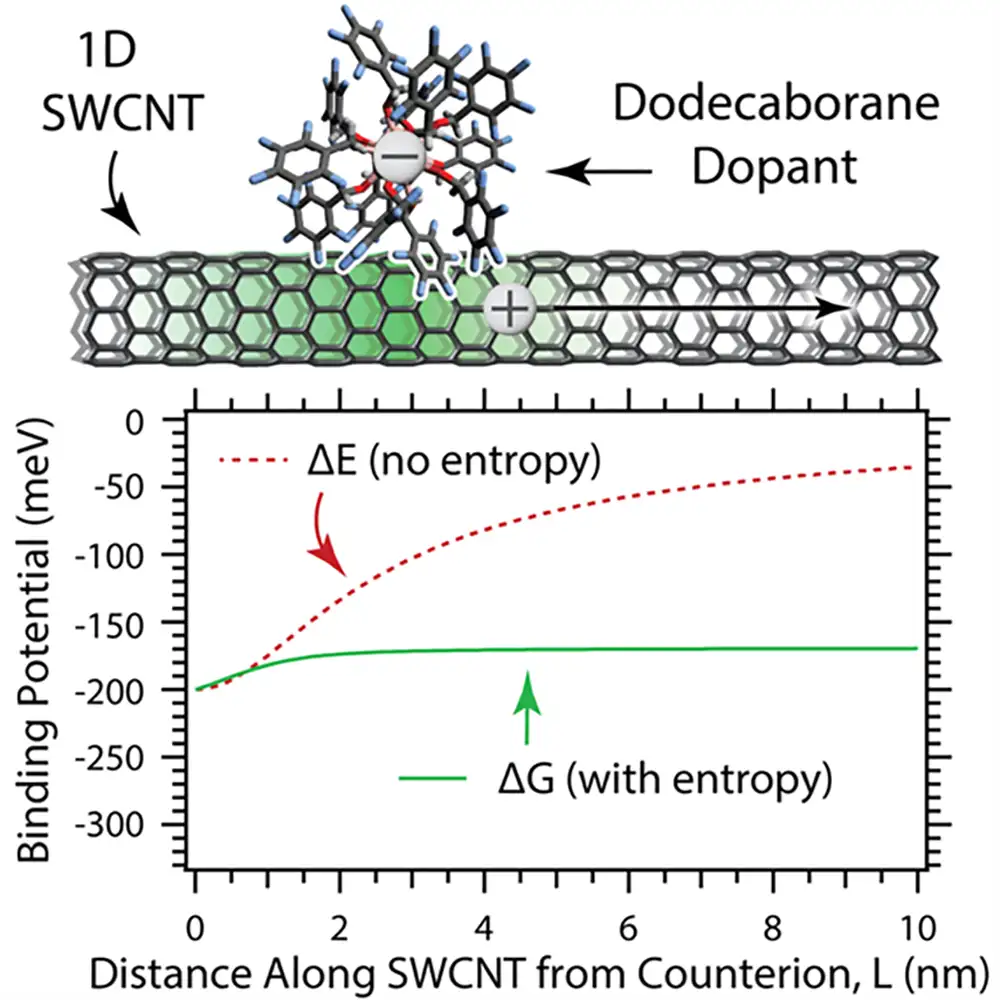
Entropy, the measure of how many ways a system can arrange itself, underpins the work of photoelectronic devices such as light-emitting diodes, transistors, and batteries. But the specific role entropy plays is often debated by scientists.
For organic electronic devices—made from polymers or small molecules instead of silicon—entropy can facilitate the separation of negatively charged photogenerated electrons and positively charged holes, allowing them to move effectively in opposite directions to prevent recombination. This produces electrical current. Although this is a key step for optimizing device efficiency, researchers have struggled to pinpoint entropy’s exact role in charge separation. Fifteen years ago, a seminal analysis suggested that while entropy could help this process in two- and three-dimensional (2D, 3D) materials, it played no significant role in one-dimensional (1D) materials. This has been the generally accepted understanding ever since.
Now, scientists at the National Laboratory of the Rockies (NLR)—joined by researchers from the University of Colorado Boulder, the University of California, Davis, and the University of California, Los Angeles—have found that entropy can indeed play a significant role in 1D systems.
The team published their findings in Advanced Materials in an article titled, “Revisiting the Role of Entropy for Charge Separation in 1D Pi-Conjugated Semiconductors.” Funding for this work was provided by the U.S. Department of Energy's Office of Science, Basic Energy Sciences Photochemistry and Radiation Chemistry Program, with additional funding from the Office of Science Bio-inspired Light-Escalated Chemistry (BioLEC) Energy Frontier Research Center.
“We started this study with organic photovoltaics in mind, although the conclusions apply to organic electronic devices of all kinds, such as organic light-emitting diodes and organic transistors,” said NLR’s Jeff Blackburn, a senior research fellow and materials scientist. “The types of devices that have enabled greater efficiency recently utilize several components and structures that are quite one-dimensional. Given that, we thought it was important to revisit the role of entropy in such systems to determine if it might influence why those efficient devices work so well.”
Differences Between 3D, 2D, and 1D Semiconductors
- Semiconductors can be produced with different dimensionalities. “Bulk,” or 3D, materials have no dimension that is much shorter than the others, in contrast with 2D and 1D materials that are “quantum-confined” in at least one dimension. Layered 2D materials such as graphene sheets are incredibly thin compared to their much greater length and width, and 1D nanowires like carbon nanotubes are confined in both width and height. This quantum confinement results in unique properties that make 1D semiconductors promising for next-generation technologies such as high-performance transistors and novel photonic devices.
Revisiting Entropy With an Updated Perspective
The team’s work shows that in real-world experiments, where materials exchange heat with their environment, a "constant-temperature" view of entropy is more appropriate than the "constant-energy" view used in the earlier study. Their new modeling reveals entropy can dramatically lower the effective energy barrier required to pull charges apart, even in 1D systems.
“We wanted to be sure we were really, truly right about this,” said Obadiah Reid, a physical chemist with NLR and the University of Colorado Boulder. “Previous calculations using the constant-energy picture of entropy seemed to give the wrong answer, and if we were going to correct that record, we needed multiple independent methods of calculation, along with experiments, to prove it to ourselves.”
Experiments Reveal New Insights for Charge Separation
To experimentally measure conductivity, the team used a model system of semiconducting single-walled carbon nanotubes (SWCNTs) that were precisely controlled by electronic doping, a technique used commonly to tune electrical conductivity in semiconductors. They employed a contactless microwave conductivity technique to measure charge separation under conditions in which the previous constant-energy calculations predicted no electrical conductivity would occur. Contrary to that prediction, the team found that positive charges were able to escape the attraction of nearby electrons, despite the large predicted “pull” of the electron-hole attraction.
To measure the effect, the team needed to be able to measure the conductivity when very few charges are present. Justin Earley, the lead graduate student on the study, performed computer modeling to optimize the design of the microwave spectroscopy system.
“Justin’s modeling gave us an enormous boost in sensitivity,” said Andrew Ferguson, NLR Spectroscopy and Photoscience group manager. “This was critical to identifying mobile charges at low dopant concentrations and allowed us to experimentally describe the role of entropy in the carrier generation process.”
Findings Can Inform Device Design
Another key finding from the study relates to the size and shape of the molecules used to dope the SWCNTs. The team found that bulky round dopant molecules produced greater conductivity, while more compact, planar dopants resulted in negligible conductivity at low carrier densities. The bulky dopants increase the distance between the electron and the hole, which lowers their initial attraction and allows the entropy gain to help the charges separate.
“These results identify practical design rules where larger dopants can maximize the entropic advantage of higher free-carrier yield and greater conductivity and may help to explain enhanced performance in organic electronic devices employing 1D materials,” Reid said. “This fundamental understanding will ultimately allow us to control charge carriers and optimize performance when designing 1D semiconductors for future innovative technologies.”
Learn more about basic energy sciences at NLR and about the U.S. Department of Energy's Office of Science Basic Energy Sciences program. Read “Revisiting the Role of Entropy for Charge Separation in 1D Pi-Conjugated Semiconductors,” in Advanced Materials.
Last Updated April 28, 2026