
Could a New Kind of Air Conditioner Help Cool Buildings While Cutting Energy and Costs?
How a Startup Joined Forces With NLR To Change How Companies Keep Their Businesses Cool

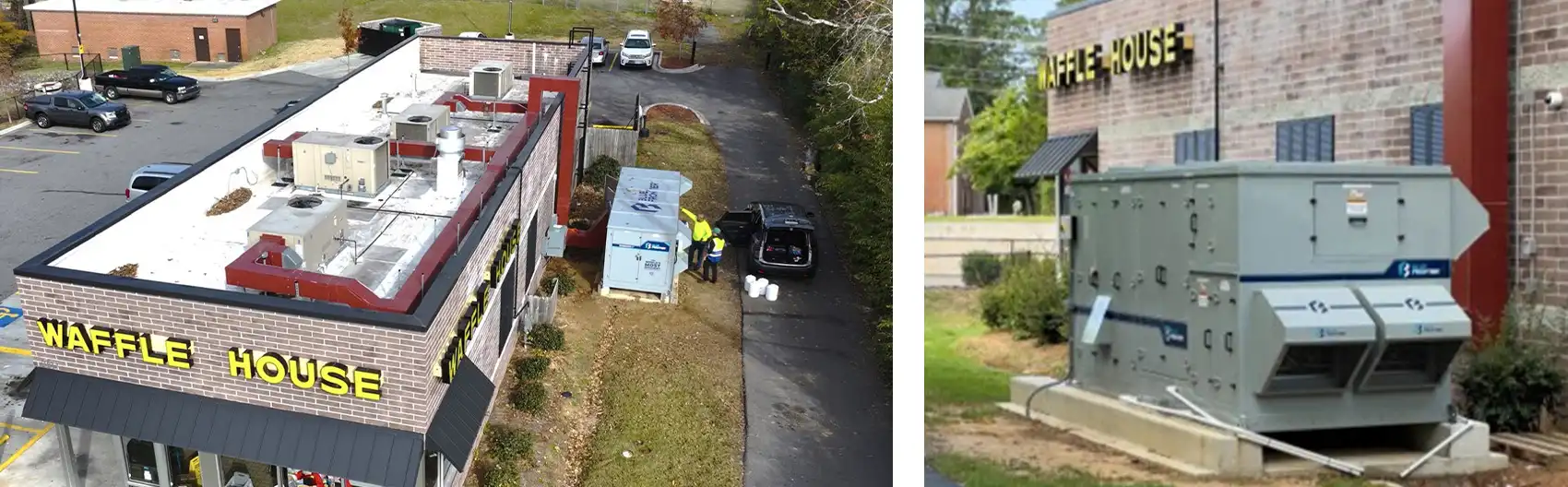
In July 2025, a team of technicians walked into a Waffle House in Macon, Georgia. That month, peak temperatures hovered around 92 degrees Fahrenheit. In the restaurant’s kitchen, where cooks fried patty melts, hash browns, and waffles on an oil-slick grill, temperatures could feel just as hot, if not hotter.
The cooks kept sizzling while the technicians installed a machine out back and turned it on. Within minutes, the cooks came out. “What did you do?” they asked. “This is the first time we’re not sweating in the middle of summer.”
That Macon Waffle House test was the first real-world pilot for a new kind of air conditioning system co-invented by researchers at the National Laboratory of the Rockies (NLR) and the startup Blue Frontier—a project made possible with support from the laboratory’s Innovation Incubator (IN2) program.
Blue Frontier’s air conditioning system can run on far less electricity and cools and dehumidifies independently, which makes it quicker and less energy-intensive to convert hot, sticky air into comfortable cool. The invention can even store energy, so it can power itself during the hottest summer afternoons—even sweaty July days in Georgia—to avoid high energy prices and help prevent grid overloads and blackouts.
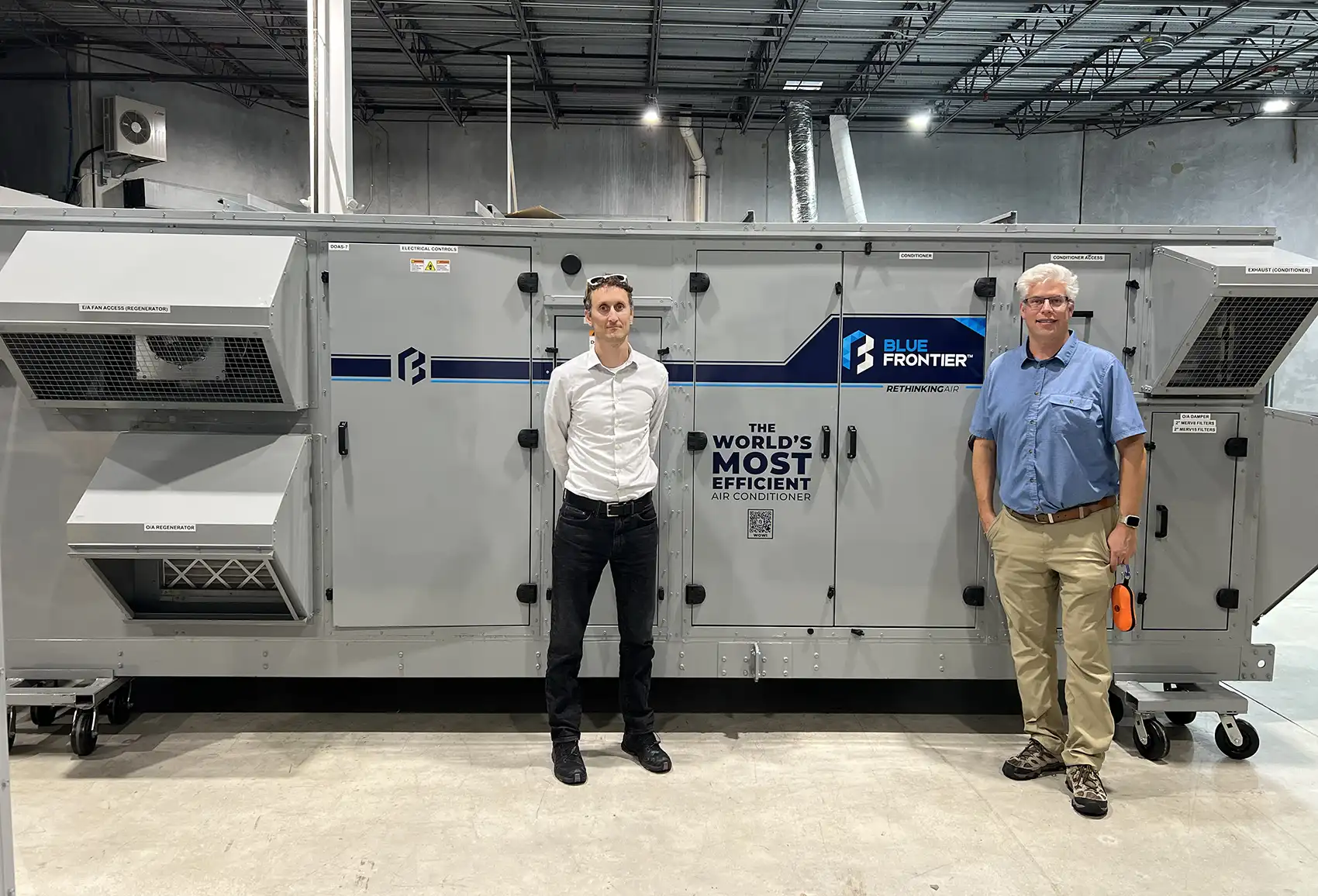
“It’s a complete rethinking of how we condition air,” said Eric Kozubal, a senior engineer at the NLR and one of the system’s co-inventors.
That IN2-backed pilot was successful, both physically for those hot cooks and statistically: The system consumed 40% less energy than the building’s previous air conditioner and cut operating costs by 65%, in part due to an 89% reduction in power use during peak grid hours when electricity costs are highest.
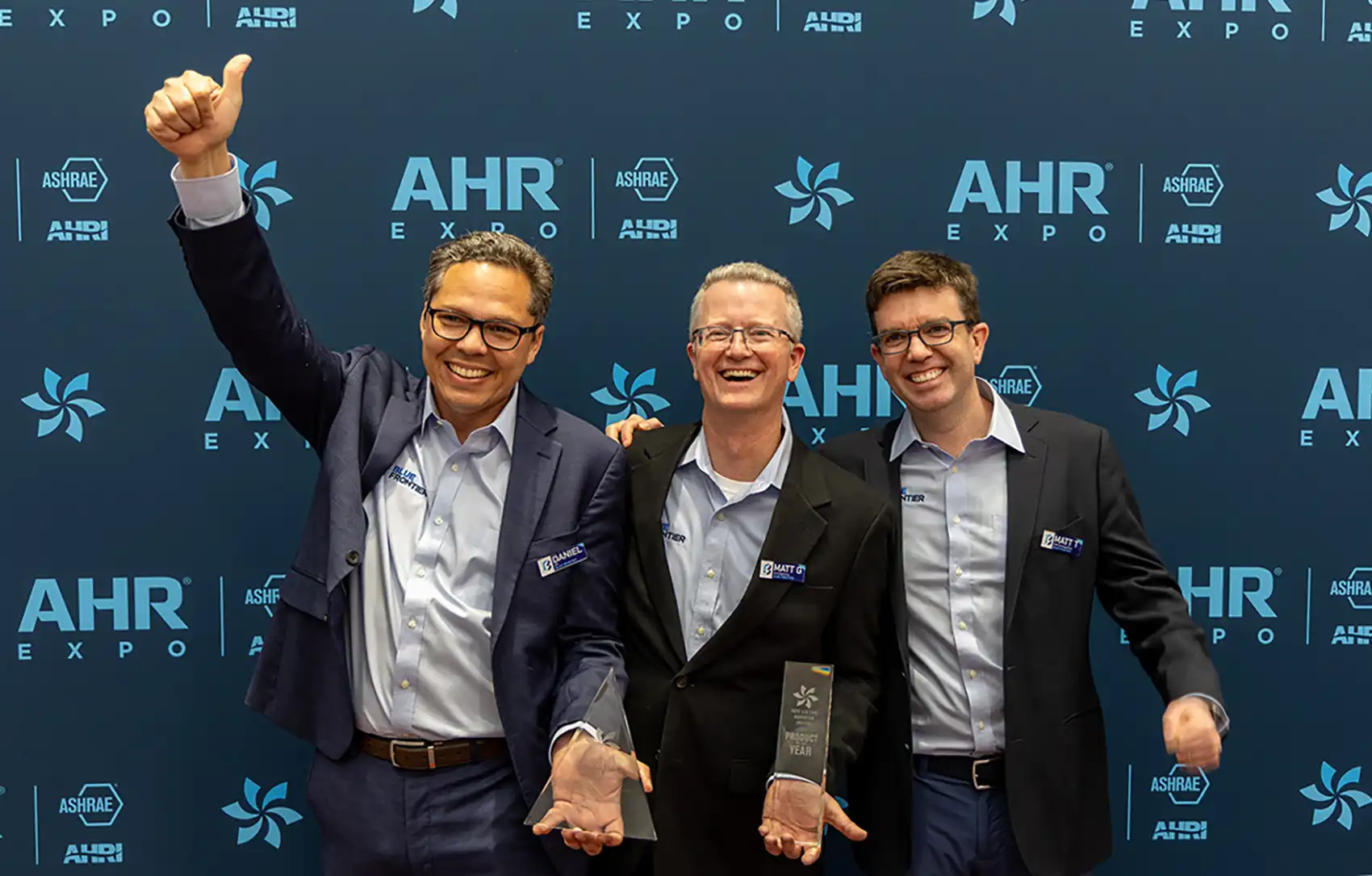
“We talk a lot about machines and energy,” said Daniel Betts, the CEO and founder of Blue Frontier. “But society is made of people. And we are influencing that directly, you know, making people’s lives better.”
The Air Conditioning Tsunami
When Betts was studying to become an engineer, he realized energy was the machine behind all the machines. “It’s super necessary for everything that we are. It’s civilizationally critical,” he said. And soon, he discovered that one specific machine consumes a huge portion of the energy produced globally: air conditioners.
Air-conditioning can be like a tsunami: A trigger, like spiking afternoon heat, creates a wave of energy demand that can overwhelm power grids. That flood is temporary but maddening. A grid can only support the demand of its highest peak, and air-conditioning is that peak more often than not.
When Betts visited NLR to give a talk, air-conditioning came up yet again. “If there was a way to add efficiency and energy storage into the air-conditioning load,” Betts told the crowd, then both energy and costs would plummet. Later that day, in a lab across campus, he met two NLR researchers who created something that could potentially do exactly that.
“Wow,” Betts remembers thinking, “here are the wizards that have figured out the solution to the entire thing.”
A Salty Solution
Those “wizards” were Eric Kozubal and Jason Woods, two senior engineers at NLR who co-invented a technology called the Energy Storing and Efficient Air Conditioner (or ESEAC).
More than half of the energy consumed by air conditioners goes to dehumidifying air. Conventional systems often overcool a room just to achieve a comfortable humidity level and must then heat it back up to the desired temperature.
But Blue Frontier and NLR’s ESEAC system uses a salt-based liquid to pull moisture from the air—just like table salt absorbs water, infamously clumping on humid days. The heat from that now-dry air is then pulled into an adjoining heat exchanger, a device that can move heat energy from one medium to another. There, the air is chilled using evaporative cooling. Just like sweat evaporating from skin helps cool our bodies, evaporating water reduces the air’s temperature to a comfortable level. When the salt solution becomes too diluted to absorb any more water vapor, the system uses heat to evaporate some of the water and reconcentrate the salty liquid.
This salt-and-water system needs little electricity—just enough to power a fan and small pumps—and also consumes less energy as temperatures rise.
The technology was young, but Betts was “mesmerized by the potential,” he said. A couple years later, he licensed it to create an air conditioner that ran on the heat from a fuel cell. He launched his first startup, Be Power Tech Inc. Four years later, he shut it down.
“That’s a really good idea. I stand by it,” Betts said. “But it requires two new technologies to play together, fuel cells and the NLR air-conditioning tech.”
Double new can mean double the risk, and risk can make investors nervous.
“It broke my heart, but a good entrepreneur is a glutton for pain,” Betts said. “And I’m driven by the potential for innovation and the responsibility associated with knowledge and capabilities that we carry, right? We’re here to leave the world a little bit better.”
The wizards would agree.
Army Bases, Movie Theaters, and a Thousand Sales Engineers
Betts went back to Kozubal and Woods at NLR. Together, they found a way to turn the original invention into an air conditioner that could power up when power is cheapest (or most convenient).
Betts licensed the technology again, and Blue Frontier was born.
Thanks to an add-on invention created by the NLR experts (something called an Electrically Driven Desiccant Regenerator), the new system could ditch the need for heat generated by a fuel cell and, instead, use the hot side of the refrigeration cycle to reconcentrate the technology’s core salt solution. That reconcentration can happen at any time, enabling companies to recharge at night or during other periods of low electricity demand when prices are low.
“That new invention transformed the air conditioner into one that consumes 90% less electricity at peak, and 50% less year-round,” Kozubal said. “It can be recharged like a battery, consuming electricity when it’s cheap.”
The journey from new invention to market success still had bumps.
“But this is again where NLR has been extraordinary,” Betts said. “We found out how to jujitsu the physics into doing the things that we wanted to do.”
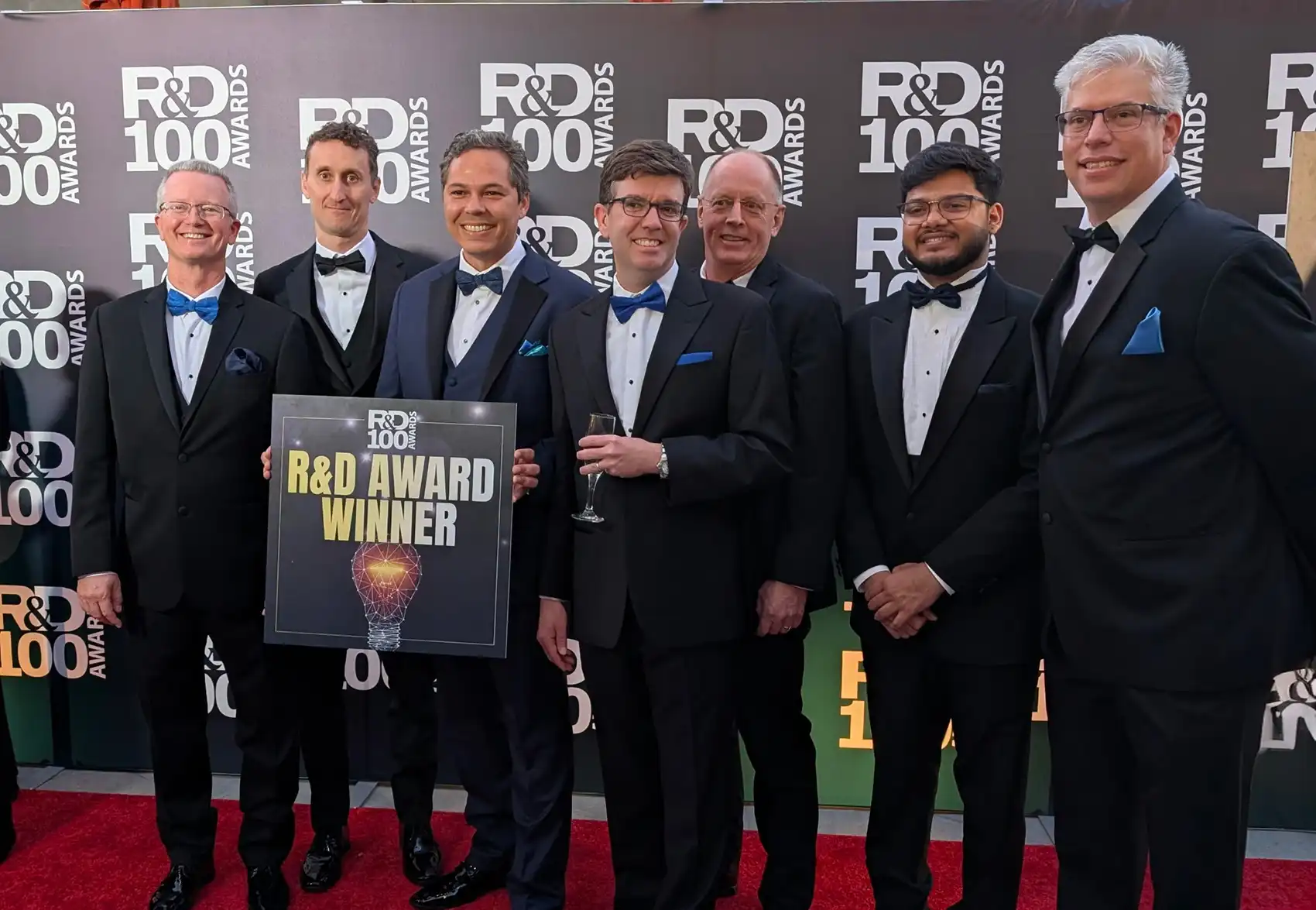
NLR’s experts and their “engineering rigor,” as Betts said, helped confirm the idea could work. The laboratory’s backing boosted investor confidence. Grants rolled in. It was time to turn their prototype into a product.
The leap to product is exciting, but it comes with new questions, like: How much would it cost to manufacture this? Can we turn a profit? “If you don’t have that, you’re not a real business,” Betts said. “And the IN2 program allowed us to define that and raise capital.”
Investors backed Blue Frontier, which gave the company enough of a backbone to build. Now, they have installed their air conditioners in a U.S. Army base in Georgia and an Air Reserve Base in Massachusetts, an IMAX theater at the Museum of Discovery and Science in Florida, plus educational campuses, healthcare centers, restaurants, and grocery stores. As of 2025, they have a network of more than 1,000 sales engineers operating across the United States.
“Blue Frontier’s success is a win for the company, our laboratory, and partnerships between industry and our national laboratories,” said Achilles Karagiozis, the Building and Industrial Energy Innovation Center director at NLR.
“But, more importantly,” he continued, “it’s a win to give Americans a way to reduce their energy costs without having to compromise on comfort.”
Last Updated April 28, 2026