
Can Surge Wave Tech Survive the Open Ocean?
When a University of Washington Marine Energy Researcher Posed the Question, the National Laboratory of the Rockies Created Space To Explore the Possibilities

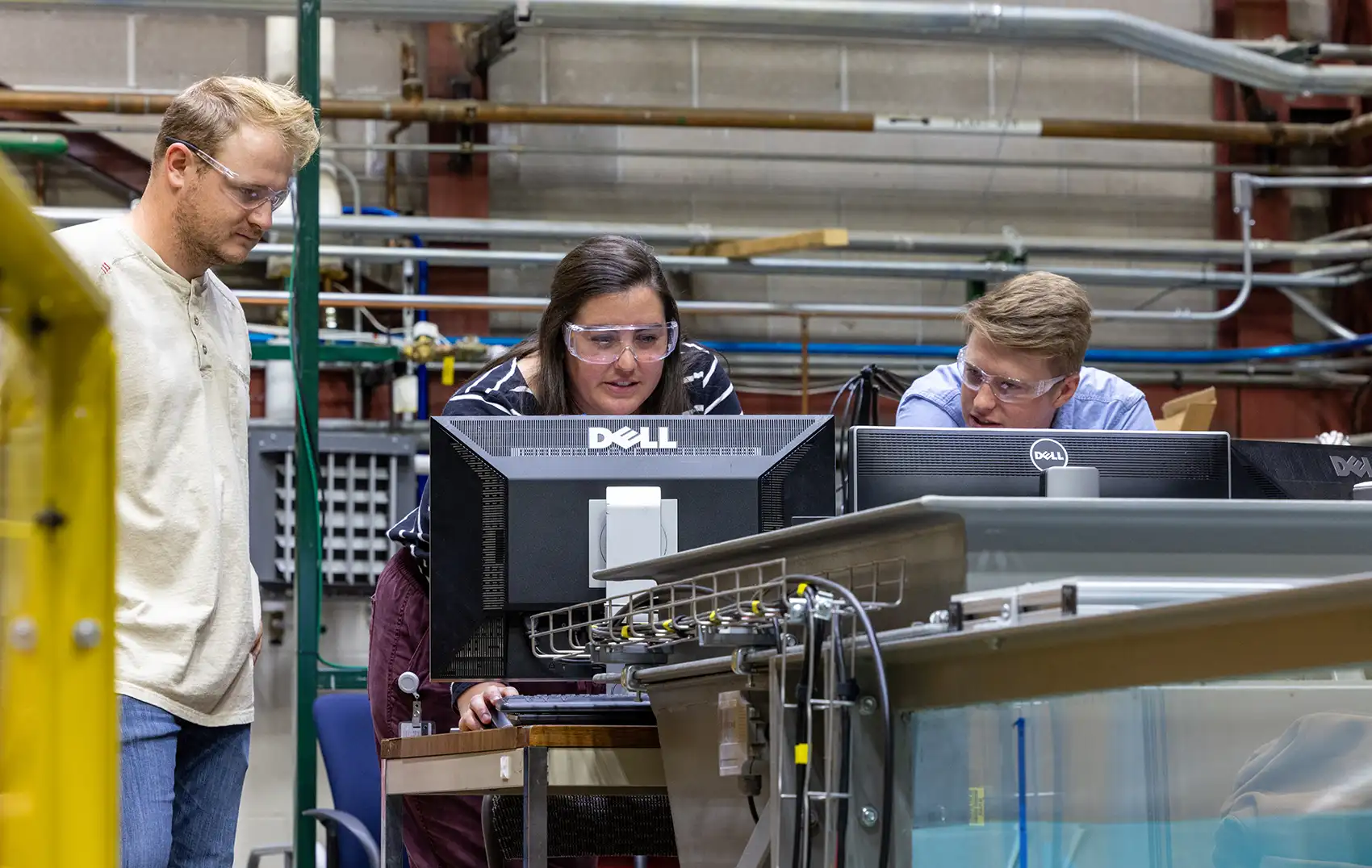
This article is the first in a series highlighting NLR facilities and capabilities accessible through the TEAMER program.
For a West Coast kid who fears ocean waves, marine energy would seem like an odd path to pursue—and the mountains a strange place to start. But Brittany Lydon did both.
“I grew up like an hour from Seattle, so I love the water. I love the Sound. I love the lakes,” she said. “And I'm actually very, very scared of ocean waves. I find them so terrifying.”
Yet, when she first encountered marine energy as a floundering University of Washington (UW) undergrad, she was hooked.
“I was in civil and environmental engineering, and they had us do a seminar where [people from] all the subsections of civil give a talk to help you learn more about each field,” she said. “And I hated all of them.”
Until one person gave a presentation on marine energy.
It was a pivotal event that set her on the path toward a career in the emerging field. And that path eventually led to the Sea Wave Environmental Lab (SWEL) at the National Laboratory of the Rockies (NLR).
Sometimes It Takes a Team
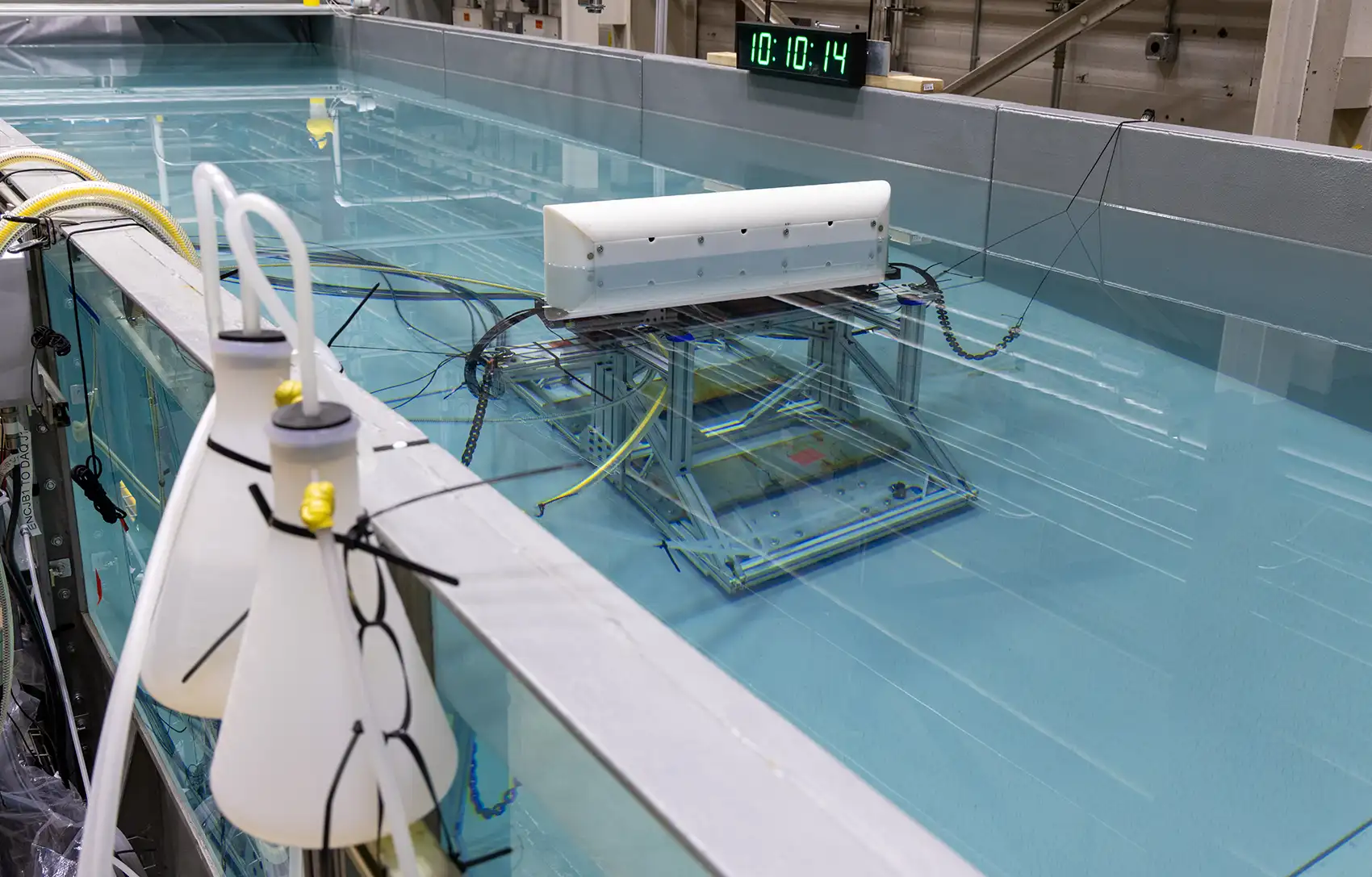
Lydon’s senior capstone project focused on marine energy, and she later returned to UW to pursue her Ph.D. with a focus on oscillating surge wave energy converters (OSWECs). OSWECs feature a flap that moves like a pendulum in response to wave surges, converting the horizontal movement of the water to electrical energy.
“This type of WEC requires that the waves are traveling perpendicular to the flap face, which you can only consistently rely on near shore, where all of the waves are coming in one direction,” Lydon explained.
The unique flap architecture of OSWECs makes them particularly effective in near-shore marine energy applications, where wave surges are strongest. Lydon’s UW research team wanted to investigate whether OSWECs could be deployed in the open ocean. TEAMER provided access to NLR’s SWEL wave tank, creating an opportunity for the researchers to better understand OSWEC dynamics without incurring the high costs of testing their device at sea.
Lydon and her team wanted to investigate whether OSWECs could be deployed in the open ocean. But short of testing their UW-developed device at sea, a cost-prohibitive prospect, they would need a wave tank much larger than UW’s to accommodate the scope of their research.
Fortuitously, Lydon had an in at NLR as an Oak Ridge Institute for Science and Education research fellow. And securing a Testing Expertise and Access for Marine Energy Research (TEAMER) award from the U.S. Department of Energy’s (DOE’s) Hydropower and Hydrokinetic Office gave her team broad access to NLR’s SWEL wave tank.
TEAMER provided the funding, facilities, and expert technical assistance the UW team needed to investigate big questions—and the flexibility to ask the right ones.
Big SWEL Brings Fresh Insight
“We have a wave tank at UW, but it’s so narrow that we couldn't get clean data. So, we looked to NLR’s, which is about three times as wide as ours,” Lydon said.
Their first round of experiments was aimed at modeling how the movement of water affects the behavior of OSWECs equipped with two different types of flaps—round and square. The resulting data provided the hydrodynamic coefficients needed to characterize device behavior, including added inertia, radiation damping, and excitation—three factors that are influenced by the frequency of waves and the design of the flap.
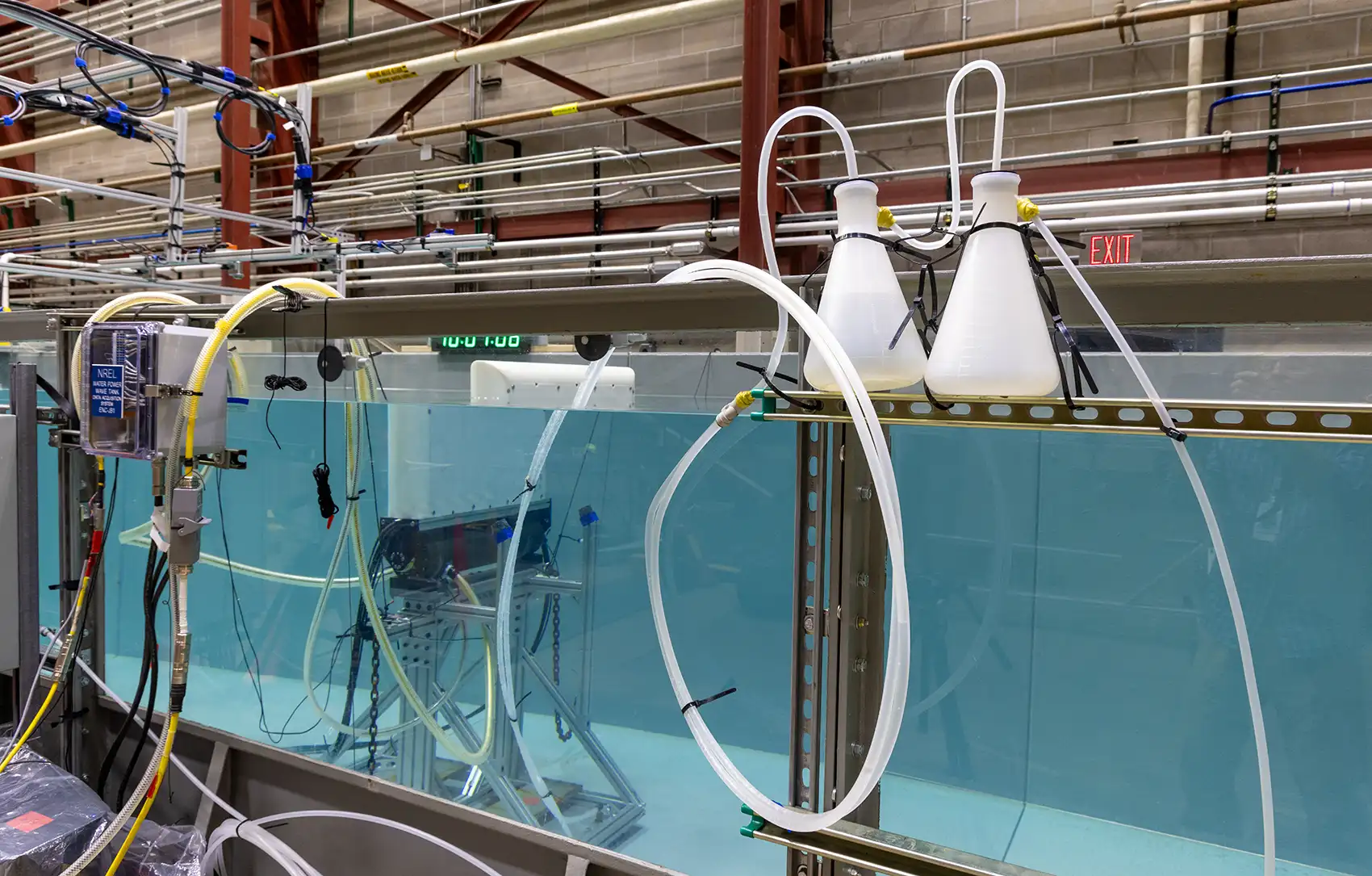
“Having these hydrodynamic parameters allows you to create a simple, linearized model of the device to help predict its behavior without having to test each and every type of wave you’re interested in,” Lydon said.
One way to get these coefficients without testing them experimentally is with boundary element method (BEM) software. BEM focuses on the boundary—the surface of the device and the water around it—which makes the calculations much faster.
“However, these techniques are not always accurate, particularly for energetic seas,” Lydon said. “In addition, many OSWEC systems use simple linear damping control schemes that may not fully optimize their behavior, especially in irregular waves.”
While there have been studies that expand the type of control applied to WECs in efforts to optimize performance, a literature review by the UW team revealed that most focus on heaving point absorbers, and even fewer involve experimental testing.
“These issues leave a significant research gap [when it comes to] understanding the fundamentals of OSWEC dynamics and how best to control the system to optimize power absorption and minimize loading,” Lydon said.
Being able to run their experiments in a wave tank the size of NLR’s was important as they worked to fill those gaps. “Not being nearly as limited by confinement as in our facility allowed us to run more frequencies, more amplitudes, more types of tests,” Lydon said. It also created an opportunity to investigate how physical testing compares to a BEM simulation.
“Not being nearly as limited by confinement as in our facility allowed us to run more frequencies, more amplitudes, more types of tests.” —UW Marine Energy Researcher Brittany Lydon
“There is still some confinement [in the SWEL wave tank], but we were able to get some really good results,” Lydon said, noting that BEM can also factor in confinement. “We were able to compare [the wave tank test results] to [BEM simulation] to see if that is accurate. And we found in certain cases it was and in others it wasn’t. That was a pretty interesting find that we weren't expecting going into the project.”
The opportunity to enhance data validity was just one advantage TEAMER afforded the UW team. Another was the technical assistance from NLR marine energy experts like project lead Rebecca Fao and lead engineer Charles Candon, who were instrumental in helping the team shift gears when the tests yielded results they hadn’t anticipated.
“That flexibility allowed us to pivot in real time to some pretty interesting results and findings,” Lydon said. “Without that, I think we would have come out with a much less rich dataset.”
A Glitch Leads to a Pivot
At the outset of their project, the UW team intended to experimentally test data-driven model predictive control (MPC) schemes for a lab-scale OSWEC in an effort to optimize flap performance. But after examining the results of their initial testing, they worked with Fao and Candon to craft an instructive workaround.
“This testing campaign was the most robust testing we have done on this device,” Lydon said. “And we found little quirks, like this driveline is really sticky and there's a lot of friction there. Or we don't really have a lot of buoyancy in our flap, and now it's drifting.”
Those were some of the experimental artifacts the team observed in their initial testing, and instead of staying on course, they said, “Well, let's address these first.”
That pivot led to “some cool results” that are detailed in a forthcoming journal article.
By the end of the six-month TEAMER project, the UW team’s multifaceted testing campaign yielded three main categories of findings.
The first is how their experimentally calculated hydrodynamic coefficients compare to BEM. “We're hoping to expand on that in an even more unconfined space and come back to it,” Lydon said. The second is how confinement exacerbated some of the quirks of their OSWEC. The third is how the team addressed experimental artifacts in real time using control strategies rather than adjusting the hardware.
All of these findings are detailed in journal articles the UW team is developing or preparing to submit.
A Career Born of Fear Takes Off
Many of the results obtained through the TEAMER testing at NLR also informed Lydon’s dissertation. It was one more milestone on the circuitous path that led to her current position as a postdoctoral researcher in marine energy.
“It was very, very kismet,” said Lydon, who now works at the UW Applied Physics Laboratory conducting research in ocean engineering, ocean sensing, and WECs alongside the very presenter who first sparked her fascination with marine energy.
“It's so humbling. Every facet of this field, from the theory to the design of these devices to building and testing them,” Lydon said. “There's so much that goes into it. It’s so interdisciplinary. You're constantly humbled. But when something goes right, it's huge.”
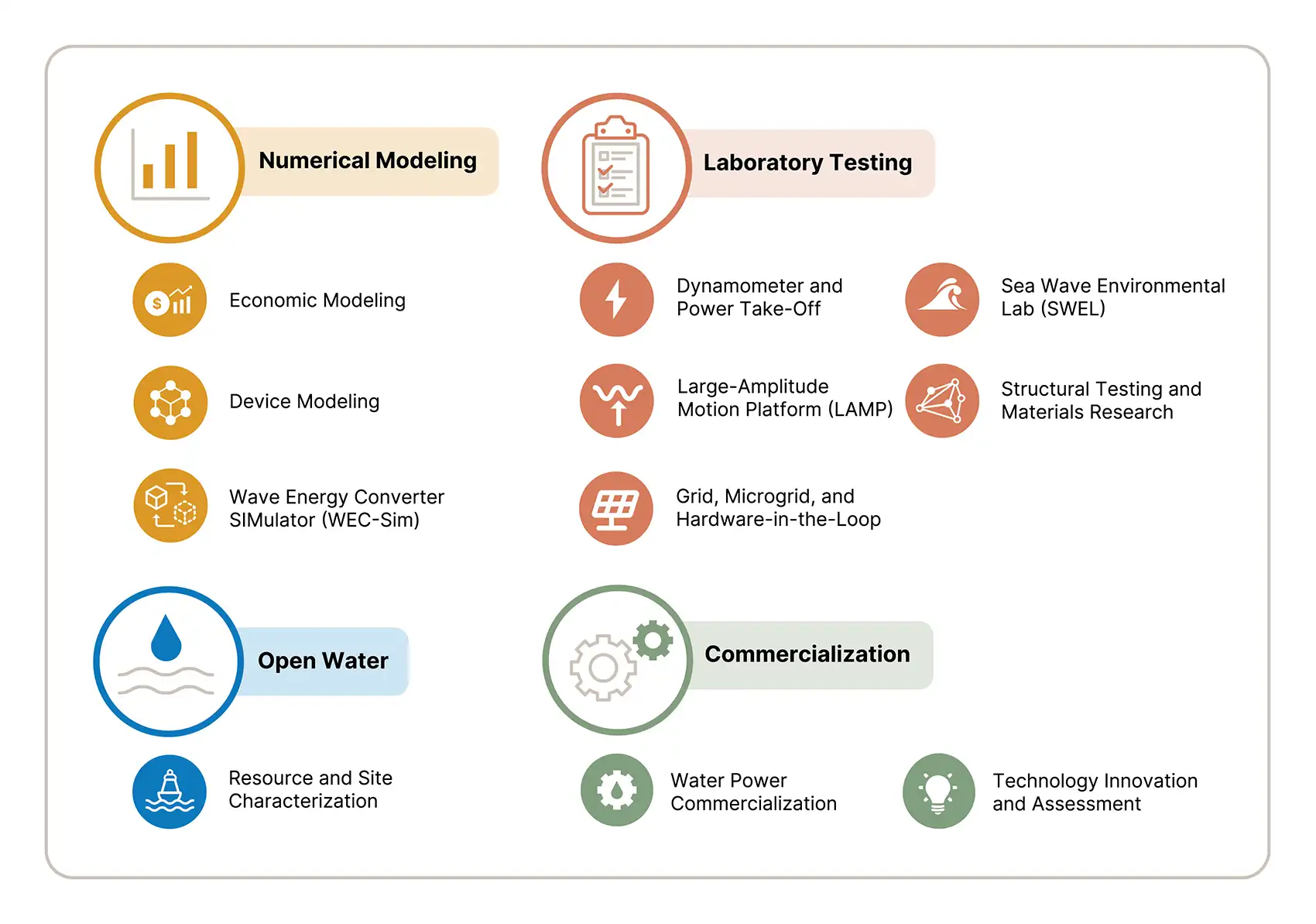
SWEL is one of several NLR TEAMER facilities available to support marine energy technology development. Partner with us to access world-class testing capabilities.
Last Updated April 28, 2026