
Beyond Small Talk: Can Chatbots Tackle Big Energy Problems?
Adaptive Computing Software Package Can Help Scale Up Laboratory Experiments to a Wide Array of Real-World Applications

When you ask a large language model chatbot a question, it can respond within seconds or minutes with human-like insight. But how can those insights be turned into actionable energy decisions?
The adaptive computing software team at the National Laboratory of the Rockies (NLR) is building tools to enable large language models to solve complex research questions across energy applications.
NLR’s adaptive computing software originated as part of the Laboratory Directed Research and Development program. Researchers were tasked with developing a tool that could support extending single-use laboratory systems and methods into scalable solutions for real-world problems. The resulting software efficiently manages the use of diverse and possibly remote and/or expensive data sources for decision support across a spectrum of energy challenges.
“We identified that there was a need across the lab to fuse together understanding of our currently available models, data, and resources and build an overarching framework,” said Marc Day, principal investigator for the adaptive computing software. “The adaptive computing software is a common interface that connects the user to scalable and efficient tools to answer their question, often questions that involve complicated experiments and large, high-performance computing platforms.”
This flexible software can help save researchers time by accelerating the experimentation decision-making process. The software not only will calculate and select the best experiment for the researchers to run first but will also connect to high-performance computing resources to actually run the experiment and get an answer. It does not stop with just one experiment: It can run a series of experiments and connect the dots between them. In addition, it can adapt to the new experiment results and choose the next best approach, while remaining mindful of the total resources available for the job. The software also balances computational needs, running expensive, high-fidelity models only when needed in the presence of stochasticity (randomness) or uncertainty.
“This is the kind of tool you need for much of our technology,” Day said. “If you step back far enough, our research has the same basic requirements. So, we exploited that commonality to come up with this interface.”
To ensure the adaptive computing software was truly flexible to answer a variety of complex questions, researchers developed concrete applications of the software on a range of energy applications explored at NLR, including the discovery and synthesis of new materials for energy technologies and building control management. These demonstrations illustrated the breadth of the software’s capabilities—and this generality has helped identify its potential utility for a national artificial intelligence (AI) initiative.
Supporting the Grid While Prioritizing Occupant Comfort
Everyone who owns a thermostat likely has their own opinion about the “perfect” temperature for that thermostat. Residents may select a perfect temperature that makes them feel the most comfortable. Utility and grid operators might choose differently—unnecessarily high energy use from air conditioning on a particularly hot day could stress the grid and lead to outages.
NLR researchers put the adaptive computing software to work to balance these conflicting priorities, helping to manage power usage on the grid while prioritizing occupant comfort. Using adaptive computing as the brain behind a buildings controller—a building automation system that monitors and manages electrical equipment for a connected community of buildings—researchers demonstrated its use in simulating and controlling a large number of structures.
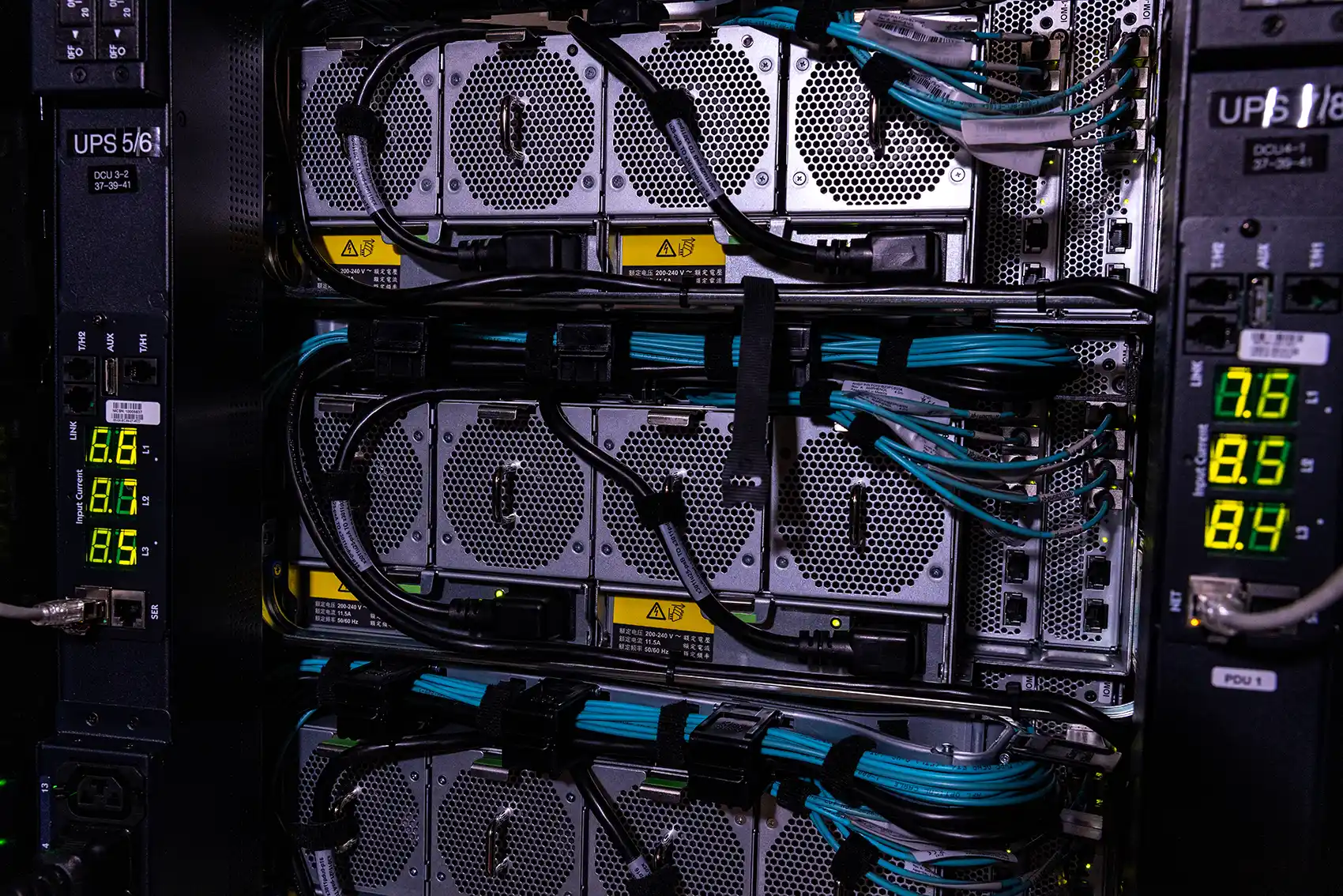
With the power of NLR’s Kestrel supercomputer, the team simulated more than 150 buildings in a community and 15 grid aggregators, which are entities that coordinate the use of distributed energy resources in a power system. The experiment aimed to achieve three main objectives: avoiding system voltage fluctuations that could cause blackouts, providing grid aggregator power tracking to support grid stability and reliability, and managing safe and comfortable temperatures for residents.
“We found we were able to manage these competing objectives effectively,” said Ryan King, an NLR researcher. “We developed a new distributed controls framework that could work with lower fidelity or data-driven models for each of the buildings and spin up high-fidelity simulations of individual buildings if needed to reduce uncertainty.”
Using this new distributed controls framework, the team eliminated almost 90% of voltage violations for grid operators while preserving occupant comfort through methods such as precooling or preheating a house based on the weather forecast, combined with a detailed representation of the building’s construction and thermal properties.
“As we added more and more buildings to the simulation, we found that we did a better job of having good outcomes for the grid,” King said. “With previous simulation methods, we wouldn’t have been able to manage the computing costs of controlling enough buildings to discover the grid benefits that emerge when managing large-scale housing communities. With this approach, we can invest just the right amount of computing resources for accurate, data-driven models at each house.”
Researchers Embed Collaboration and Time Efficiency Into National Initiatives
The adaptive computing software could be a key player in NLR’s contributions to the U.S. Department of Energy’s (DOE’s) Genesis Mission initiative—an ambitious project to combine the expertise of 17 national laboratories into an AI-driven platform to accelerate research and discovery.
The integration of the software with NLR’s Hybrid Environment Research and Operations (HERO) allows for AI-controlled experiments and simulations to be run remotely across distributed sources of data. Genesis Mission might use this capability to connect the various laboratories’ supercomputers and experimental facilities.
“In simulation coupling, you may run one simulation on a DOE machine across the country. But the second simulation might not be able to run on that type of computer, so it might be running on Kestrel here in Colorado,” NLR researcher Kevin Griffin said. “You also need the computers to be able to talk to each other. Adaptive computing can do this multisimulation, multicomputer work and provide optimization capabilities to make these computing decisions efficiently.”
Griffin supports an AI model team under Genesis Mission that is working to integrate adaptive computing into the design of combustion systems and develop a foundation model—a large-scale AI model trained on an enormous amount of data. Utilizing a foundation model for combustion technology design could dramatically accelerate discovery science and design of these technologies.
Currently, you need highly specialized programming knowledge to write code that can make effective use of adaptive computing software. Under Genesis Mission, researchers are exploring how to connect adaptive computing to an easy interface in which simulations across multiple computers can be set up, executed, and interpreted with a question via chat to an AI agent that can write the code for you.
“Even if you are able to write the code needed for the software, it is time-consuming and you inevitably code bugs into it,” Griffin said. “We’re aiming to not only get the tools in the hands of people who might not have the required software engineering background but save time for people who have that background.”
Unlock Adaptive Computing for Energy Applications
NLR’s adaptive computing software has the flexibility to work across a variety of scientific domains, saving researchers time and even enhancing research outcomes.
“We set out to make this software technology agnostic—and that almost never works. But we’ve been able to apply this to a number of new problems,” Day said. “It really gets easier every time as we simplify the interface and adapt to asking the right questions.”
Learn more about adaptive computing software and how to license it for research on NLR’s Computational Science Center webpage.
Last Updated April 28, 2026