
Athena’s Aeroportal Is User-Friendly Platform for Solving Complex Airport Challenges
Simple Web Interface Breaks Down How To Optimize Technology Solutions


Tickets? Check. Hotel? Check. Rental car? Check. Now multiply that by millions. U.S. airports saw more than 3 million passengers every day in 2024, and the number of air travelers has only followed an upward trajectory in the last quarter-century.
Airports are identifying how to meet these growing demands on key energy infrastructure while maintaining operating costs at manageable levels. Some are seeking ways to stay competitive, reduce fuel and operating costs, and keep up with regional consumer demand. To maintain smooth and reliable operations, they are also considering on-site energy generation facilities.
Putting these pieces together into a cohesive, tailored, and cost-effective system without unnecessary waste and expense means making sure it is sized and structured correctly from the start. But no airport needs to tackle this challenge alone.
Through the Aeroportal web platform, researchers with the U.S. Department of Energy’s Athena Project—led by the National Laboratory of the Rockies (NLR)—are helping airports plan for future energy demands more confidently by providing advanced modeling and artificial intelligence (AI) tools that can be customized for their specific needs.
The Aeroportal is home to several computational models, built using U.S. Department of Transportation Bureau of Transportation Statistics data from more than 300 airports and NLR’s high-performance computing facilities Kestrel and Swift, to help any airport in the country accurately plan to optimize integrated advanced technologies. The platform helps airports confirm their energy infrastructure plans can meet their goals by mapping out equipment adoption, charging infrastructure, utility cost impacts, and more. Early adopters of the Aeroportal tools include Dallas Fort Worth International Airport (DFW) and Phoenix Sky Harbor International Airport.
“We developed the Aeroportal to put these powerful tools directly in the hands of our airport partners while eliminating technical barriers to usability,” said Caleb Phillips, senior NLR computational sciences researcher and the Athena Project’s founder. “This helps airports take the plans they’ve already made and develop a clear path to actionable, research-driven outcomes at a time when investment in infrastructure needs informed planning decisions.”
Models for All Aspects of Airport Mobility
In fall 2025, the Athena research team debuted publicly available general model results for airport staff to plan out support for rental cars, ground support equipment (eGSE), and vehicles driven for transportation network companies (TNCs) like Lyft and Uber. Users can model these solutions and cost-optimal on-site energy storage options for each using NLR’s Enabling Distributed Generation Energy Storage Model. The team is developing models for employee and visitor parking and advanced aircraft, as well.
Recently released, an agentic AI assistant named Amelia can execute models for rental car centers, ground-support equipment, and TNCs. Amelia walks users through expected metrics, comparing scenarios, interpreting results, and providing recommendations.
Airport representatives can sign up for an account on the Aeroportal to access general model results that they can compare to their own use cases to approximate energy use and electric load of their planned infrastructure. Existing and new authenticated Athena stakeholder airports will also have the ability to execute tailored scenarios using their own specific airport operations data using NLR’s high-performance computing facilities via the Aeroportal.
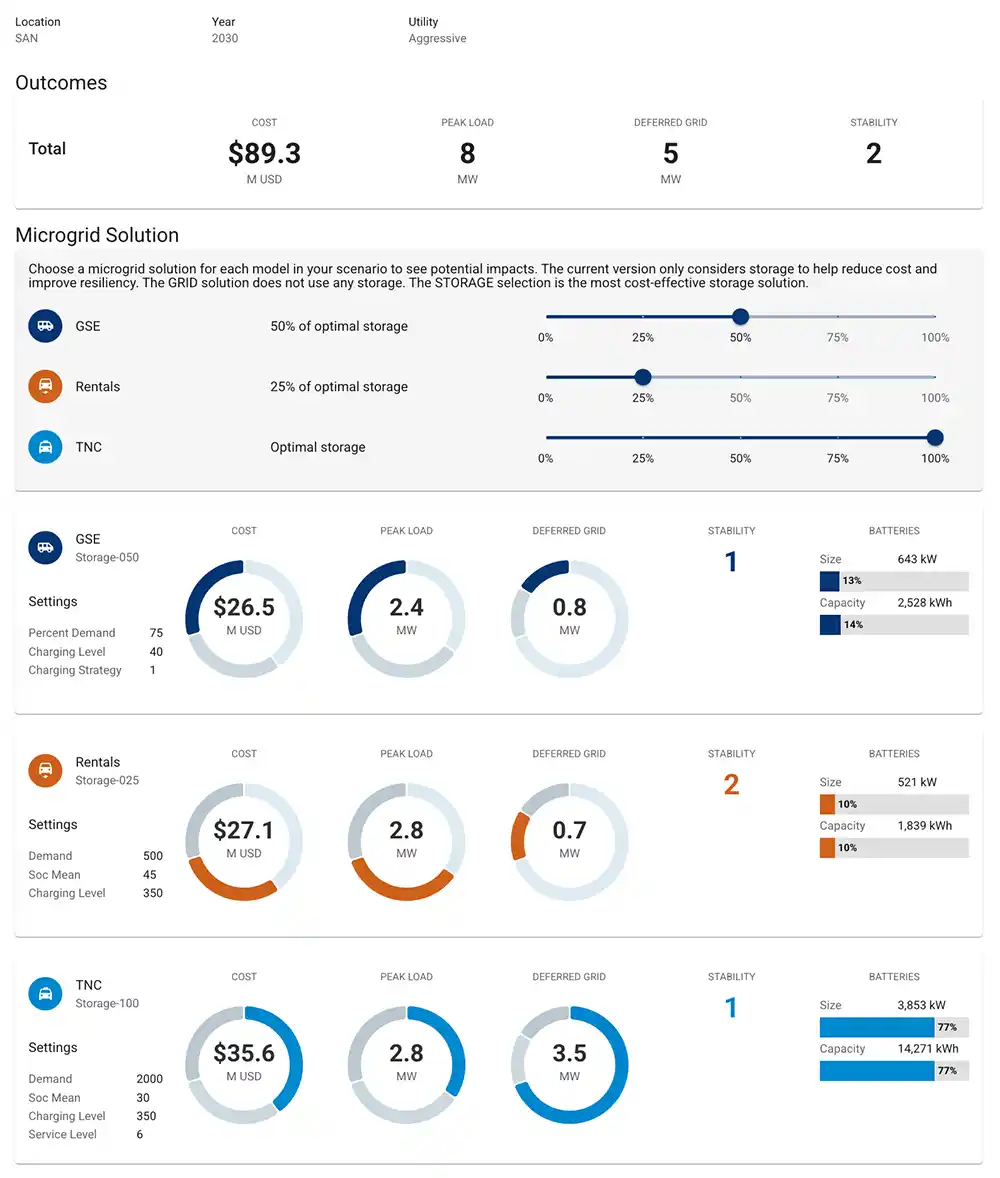
“Airports may not have access to compute clusters, or teams of data scientists and transportation engineers, yet can leverage NLR’s expertise and hefty supercomputer capabilities to get high-quality results directly and easily using the Aeroportal’s interactive dashboards,” said NLR’s Monte Lunacek, a senior computational scientist and Athena’s lead researcher.
The Aeroportal’s models are not just theoretical. A recent NLR technical report provides a peek into how Athena uses NLR’s charging-system equipment and capabilities to emulate large-scale systems with the laboratory’s Advanced Research on Integrated Energy Systems research platform to validate its models. And the research team is actively working with the project’s stakeholders, including a network of 16 U.S. airports of all sizes, to improve and adapt these models so they are user-friendly and relevant to other airports across the nation.
The TNC and rental car models were informed by close engagement with Uber and rental car companies, respectively, to understand their business models and operational patterns. Meanwhile, Salt Lake City International Airport, which has replaced close to 100% of its traditional ground support equipment with eGSE, consulted with NLR’s Athena team to help validate the eGSE model against their own system’s charging schedule and fleet composition.
“Demand at airports is growing, and transportation and energy infrastructure are under increasing pressure,” Lunacek said. “The Athena team is excited for the potential to apply our expertise and tools to the task of maintaining a robust air travel infrastructure across the nation.”
The Athena Project: Reducing Churn and Speeding Up Decision-Making

Bringing together DFW and 13 other major airports across the country, transportation and technology companies, and university researchers, the NLR-led Athena Project focuses on identifying integrated and scalable solutions for transportation hubs to lower costs, de-risk investments, and maintain grid reliability.
A managed approach to adding new grid-connected equipment to airport fleets can help airports avoid excessive energy costs and the need for additional utility infrastructure. To inform their planning, airports need an accurate understanding of how much and what kind of additional generation, storage, and charging infrastructure they may need to manage their operations’ required energy needs and grid capacity. The complexity of factors quickly adds up, with airport size, passenger transportation options and preferences, utility rate structures, and local environmental conditions all playing a role. Athena provides airports with tools that account for all of these aspects while streamlining planning efforts.
Athena research has generated results helping airports like DFW understand the benefits and drawbacks of strategies including optimizing shuttle services and installing highly tailored energy generation and storage equipment, as detailed in an IEEE conference paper. These analyses and DFW’s operations data are some of many that inform the models now in the Aeroportal.
Athena also offers custom solutions for interested airports, including AI integration for operations, a “digital twin” model to simulate the impacts of future capacity expansion scenarios, and shuttle route optimization support.
Learn more about Athena and access all of the Aeroportal’s capabilities at aeroportal.nlr.gov. Find information about related NLR transportation and mobility research and sign up for NLR’s transportation and mobility research newsletter to stay current on the latest news.
Last Updated April 28, 2026