
As Local Power Grows, Utilities Reorganize for Resilience
The Grid-Within-Grids Concept Goes Live


A powerline is a lifeline. If a remote community is cut off, so goes its gas pumps, the airport control towers, the communication networks. Its people are on their own.
Such is the risk when transmission lines bring the only power into a community, with the generators of that power located far away. But locally sited generation is growing, and it has the possibility to change the risk of outages for thousands of remote communities across the United States.
Now, an operational solution by the National Laboratory of the Rockies (NLR) is available that leverages local resources for adaptive grid recovery and response. The solution, named REORG, has completed field testing in a community that had its own brush with a wildfire, and that has sought energy resilience ever since.
The Switch From Centralized to Cellular
As flames climbed the ridge above Basalt, Colorado, during peak tourism season in 2018, the CEO and president of Holy Cross Energy Bryan Hannegan’s mind raced: If that fire reaches the single transmission line a stone’s throw away, tens of thousands of people will be trapped, powerless in the high mountain valley.
By the grace of rain and the grit of firefighters, the Lake Christine fire was stifled before it reached the power line. But it came close enough that the member-owned electric cooperative Holy Cross Energy set out on an alternative strategy for its dispersed service area. They asked, what was the vulnerability? Single, centralized sources of power. What could fix it? Distributed, local power sources. That discovery led to a project with NLR, and ultimately, the creation of REORG.
REORG shifts the architecture of the grid. When centralized control and power flow are compromised, REORG lets lower-level controllers decide operations. Self-sufficient “cells”—say, a neighborhood—become their own microgrids, use their own generation and storage, and stay powered until the grid safely reorganizes back to normal. REORG automates and validates the electrical stability at each step.
“The demand for a solution like REORG is expanding as utilities add a greater amount of distributed and localized resources to their power systems. Particularly in rural and remote systems, where restoration can be delayed by geography and distance, REORG reduces the vulnerability that communities often face in severe weather,” said Fei Ding, the principal investigator of REORG and group manager at NLR.
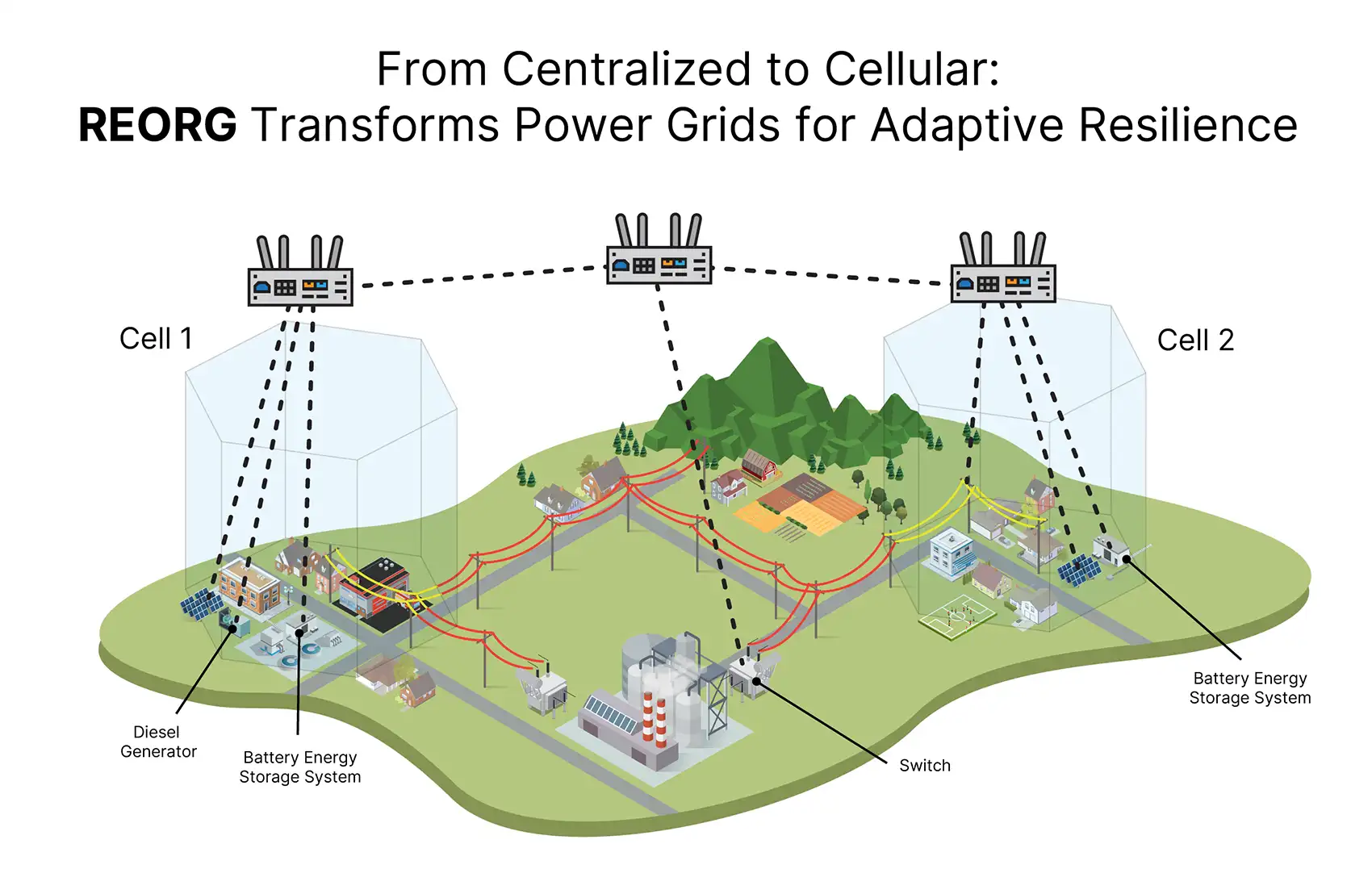
If You Have It, Use It: Resilience From Local Resources
It stands to reason that during a blackout, if you have a generator and battery nearby, you might as well use them. But that logic is less simple in a power system with thousands of people, where utilities must worry about stabilizing electricity during reconnections, and prioritizing loads. That is when automation and digital coordination come into play, which is the purpose of REORG.
Among several parallel efforts to increase resilience, longtime partner Holy Cross Energy has been promoting distributed energy growth, adding critical microgrids, and updating its switchgear. These set the groundwork for a solution like REORG, which the cooperative has also demonstrated recently.

On a slow Friday when many employees work from home, Holy Cross Energy engineers and NLR ran a live REORG experiment at the cooperative’s headquarters. They “spontaneously” separated the utility’s campus power from the main line that sources electricity from many miles away.
Once the power cut off, REORG took over. Running from the utility campus’s server room, which has its own uninterruptible power supply, REORG issued an instruction to switch on the site’s diesel generator. REORG calculated remaining fuel time and prioritized the all-important supervisory control and data acquisition (SCADA) room to stay powered.
REORG recovered power according to plans.
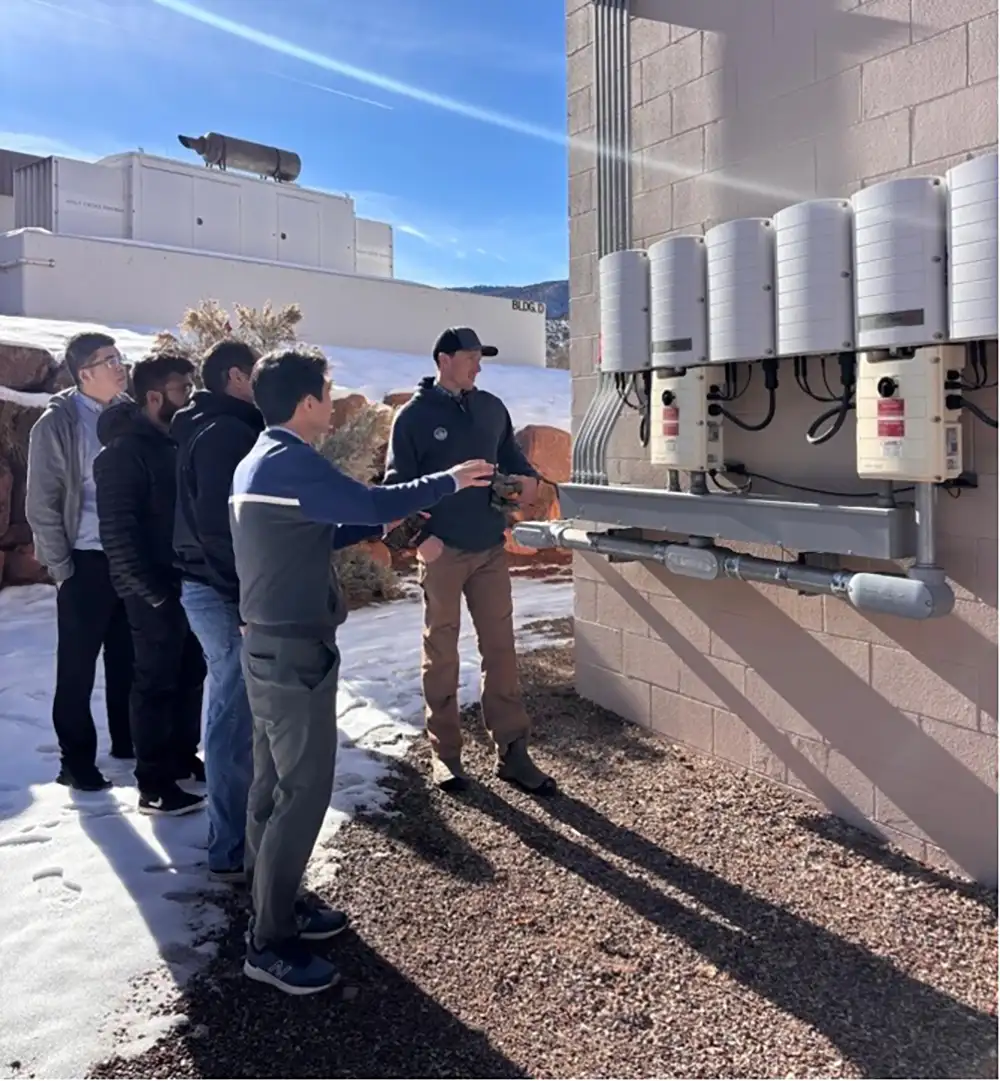
“We had already proven in the lab that REORG can autonomously recover a distribution system following an outage, but we needed a real-system validation for utilities to feel confident in this solution,” Ding said. “We found that REORG worked as expected. For utilities to run with this, it all comes down to having the hardware in place.”
Like the 900-plus other U.S. rural electric cooperatives, Holy Cross Energy is assessing what it has—a growing fleet of local energy assets—and what it needs: resilience for a widely dispersed service area. REORG may be a much different approach to operating the distribution grid, but it may be exactly what certain utilities need.
Possibilities With New Power Electronics
REORG was created with assistance from University of Connecticut, who contributed the design of algorithms for grid voltage control, and Minsait ACS, a maker of grid automation software who configured the REORG controls for their own product line. Companies like Minsait are releasing a wave of smart technologies that allow utilities to remotely flip switches and digitally optimize setpoints. REORG leverages these technologies to adaptively partition the grid. It uses the intelligence and autonomy of modern controllers to establish the self-sufficient microgrids that offer resilience when bulk grid connection fails.
Moreover, continual improvements in grid-forming inverters allow large partitions of the grid to operate independently and stably. Electronic-interfaced resources like batteries can supply the necessary firm power, which allows a solution like REORG to dynamically switch between grid arrangements.
With advanced technology, any community can become a resilient, standalone microgrid. And with REORG, those microgrids can adapt and respond to changing grid risks.
To partner with NLR around REORG and related solutions for grid operations, contact fei.ding@nlr.gov.
Last Updated April 28, 2026