
AI-Guided Electron Microscope Provides Unique Glimpse Into the World of MXenes
Researchers Close Knowledge Gap Regarding Class of Materials Used in Energy Storage, Water Purification, and Electronics

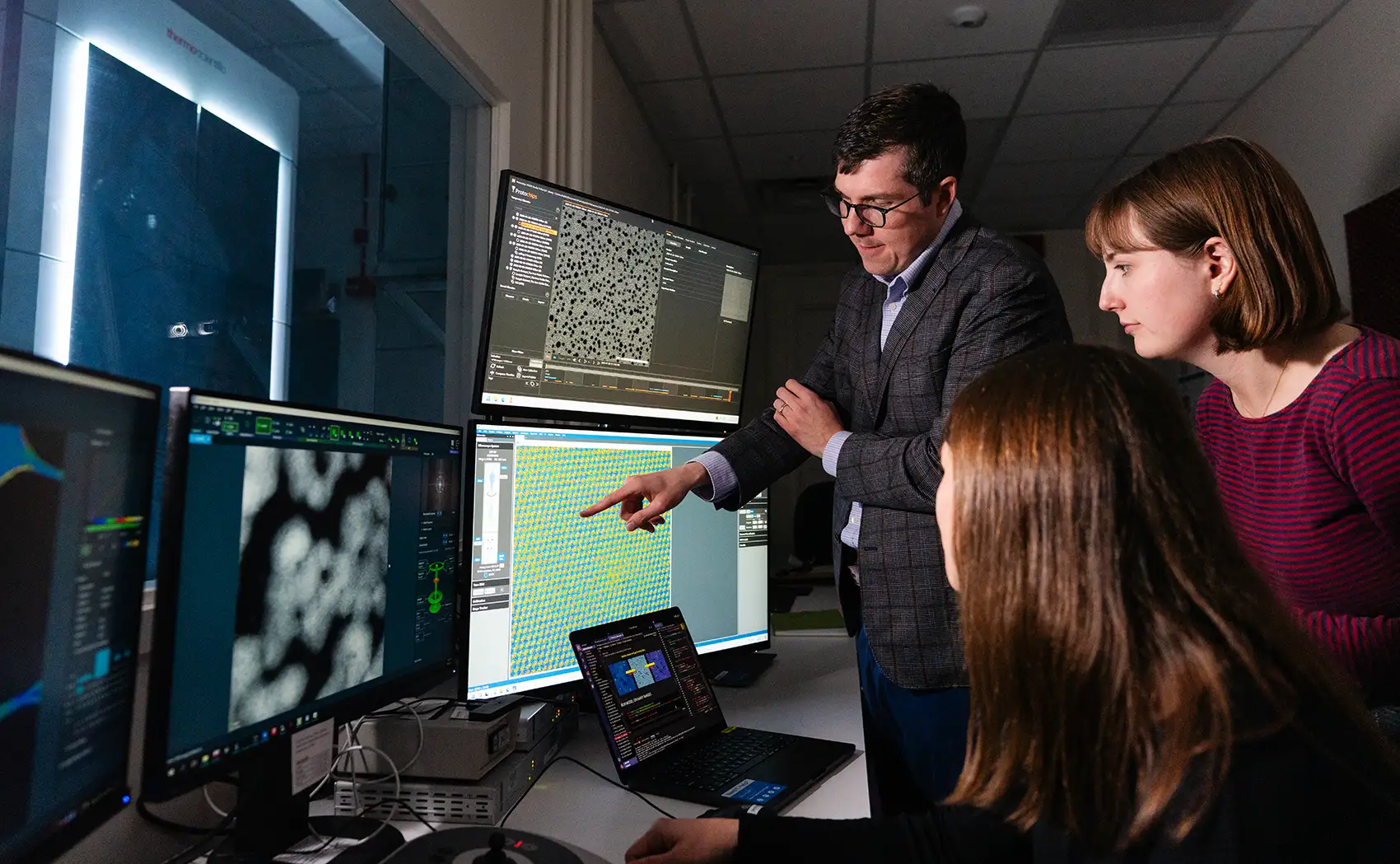
The use of artificial intelligence has enabled researchers at the National Laboratory of the Rockies (NLR) to gain a greater understanding of two-dimensional (2D) materials that can be useful for energy storage, water purification, and advanced electronics.
By closing the knowledge gap regarding a particular class of materials called MXenes—pronounced "maxenes"—the newly published research could enable the scale-up of technologies that rely on the ultrathin 2D crystalline structures. The 2D materials comprise a single or double layer of atoms, so investigating their properties requires the use of electron microscopy.
Point defects—such as missing atoms—can be instrumental in materials, strongly affecting electrical performance and thermal conductivity, according to Steven Spurgeon, a senior materials data scientist at NLR and corresponding author of a newly published paper. The paper, "Revealing the Hidden Third Dimension of Point Defects in Two-Dimensional MXenes," appears in the journal Nature Communications. The other authors from NLR are Grace Guinan, Michelle Smeaton, Hilary Egan, and Andrew Glaws.
Before this research, seeing and mapping defects in three dimensions (3D) has been a challenge.
"When we talk about defects in materials, people not in materials science often assume defects are bad, and that's not necessarily true," Spurgeon said. "Defects can actually strengthen certain materials. What's really important is that we first understand them and then gain a measure of control over them."
That control comes through the microscope. The researchers showed how various processes manipulate these defects, leading to complex 3D arrangements that have previously been poorly understood. Atomic-level point defects, especially vacancies (where an atom is missing), can significantly alter the properties and performance of 2D materials.
"In some cases, the defect can move to a surface and then kind of change the surface reactivity," Spurgeon said. "That's very important for any kind of chemical reaction. We can see that the defects can change the structure of the material. Our materials are not rigid. You've got atoms. You pull an atom out, it relaxes, so the structure changes, and that too can change the reactivity."
Other research groups involved with the work are the Anasori Lab at Purdue University, which has conducted new work in the synthesis of MXenes, as well as Argonne National Laboratory, Colorado School of Mines, Baylor University, and the University of Colorado Boulder.
The MXene in this study was made up of the transition metal carbide with titanium and carbon atoms and examined under an electron microscope that was guided by artificial intelligence. The researchers were able to visualize, and later classify, individual atoms and defects.
Machine learning enabled the researchers to take a 2D analysis to a 3D reconstruction of the defect topology and then to count the number of defects in each layer.
"As a materials scientist, the Holy Grail is you want to know where atoms are, what they are, and how to control them," said Spurgeon, who holds a doctorate in materials science and engineering. "In this paper, what we showed is that when you've got a material that's just a few layers of atoms thick, we can start to resolve in three dimensions where these missing atoms are, and that hasn't been shown before. In this class of materials, MXenes, which are inherently really thin layers of material, we can now address this problem to impart desired functionality."
Although Spurgeon serves as the article's corresponding author, he gives substantial credit for the work to Grace Guinan, a Ph.D. student in statistics at the University of Texas and part of the Science Undergraduate Laboratory Internship program at NLR. She and Spurgeon conceived the study, which was financed through internal funds.
"Grace's background was all math, and these are kind of ideal materials for a mathematician because they're just a sheet of atoms," Spurgeon said. "The goal was [to answer the question], 'Could you describe this in some new way?' What Grace was able to do was to show that she could take this projection image, deconstruct it, and figure out the configuration of each layer using a clever mathematical approach. To me, that was just wonderful and speaks to the power of collaboration."
Learn more about NLR's research using artificial intelligence.
Last Updated April 28, 2026