
AI and Robotics Are Speeding Up Discovery at National Laboratory of the Rockies
‘Self-Driving Laboratories’ Increase Research Speed, Precision, and Throughput

Self-driving cars use artificial intelligence (AI) to get from point A to point B without human drivers. Now, scientists at the National Laboratory of the Rockies (NLR) are using a similar concept to create “self-driving laboratories.”
Using AI, NLR scientists are working to automate linked laboratory tasks to increase the speed, precision, and throughput of NLR’s materials research—ultimately aiming to accelerate the pace of scientific breakthroughs.
Led by Joey Luther, a senior research fellow, and Frederick Baddour, a senior chemist in NLR’s bioenergy and bioeconomy program, the laboratory has begun developing an automated manufacturing process for two technologies: thin-film semiconductors and catalytic nanomaterials.
Together, these two case studies are forming the foundation of an AI-driven research and development framework. It could help researchers across the laboratory move toward self-driving experimentation.
“If AI is going to drive innovation in scientific domains, it has a major hurdle to surmount: the lack of any significant volumes of high-quality, reproducible, domain-specific data,” Baddour said.
“Unlike general purpose chatbots, AI copilots in the scientific domain have an exceedingly small dataset to draw from. We hope that developing rapid, autonomous systems could fill this gap in the short term, generating the data necessary to drive innovative AI applications in the physical sciences.”
Automating Routine Experiments
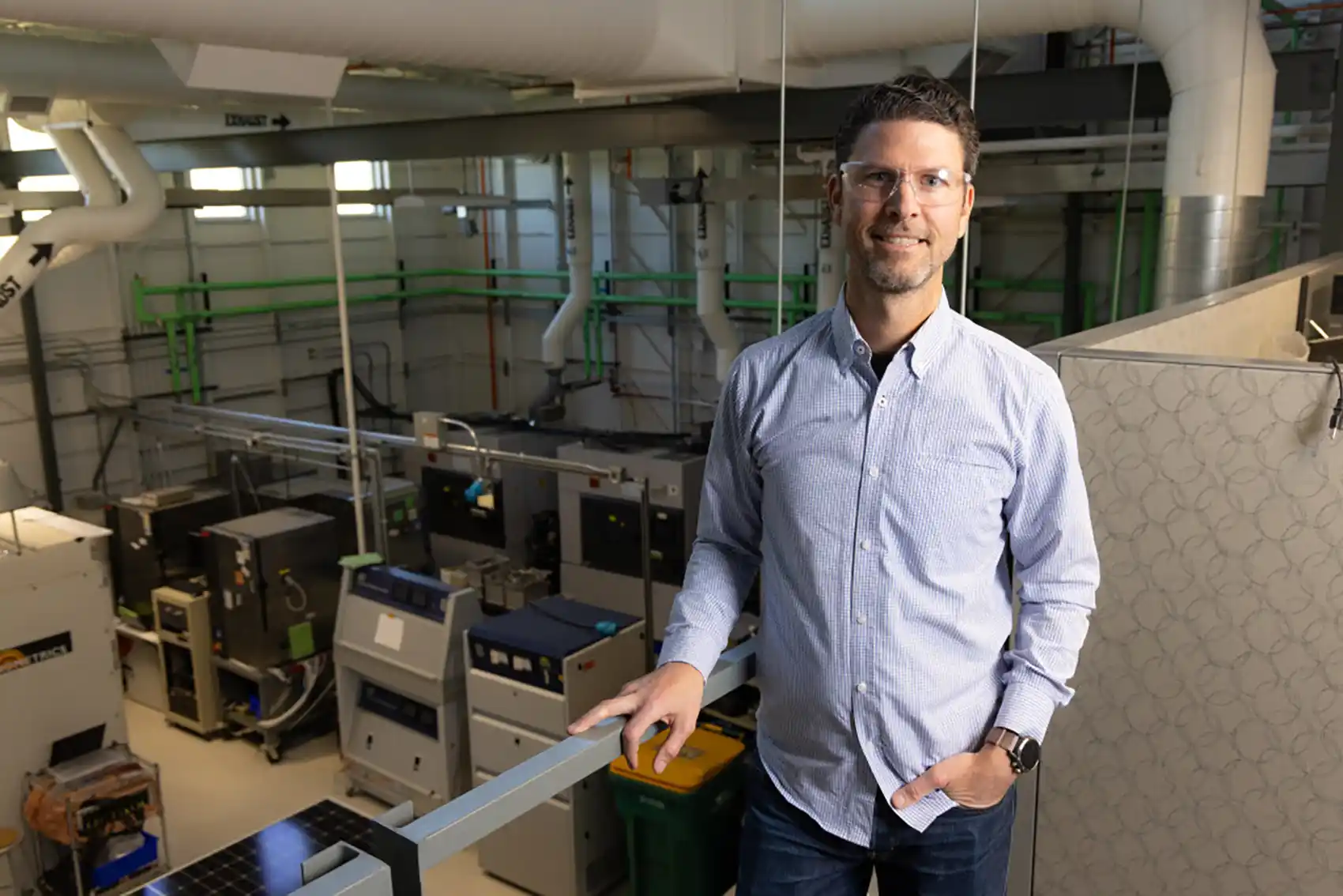
In a first case study, Luther's team is imagining how to automate the manufacturing of semiconductor films, which are useful for light absorption and energy conversion.
“Fabricating semiconductor films involves both art and skill, and it’s also widely considered to be difficult to replicate specific laboratory procedures reported in literature in another lab,” Luther said. “We’re interested in using automated processing not just because it speeds up lab work but also because it ensures processes are done exactly the same, every time.”
Now, the research team is building an automated platform—integrated with machine learning and AI—that can accomplish sequential laboratory tasks and experiments unaided by humans. The hardware platform’s current iteration uses control algorithms powered by NLR’s high-performance computers and allows humans to program a selection of experiments.
In Luther’s lab, for example, scientists might want to study the effects of different temperatures, curing times, solvents, precursors, and concentrations on the growth of semiconductor films. Evaluating just three different conditions for each of these variables could result in hundreds of separate experiments.
A self-driving lab can accomplish these types of routine experiments—from characterization to sample fabrication—without human intervention, fatigue, or variation.
“AI will give us the ability to be far more flexible about how we pursue science, discovery, and routine processing,” Luther said. “Now, we’re building the right tools to tap into this approach.”
Reimagining Experimentation for AI
In a second case study, Baddour’s research team has reimagined the process of synthesizing catalytic nanocrystals—used for advanced chemical and fuel production processes—so it can be accomplished by robotics.
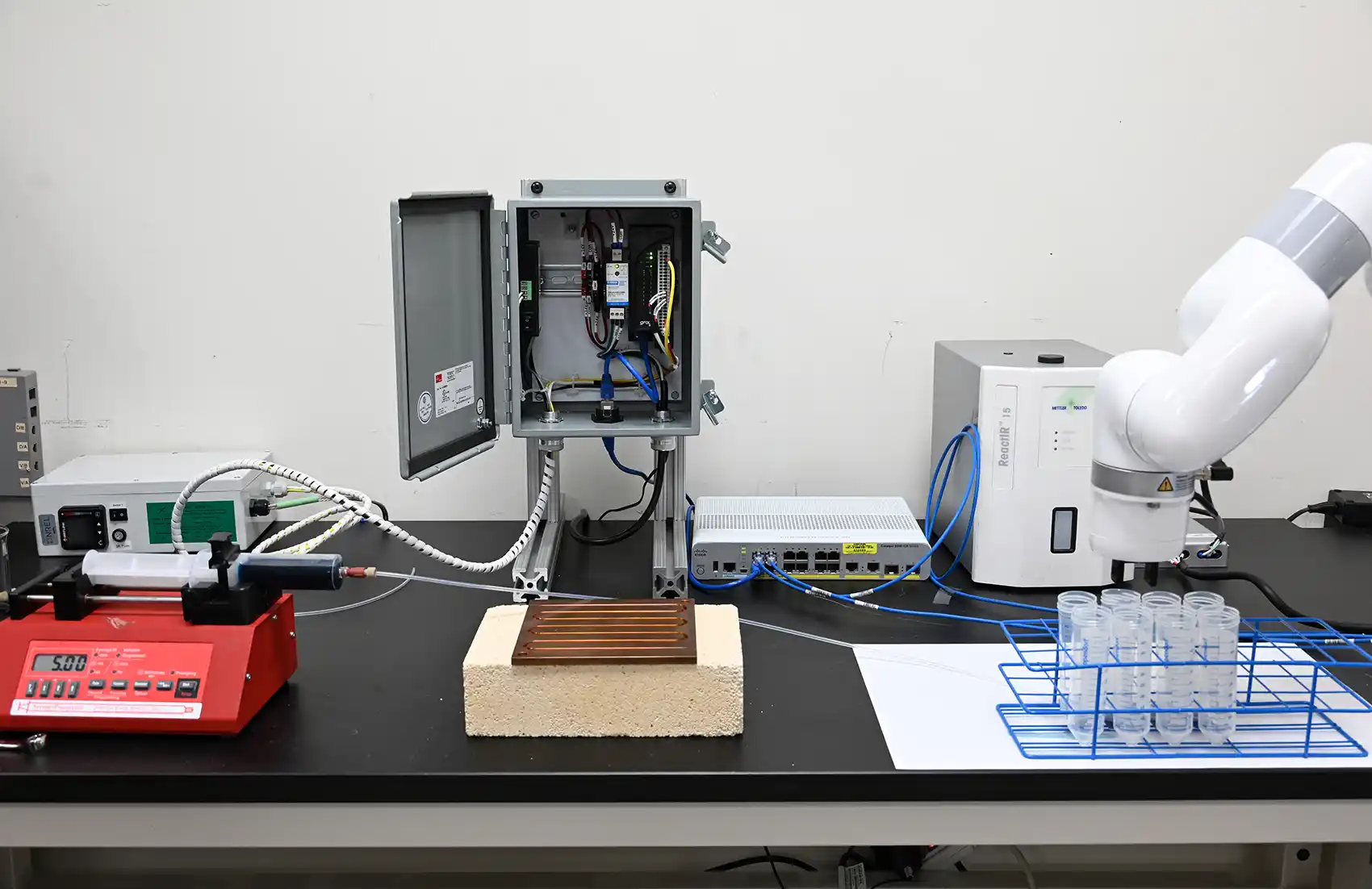
“We took a ground-up approach to automation,” Baddour said. “Instead of having a chemist perform batch chemistry using a stopwatch and glassware, we created a flow system driven by pumps and in-line spectroscopies.”
In other words, rather than designing a complicated robotic system that mimics a chemist doing benchtop experiments, the team completely changed the way the chemistry was being performed: first developing a continuous flow chemistry system, then automating its operations.
The robotic system uses an array of syringe pumps to combine chemicals determined by custom-designed control software and a robotic arm to dispense completed experiments into glassware. Then, scientists take over again for analysis and catalytic evaluation.
Today, NLR scientists set the parameters for these tasks. But, Baddour said, it could soon be possible for platforms like NLR’s to form a “closed loop” where humans point the system toward a target, and it designs and performs its own experiments for new materials discovery.
Toward that end, Baddour and colleagues were awarded funding in April 2026 from the U.S. Department of Energy’s Advanced Research Projects Agency-Energy (ARPA-E)—specifically its Catalytic Application Testing for Accelerated Learning Chemistries via High-throughput Experimentation and Modeling Efficiently program. Through that project, the team aims to develop catalysts ten times faster by producing thousands of samples daily and scaling to enable kilogram-scale production.
“We believe this is an essential step if AI models are to become successful research copilots,” Baddour said. “Designing systems that can generate high volumes of high-quality data quickly will be necessary if we want to enable AI-driven systems to move toward scientific breakthroughs, rather than optimization and prediction within the narrower domain of their training data.”
Roadmap to an Automated Laboratory
Already, Luther and Baddour have been able to acquire, process, and analyze data faster—for instance, reducing the time required to complete spectroscopic measurements from 60–90 minutes to 0.1–0.3 seconds, a roughly 1,000-times reduction. In turn, these gains are speeding up their “self-driving” processes for evaluating and manufacturing semiconductors and catalytic nanomaterials.
Now, their focus will turn to adoption across the laboratory.
“For us, the grand challenge of creating an automated discovery engine started with developing a strategic roadmap for developing automated laboratory processes, designed from the ground up for AI,” Baddour said. “Next, we’re focused on developing tools, databases, and a framework that can be utilized by other researchers to accelerate their timeline to autonomy.”
NLR’s early-stage automated laboratory research was funded by NLR through a Transformational Laboratory Directed Research and Development project. Now, the team is actively seeking opportunities to scale up their efforts.
Learn more about NLR’s materials science and bio-based chemicals and fuels research, and explore opportunities to partner with the laboratory’s bioenergy and bioeconomy team and materials science researchers.
Last Updated April 28, 2026