
Energy Discovery Awaits Within the Spin of Atoms
National Laboratory of the Rockies Researchers Use Nuclear Magnetic Resonance To Advance Innovation in Batteries, Semiconductors, and Bioplastics

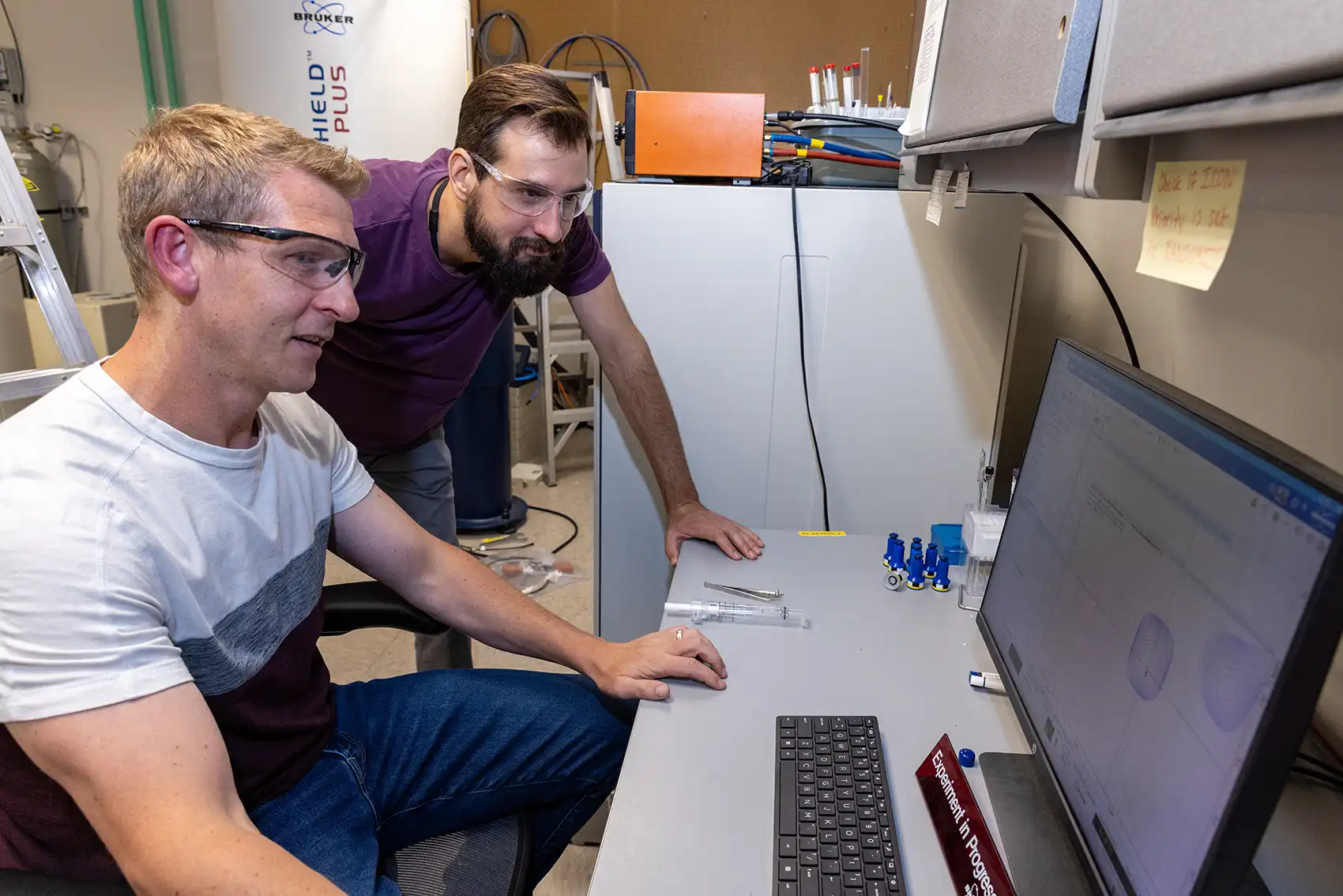
When researchers bring their inventions into the laboratory of Bennett Addison, he often has one question for them: “Did you really make what you think you made?”
At the atomic level, the answer is often no. Companies think they made a pristine semiconductor, but it falls short of expected performance. A scientist thinks they made a robust synthetic fiber, but it breaks down inexplicably. They are both overlooking an 80-year-old art form of spinning atoms with magnets that resolves atomic structure incomparably well across so many domains: nuclear magnetic resonance (NMR).
“There’s almost definitely a way that NMR is useful in your field. You just have to go and do it,” said Addison, who speaks from his experience as NMR facility director and primary NMR specialist at the U.S. Department of Energy (DOE) National Laboratory of the Rockies (NLR).
In most labs, organic chemists execute “bread-and-butter" scans, simply confirming whether input chemicals reacted correctly to create a pure final product. Once trained, NLR scientists can run these routine scans independently, only turning to Addison when things get experimental.
But from nonroutine results he has seen recently, Addison believes NMR is more versatile than industry or researchers appreciate. Not only can NMR serve much of NLR’s research umbrella, but it could also launch homegrown innovation to give U.S. energy, chemical, material, and critical mineral industries a competitive edge, if more researchers would try its lesser-used methods. That is what happened when NLR researcher Ross Kerner walked into the lab.
NMR Finds Flaws in Semiconductors and Surprises Manufacturers
Kerner was introduced to NMR in graduate school at the insistence of a collaborator and professor of chemistry. It was one of those lab courses that many students coast over, just staying on the surface, because to go any deeper requires learning more chemistry. But for someone up to the challenge, NMR offers methods to study almost any material.
To practice the art of NMR, a researcher learns the spin habits and structure of nuclei. In the most common NMR scans, they prepare their sample in a liquid solution, place it in a magnet, and read the results, which are spikes on a graph indicating the chemical environment and number of atoms, most often hydrogen. That is semester one.
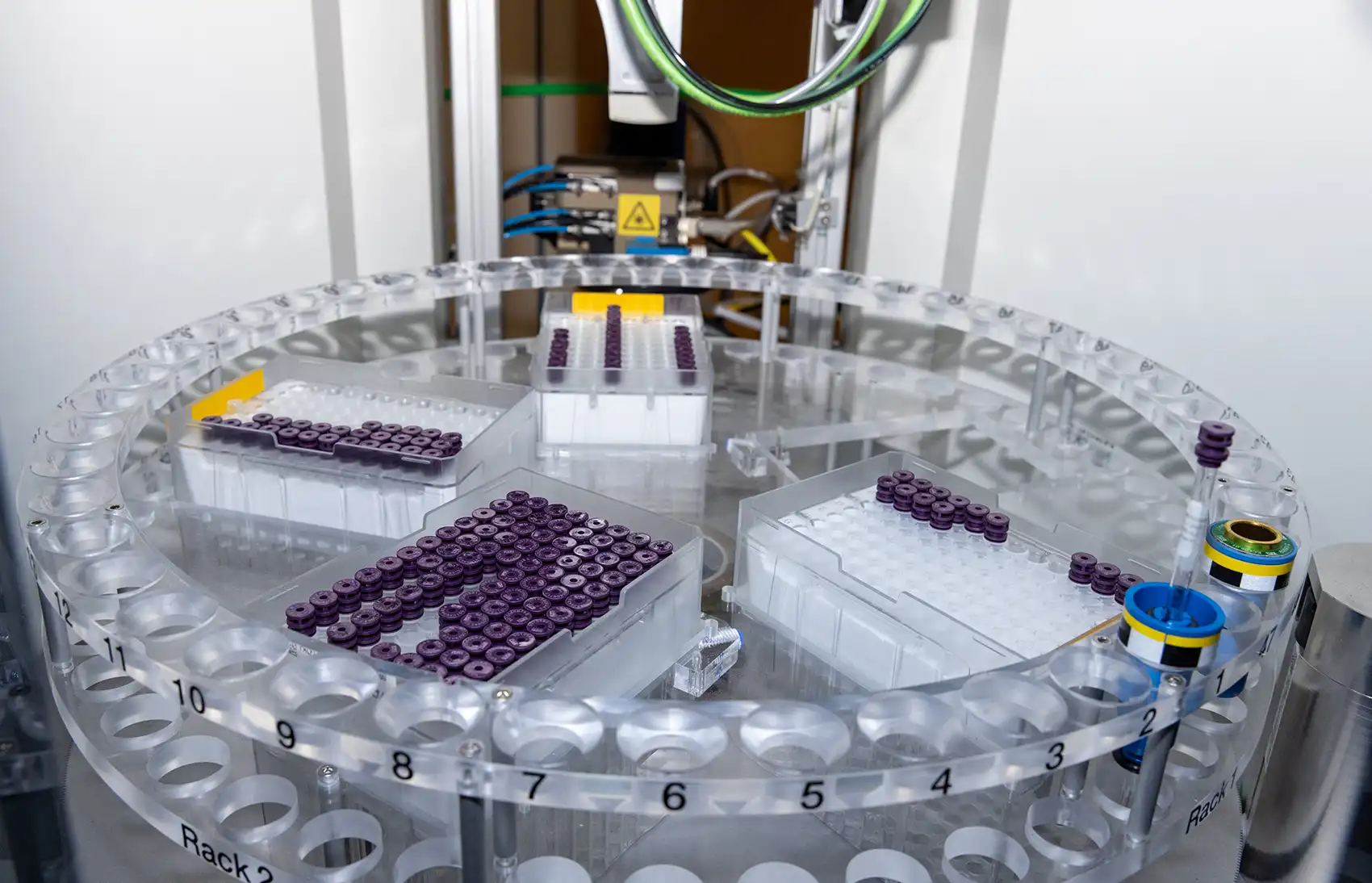
But like the periodic table, NMR grows in nuance. It can assess changes in protein configuration. It can sense the spin of nearly any element on the periodic table, given powerful enough magnets (although 1H, 13C, 31P, and 19F are among the most common). NMR can analyze insoluble gels by spinning samples at a “magic angle,” and similar tricks can study structures of solids through solid-state NMR.
Once Kerner saw the value, he dove into the chemistry. He used NMR in his thesis and then at NLR to study hybrid organic-inorganic halide semiconductor crystals. Kerner soon became a regular in the NMR lab, where he was experienced enough to run his own scans but felt stuck in routine analysis.
“I was doing really routine stuff,” Kerner said. “Then I started talking to Bennett more.”
At the time, Addison had just taken on the role of NMR facility director in addition to staff scientist. He shared Kerner’s curiosity.
“We shoot the breeze a lot while waiting on a routine analysis,” Addison said. “I’m always asking scientists what they’re working on and wondering how NMR can help.”
With just one small room boxed in by four magnets, conversation is inevitable. Addison recalled the moment their conversation took an interesting turn:
“We were discussing project ideas, and we soon realized we should be using the 600-megahertz magnet with our cryoprobe for improved sensitivity. Then, Ross says, ‘Let’s get the thin films from the manufacturer to quantify and identify the trapped solvent.’”
In other words, let us really see how pure the vendor’s product is.
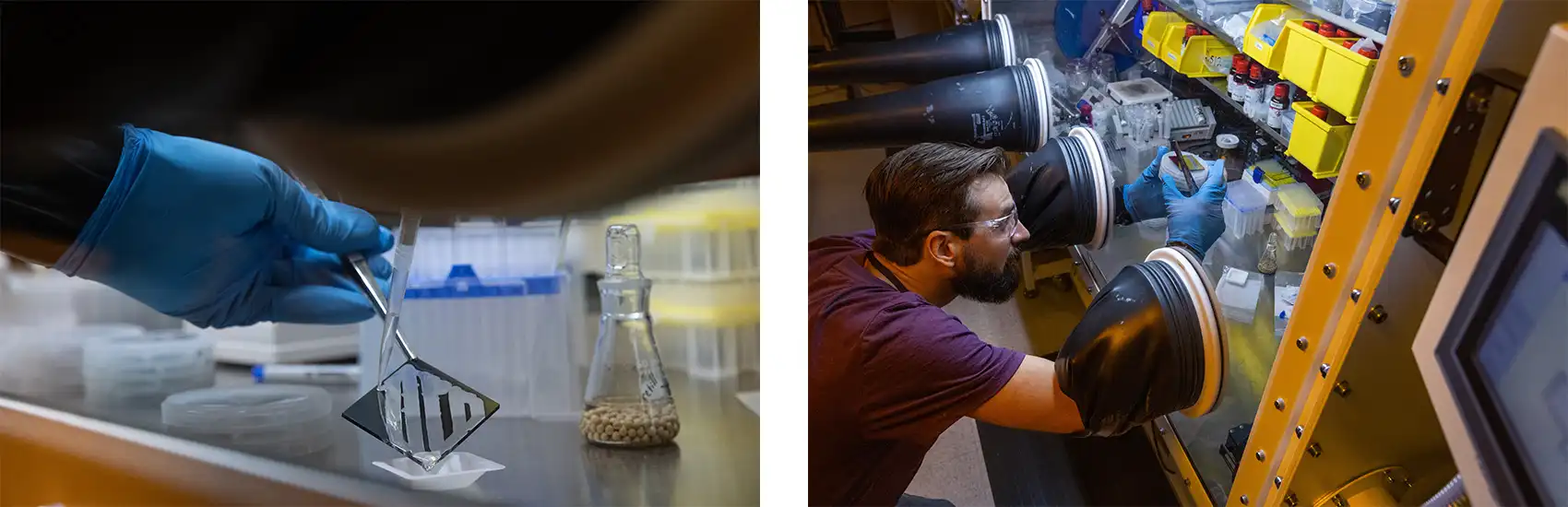
This was Kerner’s reintroduction to the power of NMR. He dissolved thin layers of the vendor’s semiconductors into a sample tray and placed the samples in the higher-sensitivity magnet. From the readout data, he saw impurities in every sample. That’s when industry took notice.
“I showed various manufacturers how many impurities, quantitatively, are or aren’t in their final product, and it blew their minds. Literally two experiments—two days of NMR—allowed several companies to adjust their process and benefit their product,” Kerner said.
Kerner, Addison, and other collaborators have published this work in Nature, ACS Applied Energy Materials, and InfoMat.
“Companies don’t often think to get access to this type of tool and push it to its limits, but as they start to establish supply chains and scale up products, truly measuring what you start with and assessing what you produce is so important,” he said.
Kerner is now racing to explore the wide world of NMR.
Bioeconomy Analysis, Characterization, Modeling, and Simulation Research
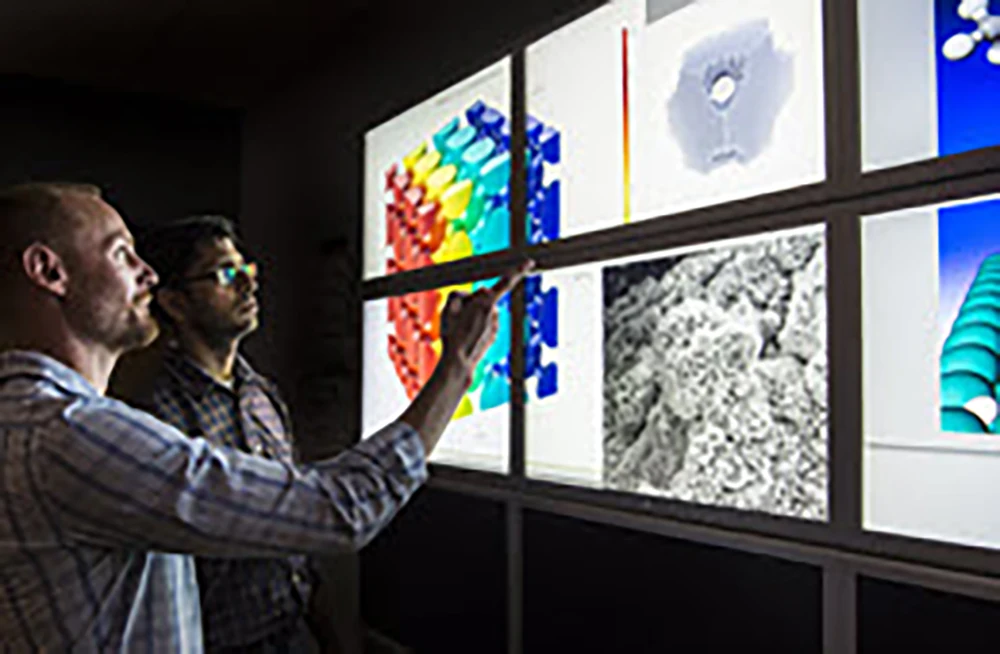
NLR's bioeconomy analysis, characterization, modeling, and simulation research and development capabilities support innovations and technologies with near- to long-term market opportunities.
“Now that I’ve come up to speed, Bennett and I are always scheming. I can’t wait to try new things with NMR,” Kerner said. “I have several applications in mind, some of which to couple with the high-throughput automation capabilities, and I’m just waiting for the field to get to the point when it will shine.”
Addison is sure that a similar awakening could await any scientific domain.
With NMR, the World Opens Up
The draw to see nature’s invisible depth runs through NMR practitioners. Addison came into NMR by analyzing the structure of spider silk, and his lab assistant Malitha Dickwella got his start with fungi.
“As one looks through literature, depictions of complex heterogenous materials like lignocellulose are always cartoons or artistic renderings, which are stagnant and almost never computationally accessible,” Addison said. “You can’t test hypotheses with a cartoon.”
The secondary cell wall of a poplar tree, for example, was once just a cartoon, until Addison and collaborators produced its first macromolecular model. Now it can be squished, squeezed, and tested on a computer, which accelerates discoveries in bioenergy and plant science. This is essential for lowering the cost for converting biomass into chemicals, fertilizers, materials, and fuels.
“To build computer models for molecular simulation, one needs rigorous spatial constraints to place atoms in the correct locations. Instead of hand-wavy claims like ‘these things are in contact,’ NMR has provided quantitative metrics about how the polymers are arranged relative to each other,” said Peter Cieselski, an NLR scientist who created the visualization and coauthored the paper “Atomistic, Macromolecular Model of the Populus Secondary Cell Quantitatively Informed by Solid-State NMR.”
A follow-up 2026 study found that the secondary cell wall structure is conserved.
This computational model was possible because of solid-state NMR. They kept the cell intact, rather than dissolving it in solution like with Kerner’s semiconductors. However, the carbon-12 isotope that trees breathe from the atmosphere—and that constitutes their wood—is scarcely detectable with NMR. Instead, they raised the crop on a partial diet of carbon-13, which contains an extra neutron whose spin can be sensed.
“If you can isotopically enrich, the world opens up,” Bennett said.
And if you cannot, Bennett has also published a review article about using solid-state NMR on bioenergy materials at natural isotopic abundance. Indeed, scientists can almost always find an NMR method that opens the atomic world. It just depends on what they want to see.
Here are a few more examples of what NMR can do.
Fast Scans of a Forest: NMR for Bio-Product Feedstocks
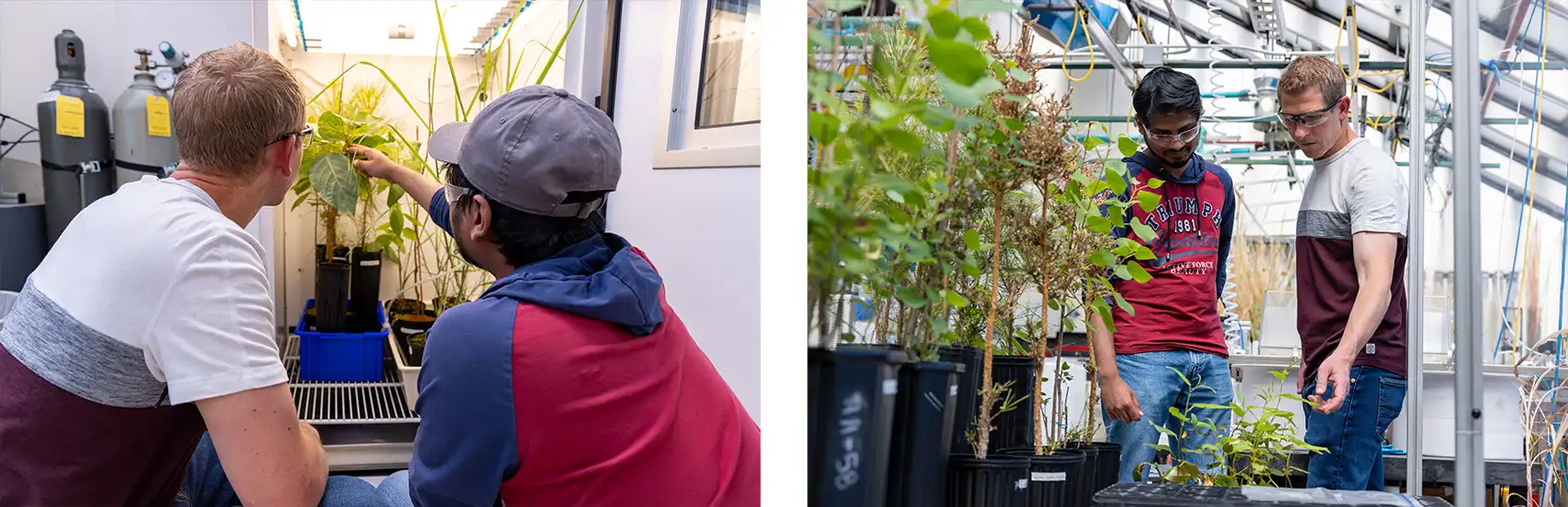
Every tree is different—which is not ideal for industries using forestry residue to make bio-based chemicals, materials, fertilizers, and fuels. For an industry whose profit is contingent on the energy locked within thousands of individual plants, it pays to know how a plantation varies. The NMR method in this case is high-throughput solution-state NMR.
With funds from the Center for Bioenergy Innovation, a cross-disciplinary U.S. Department of Energy Office of Science initiative, NLR has used NMR to show how the sugar and lignin properties of poplar trees vary across a plantation. Rather than a delicate analysis of cellular structure, this technique solubilizes tree samples and processes them rapidly in batches.
“With our high-throughput analytical pipelines including NMR, we can turn a forest into a dataset. We can efficiently profile sugar and lignin in hundreds to thousands of samples, allowing us to identify extreme phenotypes and correlate physical traits to genetics,” Bennett said.
The result is that, with a little training and the proper equipment, any scientist can quickly discover the composition of thousands of plants. With this knowledge, they can improve the energy density and consistency of bio-based chemicals and fuels.
Magic Methods: NMR for Bioplastics and Polymers
Atomic interrogation is especially hard in complex polymers. The molecular bits do not fully break down in solution, nor are they very sensitive to solid-state analysis. Plastics, bioproducts, and even living samples like brain tissue need another approach—something between solution and solid.
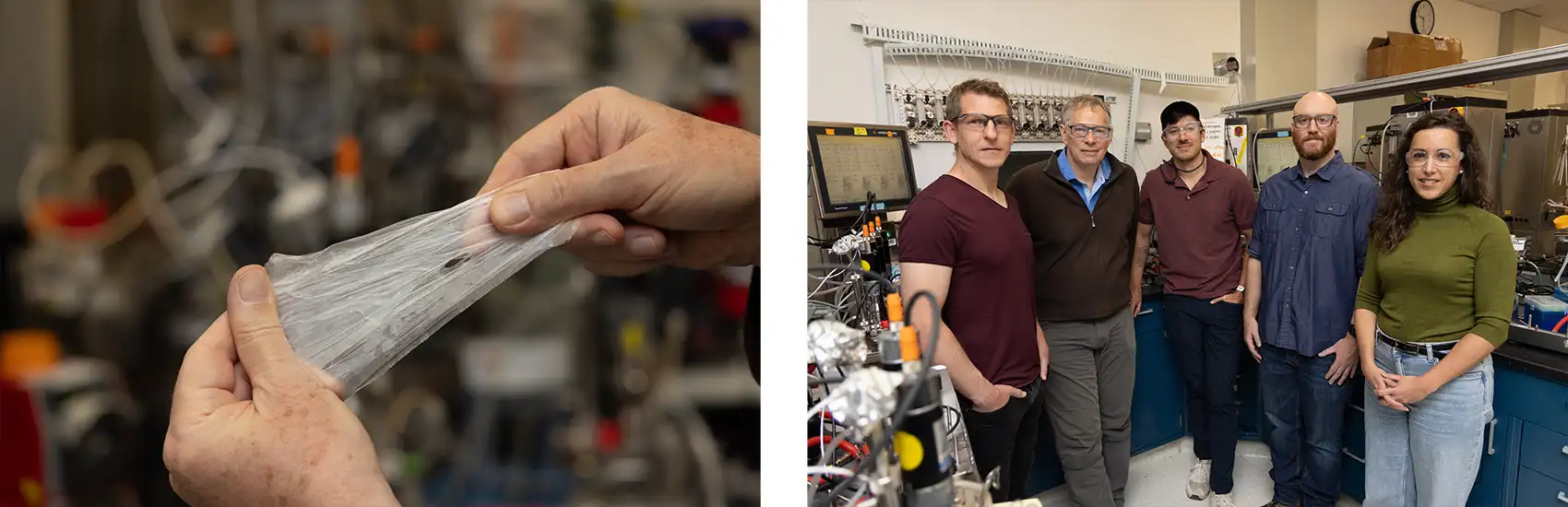
The high-resolution magic-angle spinning NMR method is well suited to such materials. Supported by the U.S. Department of Energy’s BOTTLE Consortium, NLR is a leading laboratory in developing chemical upcycling strategies and designing performance-enhanced polymers. This research includes synthesizing bio-based elastic materials.
To characterize these new materials, Bennett uses a special NMR detector that spins a sample at just the right angle—54.7 degrees—which has the so-called magic property of making NMR characterization of nondissolved materials possible. It is kind of like tilting your head enough to peer through a crack. An NLR team used this approach to confirm the properties of elastic, biodegradable materials—for adhesives, robotics, and electronics applications.
Out of Site: NMR for Lithium-Ion Batteries
The ions of a battery tend to hop from site to site. The rate of this diffusion and the orderliness of ions can determine a battery’s conductivity and, hence, its performance. But the factors at play are mostly unknown, including temperature’s role.
Addison assisted an NLR team of battery researchers, funded by an NLR-directed project, in using lithium-7 solid-state NMR to analyze ion diffusion for a range of temperatures. Thanks to NMR, the authors discovered how ion site disorder drives diffusion in Li6PS5X chemistries.
“I find this area very exciting—it’s a big open door,” Bennett said, referring to NMR of batteries and electrolytes. “It’s kind of like waiting for someone like Ross to come in and push the possibilities.”
For now, that door is wide open at NLR.
To See Deeper Into Nature, Start With Curiosity
Scientists, like their samples, can be semirigid—which may explain why NMR was not used this way sooner.
Leverage NMR
NLR’s NMR spectrometers provide distinct capabilities for analyzing a variety of samples, including biomass, plastics, battery components, and more.
“I don’t know why we didn’t do this earlier,” Kerner reminisced. “I think people get into their routine.”
Addison agrees: “Many scientists were probably just never trained.”
At NLR, training can take just a few hours to learn how to run routine scans. Indeed, throughout the day, dozens of scientists stop into the NMR facility for a 20-minute, solution-state scan. Around 120 registered users currently run NMR scans at NLR, while dozens of industry partners across very distinct domains rely on NLR’s routine NMR scans to improve their products.
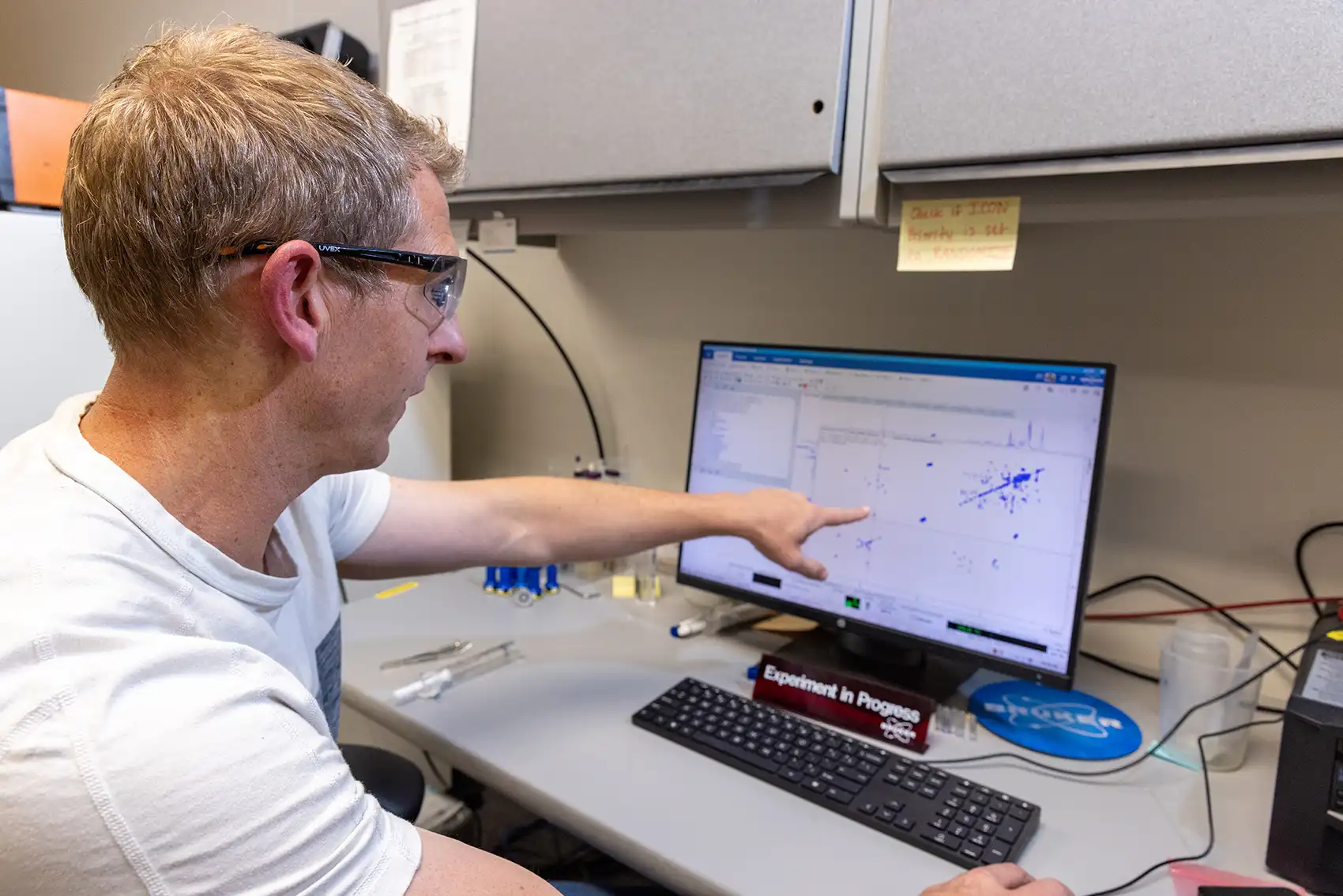
But for anything beyond the bread and butter, it helps to have Addison in the room. His expertise is useful not only for bouncing around ideas but also interpreting results, which to anyone else might just look like spikes on a graph. It requires a deep comprehension of chemistry and physics, and an appreciation for all the peculiarities of proton spins, isotopic ratios, and electromagnetic affinities.
Above all, it might just require curiosity.
“If you’re not familiar with NMR, you don’t know how easy and powerful it is,” Kerner said. “You have to have the curiosity and drive to ask the question: ‘What exactly am I putting in and getting out?’ You have to be willing to step outside the comfort zone.”
Learn more about NLR’s analytical laboratories as well as its biomass and bioproduct characterization, materials science, and electrochemical energy storage research.
Last Updated April 28, 2026