
REopt Expands Options To Help Energy Managers Cut Costs
Updated Tool Lets Users Evaluate Air-Source and Geothermal Heat Pumps and More To Boost Building Energy Performance

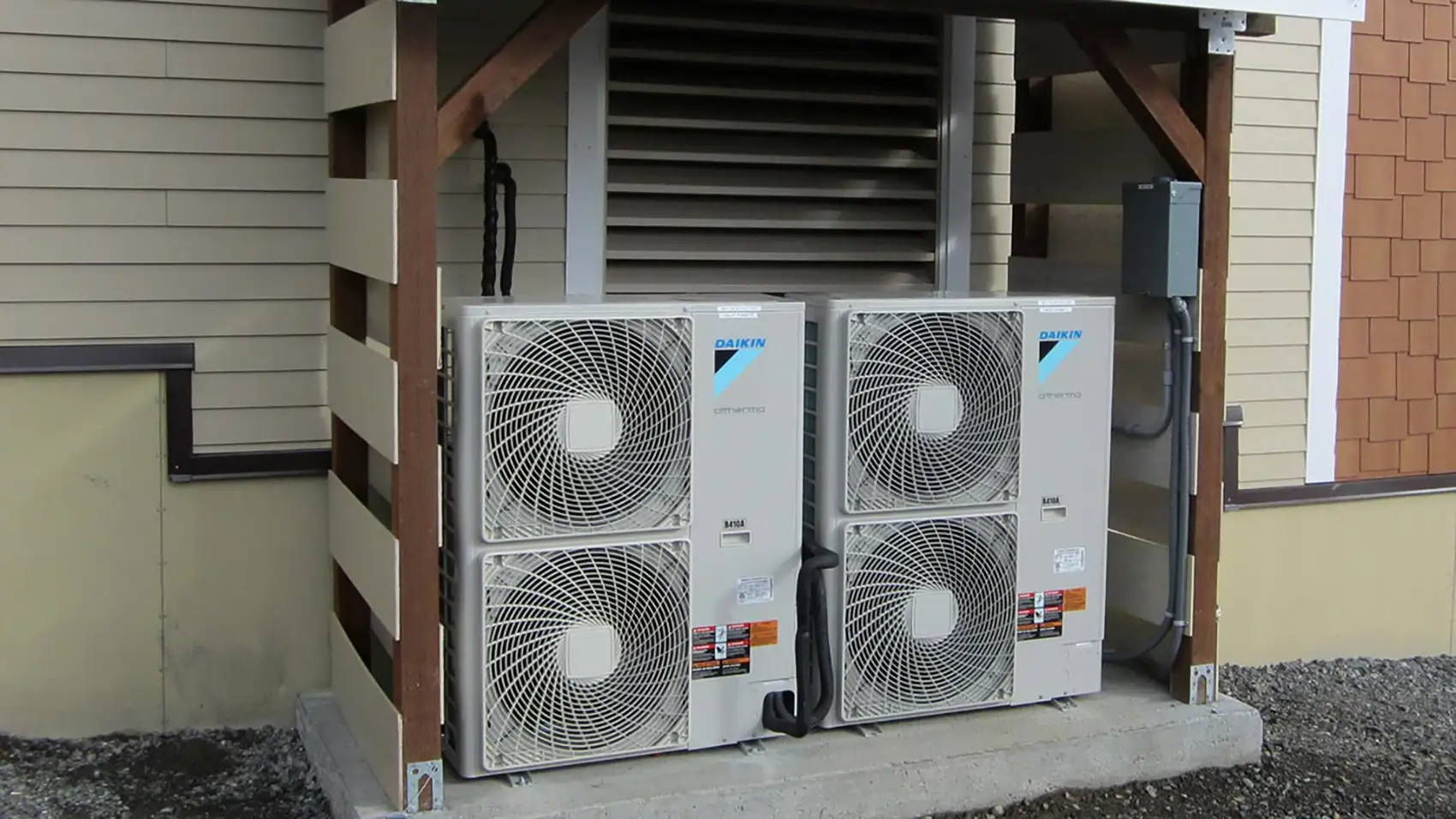
As heat pump technology has improved, pivotal questions for potential adopters include:
“Which technology(ies) can most affordably heat and cool my building?”
“What size system do I need?”
“How much would it cost?”
“How much money and energy would it save?”
For operations managers tasked with increasing building energy performance and cutting costs, data tells the story. Now the National Laboratory of the Rockies’ (NLR’s) REopt® Web Tool tells a more comprehensive story with the addition of air-source heat pump (ASHP) analysis capabilities and other user-friendly features that streamline efforts to optimize a building’s energy system.
The publicly available REopt Web Tool is a techno-economic decision support platform used to evaluate the economic viability of various energy resources for a building, campus, or microgrid. In addition to many other energy generation and storage technology models, REopt has included geothermal heat pump (GHP) evaluation capabilities since 2022 and added a hybrid geothermal heat exchange option in 2023. Now the NLR team has added ASHP to the mix of heating and cooling technology options the tool can evaluate.
REopt Responds to Interest in Heat Pumps
In commercial, industrial, and federal buildings, heating and cooling account for upward of 60% of total operational costs. “A significant portion of these loads could be served by heat pumps,” said Bill Becker, an NLR researcher who led the effort to integrate ASHP into REopt.
Whether the goal is to increase commercial profit or save taxpayer dollars, REopt is a user-friendly tool energy managers can use to perform a holistic, technology-neutral evaluation of a wide range of energy options, weigh the benefits and trade-offs, and identify the synergies between technologies.
With this update to NLR’s REopt Web Tool, such scenarios can now consider ASHP and GHP technology, along with on-site generation and storage, to identify optimized energy solutions.
Funded by the U.S. Department of Energy’s (DOE’s) Federal Energy Management Program and Industrial Technologies Office, REopt’s ASHP capabilities deliver more comprehensive technology options and streamlined decision support.
Heat Pump Features Make Complex Decisions Easier
With REopt’s ASHP analysis capabilities, users can evaluate various heating, ventilation, and air conditioning (HVAC) solutions, from installing hybrid configurations that retain existing HVAC systems as supplemental and backup to fully replacing an existing HVAC system, relying on an integrated resistive-heater backup.
“When we add a technology like heat pumps to REopt, which already evaluates many on-site generation and storage technologies, users can now find synergies or benefits of having multiple technologies,” Becker said.
REopt has also added features to provide users with a more streamlined and satisfactory user experience, including:
- Expanded net-metering and net-billing modeling. The web tool now offers more detailed and clarified net-metering and net-billing modeling options.
- More robust portfolio and sensitivity analysis. With REopt’s portfolio and sensitivity analysis capability, web tool users can run multiple REopt analyses in parallel. The former makes it easier to screen multiple facilities to prioritize sites for detailed analysis, and the latter enhances decision-making by allowing users to explore how varying key inputs impacts results.
- Expanded energy resilience performance capability. This capability has been extended to all web tool evaluations, enabling users to more effectively assess the probability that on-site energy resources, including backup power systems and generators, can support critical electric loads during grid outages.
- Downloadable results in Excel. With a new feature on the Saved Evaluations page, web tool users can select multiple evaluations, download the results to an Excel spreadsheet, and quickly build custom summary tables, simplifying the comparison of scenarios for a sensitivity analysis or a multisite building portfolio.
Tool Grows in Response to Evolving Technology Options
These added capabilities in the user-friendly REopt Web Tool and open-source code (REopt application programming interface and REopt Julia package) highlight DOE’s collaborative efforts to ensure REopt continues to grow to enable comprehensive, objective, integrated, and optimized energy solutions for cost savings and reliability.
As an example of REopt’s extensibility, the tool’s default cost and performance assumptions for ASHPs and GHPs are focused on commercial applications, but they could be modified to evaluate residential- or industrial-scale applications in the future. User feedback will inform future REopt improvements.
As REopt continues to grow its base of over 120,000 users across 174 countries, the development team remains dedicated to providing valuable insight and decision support.
Learn more about REopt, visit the REopt User Forum with questions or feedback, and explore the new capabilities detailed in the REopt User Manual.
Last Updated Jan. 22, 2026