Could New Kind of Data Center Give Back to the Grid?
How the Fastest-Growing Loads Could Be Power Partners, Not Power Drains

Some newly built U.S. data centers have sat empty and powerless for years. All they need is energy. But because these centers need so much energy, they often must wait for utilities to expand their grids to handle all that extra power. In some areas, queues to connect can extend up to a decade.
“We’ve seen a breakdown in the utility and data center relationship,” said Jeff Bladen, the head of energy at Verrus, a data center company that launched in early 2024. “Utilities are no longer able to meet the needs of data centers, and data centers are building at a scale that doesn’t line up with what utilities can provide.”
Verrus inventors chose to turn that one-sided, take-only relationship into a give-and-take. Rather than build a data center that only drains energy from the local grid—and by extension, the local community—the startup’s data centers store energy for either the center or the community to use when energy demand spikes. That reciprocity could benefit local utilities and get Verrus data centers faster access to a grid connection.
The Verrus facilities are also more efficient, which means they consume less energy to perform the same colossal calculations needed for the daily digital services people depend on, like banking, social media, healthcare, and artificial intelligence.
And the company’s new model is ready to go—right now—thanks, in part, to some recent testing at the National Laboratory of the Rockies (NLR).
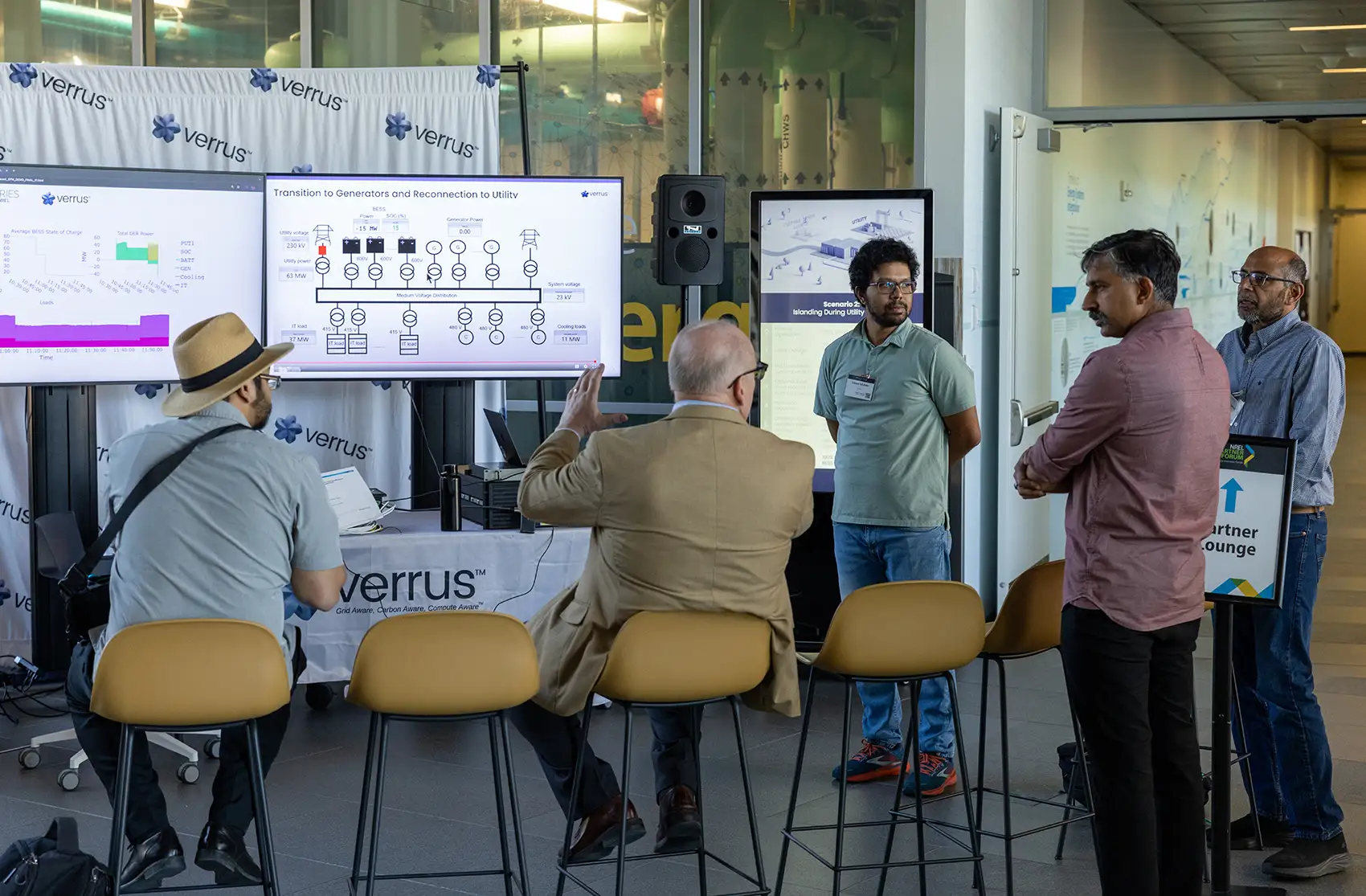
The NLR team—and a simulation platform that does not exist anywhere else—helped Verrus demonstrate that their design works as intended and can handle simulated snags, grid disruptions, or storm systems.
In short, the team demonstrated that their design is ready for the real world.
How To Build a Truly Flexible Data Center
Data centers are not just for large tech companies. Average Americans can thank them for video streaming services, map apps, and even critical real-time updates during an emergency, like a wildfire. Still, communities are not always keen to host one of these facilities—which consume significant amounts of both energy and water—in their backyard.
But Verrus designed their data centers to work with the local grid. Their novel design relies on utility-scale batteries, which enables them to automatically switch from the grid to battery power without interrupting service. That instantaneous swap helps enhance the grid’s operational stability. If a Verrus data center operator receives a signal from the utility that energy demand is skyrocketing, their battery system can prevent an outage before one starts.
Sounds straightforward, right? But that is not how most data centers work. Many still depend on generators for backup power. Generators cannot react as quickly as batteries (which are always “on” electrically). Generators also tend to respond after an outage has already started. And batteries can provide other grid services, like helping to smooth the grid’s frequency (its so-called heartbeat).
In other words, a generator-backed data center protects itself. A Verrus data center protects itself and the community.
These types of flexible, more grid-friendly data centers are becoming more popular. But the Verrus system was entirely new. According to Bladen, the Verrus model is “a complete departure from the way data centers have traditionally been designed.”
Verrus’ design uses a new kind of distribution network that functions like an energy highway. Cars can often travel more efficiently on highways than on back roads; for the same reason, electricity can travel more efficiently on Verrus’ electric highways than on traditional paths. Behind this navigational network is a kind of traffic controller, or what Verrus calls a “purpose-built optimization platform.” And that controller has an electric brain.
Before Verrus sends that brain out into the world, the team needed to vet its smarts. To do that, they needed help. They needed what NLR’s Kumaraguru Prabakar (who goes by Kumar) calls “an imaginary universe.” A universe that only exists in one place: NLR.
How To Assess a Data Center’s Brain
Most data centers are constructed in remote locations, which makes field repairs especially costly—approximately $50,000 to $100,000 per day, according to Prabakar, an electrical engineer at NLR. But there is a better, more affordable, comprehensive way to check for potential errors before a company deploys its technology.
“We do this in a controlled environment,” Prabakar said. “They remote into the machine. They run their codes. It’s not rushed. You have all the time in the world. If something goes bad, it’s an experiment. Nothing is broken. There’s no bad publicity or anything. Everybody wins.”
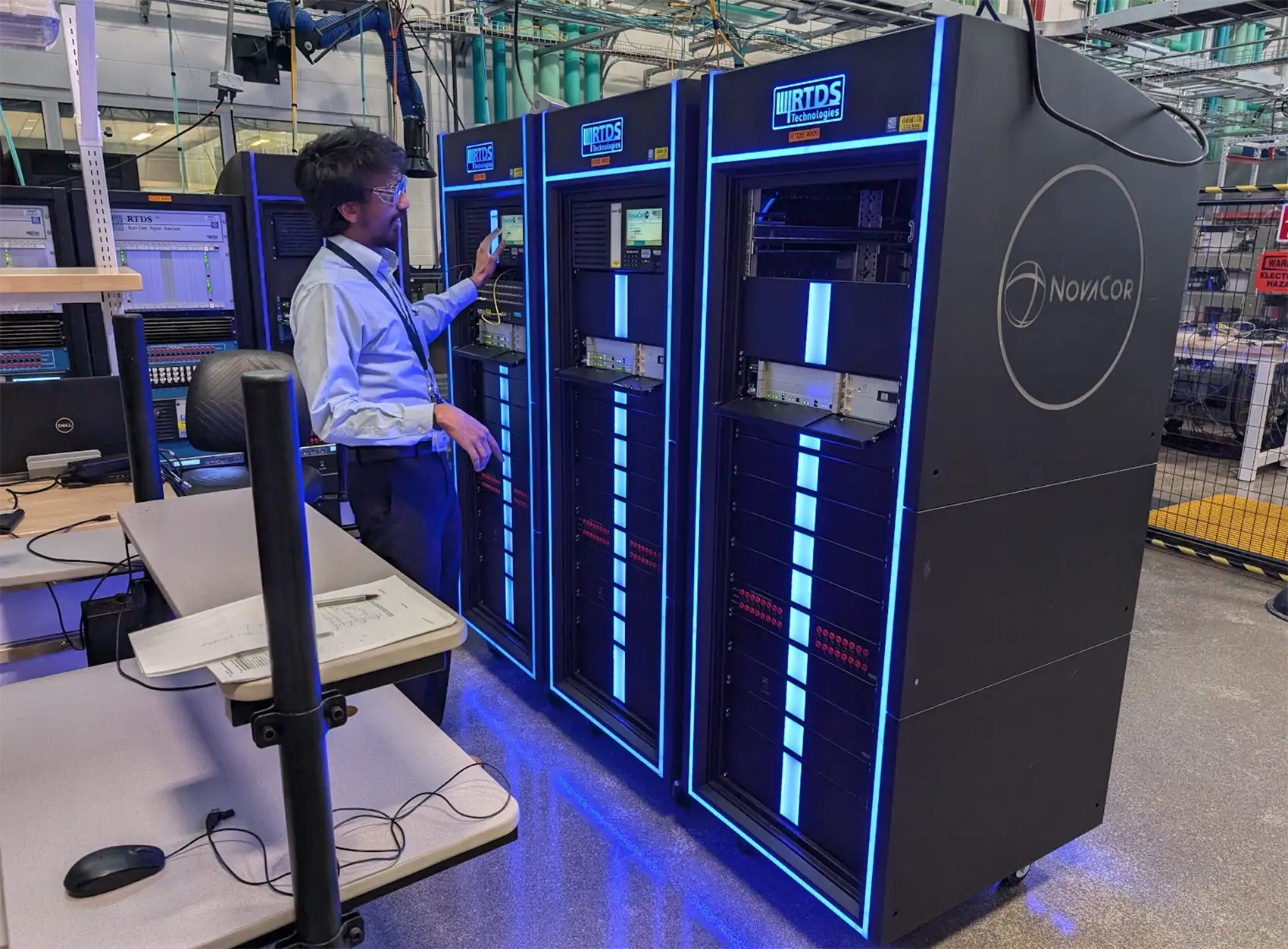
The “machine” Prabakar is referring to is NLR’s Advanced Research on Integrated Energy Systems (ARIES) platform. ARIES can simulate the electrical brains behind a single device or an entire country. Prabakar and his colleagues connected Verrus’ code—their electric brain—to simulated power grids and ran as many real-world scenarios as possible.
“These codes run 24/7, 365 days a year. They have to make decisions every second, so it’s highly important that they don’t break,” Prabakar said.
If the code does break in the field, that could lead to data center downtime, which can cause financial and reputational damage. To help avoid this, Verrus and NLR experts pushed the system to extremes to break it in the safety of a low-cost, risk-free imaginary universe. The team used ARIES to check a whopping 10,000 to 20,000 lines of code. Just one error can impact a data center’s operations. But ARIES’ digital real-time simulators—a kind of high-performance computer—can rapidly subject the software to millions of real-time simulated situations. The platform can identify potential errors in just two days, as opposed to months of in-house testing, according to Prabakar.
“That’s the beauty of ARIES,” Prabakar said. “We’ve been building these new experimental capabilities that let us finish projects in a quarter of the time and a quarter of the cost that it used to take.”
NLR and the U.S. Department of Energy officially launched the ARIES platform in 2020. With ARIES, researchers can accurately simulate real-world energy systems—vast webs of energy technologies that include single devices, like smart phones or batteries; and integrated systems, like data centers, cities, or entire regions. The ARIES platform was—and still is—the most powerful tool to untangle, understand, and improve our energy labyrinths. Users can even analyze how a new data center design, like Verrus’, is likely to function when paired with regional power plants and power grids. The tool can also recreate specific scenarios to troubleshoot whether a technology or system is working as expected.
“ARIES offers significant opportunities not just for data center operators but also utilities that are facing growing challenges around adding power to the grid and managing lengthy interconnection processes,” said Andrew Hudgins, the acting laboratory program manager for ARIES.
Thanks to ARIES, Hudgins continued, “we have the capabilities to solve larger system-wide issues that if not addressed would exacerbate problems on the grid.”
In other words, the platform can help anticipate problems before they exist. And it can help companies, like Verrus, build the reciprocal relationships the country needs to build a powerful future.
Ready to tackle your toughest energy questions? NLR can provide the expertise, facilities, and data-driven insights to efficiently advance your technology to market. Discover how we can help.
Last Updated Jan. 22, 2026