
Gas-Grid Interoperability
NLR's integrated gas-grid interoperability analysis helps operators and planners evaluate flexibility options and constraints, risks, and infrastructure investment needs across these interconnected systems.
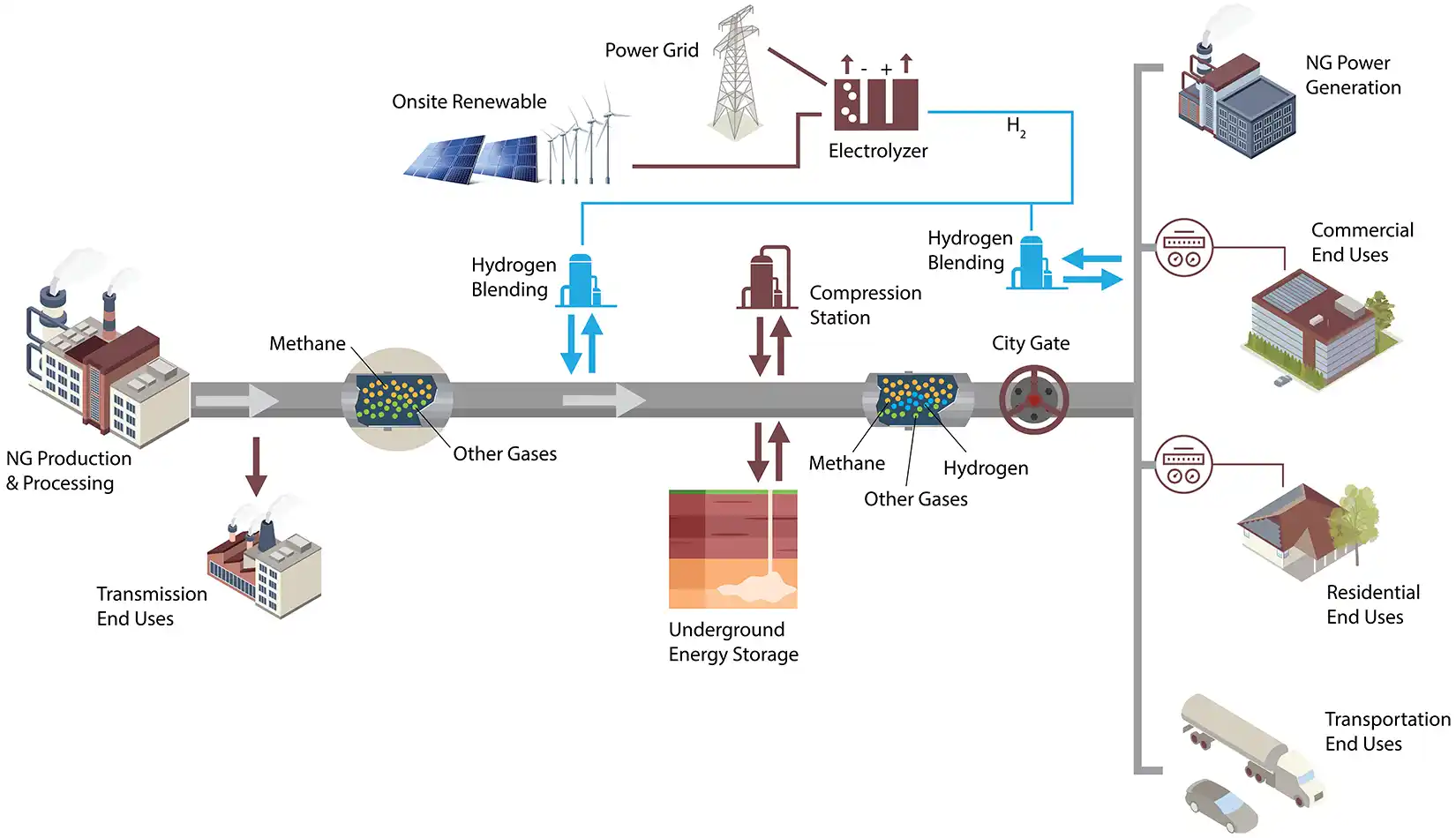
Gas-based energy carriers such as methane (natural gas), natural gas, hydrogen, syngas, and other synthesized fuels play an important role in today's electric grid, and that connection is expected to grow. In addition, factors such as rising data center demand and industrial activity are reshaping the electricity load profile. To meet these challenges, gas-fired units may need to operate more flexibly, which can drive swings in gas flow and pressure that strain pipeline systems originally designed for more stable operating patterns.
Many components of the gas system—including compressors, storage sites, and some extraction operations—also rely on electricity. Disturbances in one system can spread quickly to others, especially during peak demand periods.
Key Trends Driving Gas-Grid Interoperability
- Diverse energy carriers
Expansion from methane to hydrogen, syngas, and blended fuels—all with different requirements for pipelines and equipment integrity - Emerging loads
Data centers and modern industrial activity contribute to sustained electricity demand, affecting both gas and power operations - Increasing system coupling and planning complexity
Gas and electric systems are becoming more tightly coupled through shared infrastructure use, reliability exposure, and long-lived investment decisions, making isolated planning approaches increasingly inadequate.
Capabilities
Integrated analysis supports coordinated decision-making by examining how gas supply, pipeline constraints, electricity demand, and power-system operations influence one another. This capability enables system planners to identify infrastructure needs, evaluate operational risks, and compare long-term development pathways across both sectors.
Key elements:
- Joint assessment of gas delivery and power-system requirements
- Identification of constraints that impact system performance
- Evaluation of alternative infrastructure or operational strategies
Contact Brian Sergi for more information.
Comprehensive evaluation of gas transmission and distribution networks helps determine how pipelines, compression, storage, and end-use connections perform under different operating conditions. This includes identifying bottlenecks, assessing upgrade needs, and examining the impacts of different gas compositions.
Key elements:
- Analysis of pressure behavior, flow dynamics, and operational limits
- Evaluation of infrastructure modifications and associated costs
- Assessment of system performance under varying gas compositions and demand patterns
Contact Burcin Cakir Erdener for more information.
Operational coordination examines how conditions in one system influence the other in real time, considering market rules. Understanding these interactions is essential for ensuring reliable service during peak demand, large swings, or unexpected outages.
Key elements:
- Representation of gas-electric operational dependencies
- Examination of system behavior during contingencies and high-demand conditions
- Modeling of gas system flexibilities for gas-grid interoperability, e.g., line-pack and underground gas storage
- Support for operational strategies that enhance overall system stability
Contact Omar Jose Guerra Fernandez for more information.
Future energy needs involve uncertainty in fuel availability, industrial growth, regional demand patterns, and technology choices. Scenario analysis allows planners, operators, and stakeholders to explore alternatives and understand potential impacts on both gas and electric systems.
Key elements:
- Holistic assessment of multiple system futures
- Evaluation of infrastructure portfolios under diverse conditions
- Engagement with partners to test assumptions, share data, and align planning approaches
Contact Brian Sergi for more information.
Publications
Hydrogen Blending Into Natural Gas Pipeline Infrastructure: Review of the State of Technology, NLR Technical Report (2022)
Modeling Integrated Electricity and Natural Gas Systems Using Cosimulation, NLR Presentation (2022)
Coordinated Modeling of Electric Grid and Natural Gas Network Operations, NLR Presentation (2021)
Electric Power Grid and Natural Gas Network Operations and Coordination, NLR Technical Report (2020)
Coordinated Operation of Electricity and Natural Gas Systems From Day-Ahead to Real-Time Markets, Journal of Cleaner Production (2021)
Contact
Share

Last Updated March 12, 2026